

504 Green Energy Enhancement Act This bill increases from $5.5 million to $20 million the maximum amount of certain Small Business Administration loans for plant acquisition, construction, conversion, and expansion. Projects eligible for these increased loan amounts must (1) reduce the borrower's energy consumption by at least 10%; or (2) generate renewable energy or renewable fuels, such as biodiesel or ethanol production.
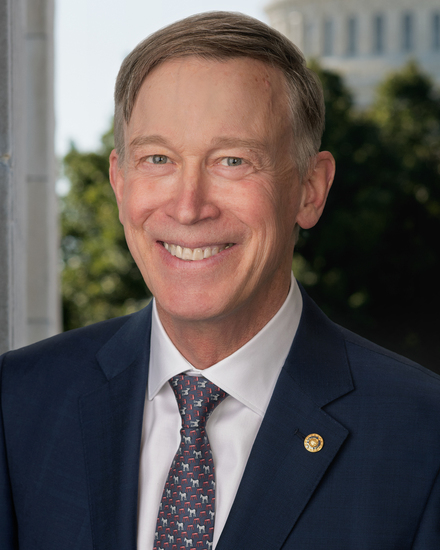
Sen. John W. Hickenlooper
Sponsored bills
Capital for Cooperatives Act This bill eliminates the requirement that cooperatives provide a personal guarantee with respect to certain Small Business Administration (SBA) loans. It also requires the SBA, in collaboration with the Interagency Working Group on Cooperative Development, to develop recommendations and cooperate with federal agencies and other entities to promote, support, and increase the number of cooperatives.
Native American Entrepreneurial and Opportunity Act of 2021 This bill provides statutory authority for the establishment of the Office of Native American Affairs within the Small Business Administration (SBA). The office must establish a working relationship with Indian tribes and Native Hawaiian organizations by targeting SBA programs relating to entrepreneurial development, contracting, and capital access to revitalize Native businesses and economic development in Indian country.
Retirement Security and Savings Act of 2021 This bill modifies various tax policies, credits, and requirements that apply to employer-provided retirement plans and Individual Retirement Accounts.
Hemp Access and Consumer Safety Act This bill allows hemp and hemp-derived ingredients to be included in food and dietary supplements. Current law prohibits, with limited exceptions, the sale of food and dietary supplements that contain an ingredient that is an active ingredient in (1) an approved drug, or (2) a drug for which there have been substantial and publicly known clinical investigations. This bill exempts hemp and hemp-derived ingredients, such as hemp-derived cannabidiol, from this prohibition. The Food and Drug Administration may establish labeling and packaging requirements for such foods and dietary supplements.
This resolution expresses the sense of the Senate that the United States must (1) accelerate the electrification of households, buildings, and businesses; (2) modernize the electricity grid; and (3) continue on the path towards decarbonizing electricity generation by 2035.
United States Postal Service Shipping Equity Act This bill authorizes the mailing of alcoholic beverages by certain entities in accordance with the delivery requirements otherwise applicable to a privately carried shipment. The authorization applies to an entity (including a winery, brewery, beverage distilled spirits plant, or other wholesaler, distributer, importer, or retailer of alcoholic beverages) that has registered with, obtained a permit from, or obtained approval of an application from the Department of the Treasury. The bill directs the U.S. Postal Service (USPS) to prescribe regulations (1) requiring direct delivery to a duly authorized agent at a postal facility or to the addressee, who must be at least 21 years of age and present a valid, government-issued photo identification at the time of delivery; (2) prohibiting such alcoholic beverages from being for resale or any other commercial purpose; and (3) requiring such entity to certify that the mailing is not in violation of applicable laws or regulations and to provide other information as directed by the USPS. A state, local, or tribal government may bring a civil action against the USPS in U.S. district court for a violation of a law of the state, locality, or tribe regarding the sale, mailing, transportation, or importation of alcoholic beverages. The USPS shall be liable to the same extent as a private individual under like circumstances but shall not be liable for interest prior to judgment or for punitive damages.
Gym Mitigation and Survival Act of 2021 or the GYMS Act of 2021 This bill establishes a grant program to provide economic support to eligible fitness facilities in response to the COVID-19 (i.e., coronavirus disease 2019) pandemic. Specifically, the bill authorizes the Small Business Administration to make initial and supplemental grants to privately owned fitness facilities that primarily provide health or fitness services and that do not offer golf, hunting, sailing, or riding facilities. The total amount of grant funds for a recipient may not exceed $25 million, and the recipient must use these funds for payroll costs, rent or mortgage obligations, and other ordinary and necessary business expenses.
Citizenship for Essential Workers Act This bill establishes a mechanism for eligible aliens who worked as essential workers during the declared COVID-19 (i.e., coronavirus disease 2019) public health emergency to apply for and obtain permanent resident status. The bill also narrows certain grounds for deportability and inadmissibility. To be eligible for permanent resident status under this bill, an alien must have earned income at any point during the COVID-19 emergency period doing work deemed essential by the Department of Homeland Security (DHS) or a state or local government. An alien may also be eligible if that alien is a parent, spouse, or child of (1) an eligible alien who died from COVID-19, or (2) a member of the Armed Forces. Certain aliens shall be ineligible, such as an alien who was a refugee on January 1, 2021. To obtain permanent resident status under this bill, an applying alien must satisfy additional requirements, including by passing a background check. Furthermore, the bill repeals provisions providing for three-year bars and permanent bars to admission into the United States. (Generally, these bars apply to aliens who were previously removed or unlawfully present in the United States.) The bill also narrows the scope of certain crime-based grounds for inadmissibility or deportability, such as by redefining the term conviction to exclude expunged convictions. The Department of Justice or DHS may waive certain grounds of inadmissibility or deportability (1) for humanitarian purposes, (2) to ensure family unity, or (3) for the public interest.
Equity in Neuroscience and Alzheimer's Clinical Trials Act of 2021 or the ENACT Act of 2021 This bill sets out activities and requirements to increase the participation of underrepresented populations in research and clinical trials for Alzheimer's disease and related dementias. Specifically, the National Institute on Aging (NIA) must establish and provide technical assistance to Alzheimer's research centers located in areas with higher concentrations of minority groups. These centers must establish diagnostic and treatment clinics designed to serve minority, rural, and other underserved populations; operate clinical trials; and carry out public outreach to encourage members of minority populations to participate in clinical trials and research. Additionally, the NIA must disseminate information to members of minority populations about participating in clinical trials and take other actions to enhance diversity with respect to the Alzheimer's research that it conducts or supports. The bill also directs the NIA to increase diversity among Alzheimer's researchers by encouraging the participation of individuals who are from groups that are underrepresented in clinical, behavioral, and social sciences.