

This resolution commemorates the 50th anniversary of the National Center for Toxicological Research.
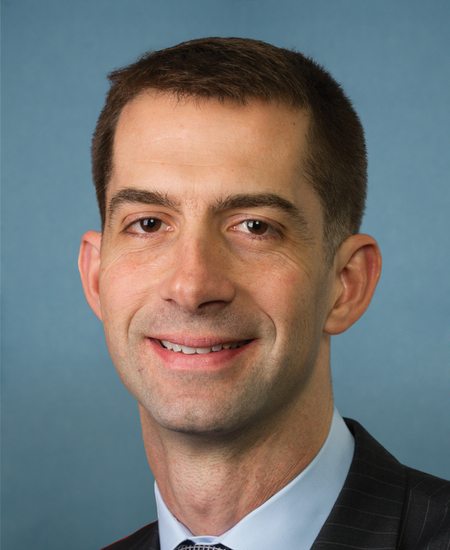
Sen. Tom Cotton
Sponsored bills
Securing the Homeland from International Entrants with Life-threatening Diseases Act or the SHIELD Act This bill suspends for one year the admission and parole into the United States of certain categories of individuals who are from or were recently in a country that fails to meet certain criteria related to COVID-19. This restriction applies to certain individuals entering the United States from Mexico or Canada through a port of entry or U.S. Border Patrol station and (1) whose country of origin has not been categorized by the Centers for Disease Control and Prevention as a low-risk country for COVID-19, or (2) who was in such a country at any time in the 30 days before arriving in the United States. The bill exempts certain individuals from this restriction, including U.S. citizens and lawful permanent residents, members of the Armed Forces, and persons from a foreign country who arrive at a designated port of entry with valid travel documents. The Department of Homeland Security shall transport barred individuals to a foreign location, such as an individual's country of origin, to the extent practicable.
This resolution urges the Biden Administration to ensure that the military has all the necessary resources to build and sustain the country's military strength.
Unnecessary Agency Regulations Reduction Act of 2021 This bill requires the Office of Information and Regulatory Affairs to annually report a list of major rules (i.e., rules with a significant economic impact, cost to consumers, or adverse effects on competition) that it recommends should be consolidated or repealed because they are outdated, duplicative, or incur excessive compliance costs. Congress must review the list to determine, and recommend by joint resolution, any such rules to consolidate or repeal.
Protect American Power Infrastructure Act This bill prohibits certain transactions that involve using bulk-power equipment to provide power for defense critical electric infrastructure in the United States if a foreign adversary owns or exercises influence over the equipment, including transactions that (1) involve equipment designed, developed, manufactured, or supplied by persons owned by, controlled by, or subject to the direction of a foreign adversary; and (2) pose an undue risk of catastrophic effects on the security or resiliency of such infrastructure. However, the Department of Energy may approve transactions if it designs or negotiates measures to mitigate such risks.
Enhancing Credit Opportunities in Rural America Act of 2021 or the ECORA Act of 2021 This bill modifies the requirements for calculating taxable income to exclude from gross income interest received by a lender from real estate loans secured by agricultural real estate or by a leasehold mortgage (with a status as a lien) on agricultural real estate. Agricultural real estate includes real property that is substantially used for the production of one or more agricultural products. It also includes any single family residence that is (1) the principal residence of its occupant, (2) located in a rural area which is not within a Metropolitan Statistical Area and has a population of 2,500 or less, and (3) is purchased or improved with the proceeds of a loan secured by agricultural real estate or by a household mortgage.
National Cold War Center Act of 2021 This bill designates the museum located at Blytheville/Eaker Air Force Base in Blytheville, Arkansas, as the National Cold War Center.
Equal Enforcement of Cocaine Laws Act This bill eliminates the federal sentencing disparity between drug offenses involving crack cocaine and powder cocaine. Currently, different threshold quantities of crack cocaine and powder cocaine (e.g., 28 grams of crack cocaine and 500 grams of powder cocaine) trigger the same statutory criminal penalties. Under the bill, the same threshold quantity of crack cocaine and powder cocaine (e.g., 28 grams) triggers the same statutory criminal penalties. The change applies to future cases and cases pending on the date of enactment. However, the change does not apply retroactively.
Holding the Chinese Communist Party Accountable for Infecting Americans Act of 2021 This bill allows foreign states to be sued in a U.S. court for physical or economic harms occurring in the United States as a result of COVID-19. (Typically, a foreign state is immune from lawsuits filed against it in a U.S. court.) Specifically, a foreign state shall not have immunity from a lawsuit seeking damages for (1) the foreign state's spread of COVID-19, or (2) tortious acts intended to deliberately conceal or distort the existence or nature of COVID-19. If the United States is in discussions with a foreign state that is seeking to resolve claims related to COVID-19 against the foreign state, the Department of Justice may intervene and seek a stay in a case filed under this bill involving the foreign state.
Education Savings Accounts for Military Families Act of 2021 This bill directs the Department of Education (ED) to establish a program to provide children with parents on active duty in the uniformed services with funds to pay educational expenses. Specifically, ED must establish a tax-exempt Military Education Savings Account for dependent children of parents in the uniformed services for the payment of the children's educational expenses. Funds in the savings account may be used for specified purposes, including the cost of attendance at a private elementary or secondary school or institution of higher education, private tutoring, or costs associated with an apprenticeship or other vocational training program.