

Maddy summaryThe CLEAR Act of 2025 limits legal challenges to energy projects by blocking repeated lawsuits about the same project's authorization. It establishes that once a court rules on any legal action concerning an energy project's authorization (like permits for electricity, fossil fuels, or critical minerals), no further lawsuits about that project can be filed - regardless of the parties or type of relief sought. The bill requires courts to remand procedural errors to agencies within 180 days and sets a 150-day deadline for filing challenges after authorization is public. Exceptions include post-completion violations or enforcement actions by government agencies. This primarily affects energy developers, federal/state agencies, and legal challengers by reducing litigation delays for projects already approved.
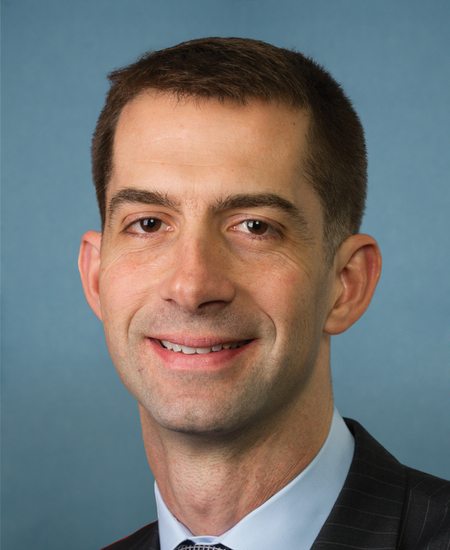
Sen. Tom Cotton
Sponsored bills
Maddy summaryS 3287, the Fair Allocation of Interstate Rates Act, prevents transmission providers serving customers across multiple states from charging out-of-state consumers for electric transmission facilities built to implement a specific state's energy policy (like renewable mandates). It prohibits cost allocation to consumers not residing in the state whose policy led to the facility's construction, unless that consumer's state explicitly consents. The bill establishes that benefits of such facilities are presumed to accrue only to residents of the implementing state, making them the default "cost causers." This directly affects interstate electricity providers and consumers in states with differing energy policies, requiring new cost-allocation rules within 180 days of enactment.
Maddy summaryThis bill (S 3179, the "Halo Act") makes it a federal crime to approach within 25 feet of a Federal immigration enforcement officer after being verbally warned not to, if the person intends to impede the officer's work, threaten them with physical harm, or harass them. The law defines "harass" as causing substantial emotional distress with no legitimate purpose and specifies that the warning must be given by the officer. Violators face fines, up to 5 years in prison, or both. It directly affects individuals who interfere with immigration enforcement activities, not the officers themselves.
Maddy summaryThe Shutdown Fairness Act guarantees standard pay for covered government workers and contractors during federal funding gaps. It directly affects federal employees, military personnel on active duty, and contractor staff who must work during a shutdown, ensuring they receive their regular compensation without regard to prior furloughs. The bill requires agencies to use emergency funds to pay covered employees within 7 days of enactment for the 2025-2026 shutdown period, and on regular pay schedules for future shutdowns. This applies retroactively from September 30, 2025, and limits funds strictly to pay, prohibiting reprogramming for other purposes.
Shutdown Fairness Act This bill provides appropriations to pay federal employees who work during a government shutdown. Specifically, the bill provides appropriations for federal agencies to provide standard rates of pay, allowances, pay differentials, benefits, and other payments to excepted employees for work performed during any period in which interim continuing appropriations or full-year appropriations are not in effect for a fiscal year (i.e., a government shutdown). An excepted employee is an employee who is required to work during a government shutdown. Under current law, excepted employees are not paid until the government shutdown is over. This bill provides appropriations to pay excepted employees during a government shutdown. The bill also specifies that the term excepted employee includes certain contractors who support federal employees during a government shutdown and members of the Armed Forces who are on active duty. A federal agency may not use the funds provided by this bill during any period in which continuing appropriations are in effect for the purpose of paying excepted employees of the agency. The bill must take effect as if it had been enacted on September 30, 2025.
Maddy summarySRES 490 is a Senate resolution (not a bill) that affirms the U.S. Senate's position on maintaining American leadership in artificial intelligence. It states that preserving U.S. AI dominance is critical for national security, economic competitiveness, and global influence, particularly in countering China's AI investments and reliance on U.S. chips. The resolution supports existing policies like export controls on advanced chips and emphasizes prioritizing U.S. companies' access to AI resources while restricting adversaries' access. It does not create new laws or alter current policy but expresses the Senate's endorsement of the White House AI Action Plan and ongoing efforts to secure U.S. technological advantages.
Maddy summaryThis bill defines "copy-cat ingredients" as substances mimicking approved drugs but made via different processes or with lower quality, and clarifies "counterfeit drugs" under existing law. It updates the Fentanyl Sanctions Act to replace all references to "opioid" with "illicit drug," expanding the law's scope to cover all counterfeit pharmaceuticals - not just opioid-related products. The bill also adds a waiver allowing access to medications on the HHS drug shortage list. These changes help regulators and law enforcement better identify and address counterfeit drugs affecting patients and the healthcare system.
Maddy summaryThis bill requires U.S. companies exporting advanced integrated circuits (high-performance chips used in AI/data centers) to "countries of concern" (including China, Hong Kong, and Macau) to first offer them to U.S. customers for 15 days. Companies must certify they have no backlog of U.S. orders for similar chips and aren’t providing better terms to foreign buyers. It also creates a "trusted U.S. person" program, allowing certain companies to export without licenses if they meet security, U.S. manufacturing sourcing, and ownership requirements. The law directly affects chip exporters, U.S. tech companies purchasing these chips, and foreign entities seeking access to advanced semiconductors.
Maddy summaryThis bill allows federal prosecutors to directly charge juveniles aged 16 or older with specific violent crimes in federal court, bypassing the usual process requiring the Attorney General to file a transfer motion. It directly affects juveniles aged 16+ accused of five serious offenses: murder, aggravated assault, motor vehicle theft, armed robbery, or aggravated sexual assault involving a firearm. The key mechanism removes the mandatory transfer step for these cases, enabling immediate federal prosecution. The bill targets only the most severe crimes listed under federal law, not all juvenile offenses.
Maddy summaryThe Border Lands Conservation Act directs the Secretaries of Interior and Agriculture to install roads and surveillance technology on federal lands adjacent to the U.S. borders with Mexico and Canada to enhance border security and operational control. It requires reports on environmental damage and wildfires caused by illegal border crossings, establishes a program to manage vegetation and reduce fire risks on border lands, and prohibits federal funding for housing undocumented immigrants on federal lands (except in detention facilities). The bill affects federal land management agencies, the Department of Homeland Security, and border states, while explicitly protecting tribal sovereignty and legal land uses like grazing and recreation.