

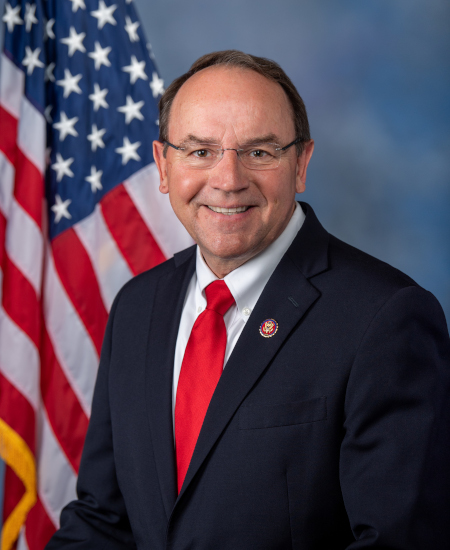
Photo of Thomas P. Tiffany
R United States House · District 7 · Wisconsin

Rep. Thomas P. Tiffany

Compare
Total votes
2,818
all sessions
Attendance
96%
118 missed
Lower than 87% of chamber peers
With party
90%
of cast votes
Lower than 86% of chamber peers
Bipartisan score
5%
crosses aisle rarely
Higher than 85% of chamber peers
Sponsored
905
bills & resolutions
Lower than 77% of chamber peers
Committees
6
assignments
905 bills and resolutions

Sponsored bills

Total
905
Primary
58
Co-sponsor
847
This page
905
matching current filters
Co-sponsor HR 7758
In committee · Utah House · Co-sponsor
The Dalilah Law

Maddy summaryThis bill, known as the Dalilah Law, would restrict commercial driver's licenses to U.S. citizens, lawful permanent residents, and holders of specific work visas. It requires states to verify the citizenship or visa status of all CDL applicants and renewals within 180 days of enactment, while also mandating English language proficiency testing for all license holders. States that fail to enforce these requirements or issue licenses to ineligible individuals risk losing federal transportation funding. The law also imposes lifetime disqualifications for operating commercial vehicles without proper immigration status.

In committee Mar 4, 2026 1 co-sponsor
Primary HR 7780
In committee · Utah House · Lead sponsor
One Nation, One Visa Policy Act

Maddy summaryThis bill, titled the One Nation, One Visa Policy Act, would require all Chinese nationals to have a valid visa before being allowed entry into the United States. It directly affects Chinese citizens and passport holders by prohibiting their visa-free admission and directing the Department of Homeland Security to stop using funds for any Chinese participation in existing visa waiver programs. The legislation explicitly includes Hong Kong and Macau under the definition of the People's Republic of China for the purposes of this restriction. The bill would remove the ability of Chinese nationals to enter the country without a visa under current waiver arrangements.

In committee Mar 3, 2026 0 co-sponsors
Co-sponsor HR 7719
In committee · Utah House · Co-sponsor
SOS Act of 2026

Maddy summaryThis bill, titled the Securing Our Streets Act of 2026, directs the Attorney General to distribute federal grants to states that implement specific criminal justice policies aimed at reducing repeat offenses. To qualify for funding, states must adopt laws requiring repeat offenders to serve at least 85 percent of their sentences, mandate pretrial detention for violent offenders posing a clear threat to public safety, and impose life imprisonment for individuals convicted of three distinct violent crimes. The grants, totaling up to $10 billion over five years, can only be used to build secure correctional facilities, expand incarceration capacity for violent offenders, and train correctional staff.

In committee Feb 25, 2026 1 co-sponsor
Co-sponsor HR 7678
In committee · Utah House · Co-sponsor
Gun Owner Registration Information Protection Act

Maddy summaryHR 7678, the Gun Owner Registration Information Protection Act, prohibits federal funding for state or local databases that track lawfully owned firearms or their owners. The bill allows federal funding for databases recording lost or stolen firearms but bans it for databases listing legal gun ownership. This means states cannot use federal money to create or maintain systems that compile information about legally owned guns. The bill directly affects state and local governments that rely on federal funds for firearm ownership databases.

In committee Feb 25, 2026 1 co-sponsor
Co-sponsor HR 2189
Passed · Utah House · Co-sponsor
To modernize Federal firearms laws to account for advancements in technology and less-than-lethal weapons, and for other purposes.

Law-Enforcement Innovate to De-Escalate Act This bill removes less-than-lethal projectile devices (e.g., certain TASERs) from regulation under the Gun Control Act. The term less-than-lethal projectile device means a device that (1) is not designed or intended to expel (and may not be readily converted to discharge) commonly used ammunition or projectiles exceeding a velocity of 500 feet per second; (2) is designed and intended to be used in a manner not likely to cause death or serious bodily injury; and (3) does not accept (and cannot be readily modified to accept) an ammunition feeding device. The bill also requires the Bureau of Alcohol, Tobacco, Firearms and Explosives to determine whether a device satisfies the definition of a less-than-lethal projectile device within 90 days of a request.

Passed Feb 24, 2026 1 co-sponsor
Primary HR 5497
In committee · Utah House · Lead sponsor
Apostle Islands National Park and Preserve Act

Maddy summaryThis bill renames "Apostle Islands National Lakeshore" as "Apostle Islands National Park and Preserve," creating two distinct areas within the same unit. The Park (with stricter rules) prohibits hunting/trapping except under tribal agreements, while the Preserve maintains existing hunting, fishing, and trapping rules from before the bill. Boundaries are defined by a specific map, and the National Park Service must add interpretive signage about regional history and tribal connections at visitor centers. Tribal treaty rights to hunt, fish, and gather remain fully protected under this law.

In committee Feb 11, 2026 0 co-sponsors
Co-sponsor HR 7387
In committee · Utah House · Co-sponsor
Stop Settlement Slush Funds Act of 2026

Maddy summaryThis bill prohibits federal officials from using settlement agreements to direct payments to third parties unless those payments directly compensate for actual harm caused by the defendant or pay for services rendered in the case. It prevents the government from creating slush funds through settlements that benefit unrelated organizations or individuals beyond the scope of direct restitution. Federal agencies must annually report to the Congressional Budget Office on settlement payments that meet the new criteria, while agency inspectors general must audit and publicly report any violations. The reporting and audit requirements are set to expire seven years after the law takes effect.

In committee Feb 5, 2026 1 co-sponsor
Co-sponsor HR 7300
In committee · Utah House · Co-sponsor
Make Elections Great Again Act

Maddy summaryThe Make Elections Great Again Act (HR 7300) would require voters to present photo identification to cast ballots in person or by mail for federal elections, with limited exceptions for religious objections or military voters. It would establish new requirements for proving U.S. citizenship during voter registration, including documentary proof of citizenship and proof of state residency. The bill would change mail-in ballot procedures by requiring voters to request mail-in ballots (rather than universal mail-in voting), implementing barcode tracking for mail-in ballots, and setting strict deadlines for ballot receipt. These provisions would apply to all states for federal elections held in 2027 or later, affecting how voters register, vote in person, and submit mail-in ballots for federal office elections.

In committee Feb 2, 2026 1 co-sponsor
Co-sponsor HR 7296
In committee · Utah House · Co-sponsor
SAVE America Act

Safeguard American Voter Eligibility Act or the SAVE America Act This bill requires individuals to provide documentary proof of U.S. citizenship when registering to vote, and requires photo identification to vote, in federal elections. Specifically, the bill prohibits states from accepting and processing an application to register to vote in a federal election unless the applicant presents documentary proof of U.S. citizenship. The bill specifies what documents are considered acceptable proof of U.S. citizenship, such as identification that complies with the REAL ID Act of 2005 that indicates U.S. citizenship. Further, the bill (1) prohibits states from registering an individual to vote in a federal election unless, at the time the individual applies to register to vote, the individual provides documentary proof of U.S. citizenship; and (2) requires states to establish an alternative process to demonstrate U.S. citizenship. Each state must take affirmative steps on an ongoing basis to ensure that only U.S. citizens are registered to vote, which shall include establishing a program to identify individuals who are not U.S. citizens using information supplied by certain sources. Additionally, states must remove noncitizens from their official lists of eligible voters. The bill (1) provides for a private right of action for certain violations, and (2) establishes criminal penalties for certain offenses. Individuals voting in federal elections must present an eligible photo identification document. An individual who votes by absentee ballot must submit a copy of their identification document with both the request for, and the submission of, the absentee ballot.

In committee Jan 30, 2026 1 co-sponsor
Primary HR 7304
In committee · Utah House · Lead sponsor
OMAR Act

Maddy summaryHR 7304, the OMAR Act, amends campaign finance rules to prevent using campaign funds for spouses' or close relatives' services. It prohibits candidates' committees from compensating a candidate's spouse or immediate family member (defined as children, parents, siblings, or grandchildren) for work related to the campaign, and requires committees to disclose any such payments in regular campaign reports. The bill also adds penalties for candidates who knowingly allowed violations, including preventing committees from reimbursing candidates for fines paid due to these violations. These changes apply to campaign payments made after the bill's enactment.

In committee Jan 30, 2026 0 co-sponsors
Showing 41 to 50 of 905 bills
Previous 1 4 5 6 91 Next