

Maddy summaryThe Stay Cool Act establishes a comprehensive framework to help communities prepare for and respond to extreme heat events by creating cooling centers, improving housing conditions, and enhancing urban infrastructure. It directs federal funding to states and local governments to build and equip cooling facilities, install air conditioning in public housing, and develop green spaces and water features to lower temperatures. The bill also creates a national system to track heat-related health risks, mandates checks on vulnerable seniors during heatwaves, and allows tax credits for businesses that keep their doors open during heat emergencies. Additionally, it requires updates to utility assistance programs to account for cooling costs and calls for studies on heat-related mortality and safe residential temperature standards.
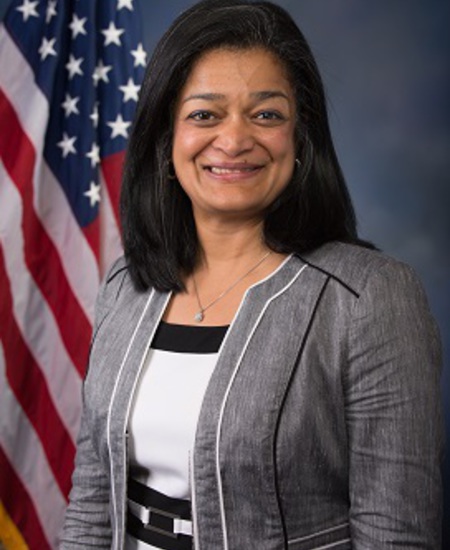
Rep. Pramila Jayapal
Sponsored bills
Maddy summaryThis joint resolution seeks to officially reject a final rule issued by the Department of Education regarding federal student loan programs. If passed, the measure would prevent the new regulations from taking effect, leaving the previous rules in place. The bill directly impacts borrowers, lenders, and the Department of Education by nullifying the specific changes outlined in the "Reimagining and Improving Student Education" proposal. It is a procedural action that uses the Congressional Review Act to disapprove the agency's policy without altering the underlying law.
Maddy summaryThis resolution expresses the House of Representatives' desire to eliminate child poverty and establish a national target to guide future policy. It recognizes the significant drop in poverty during 2021 caused by expanded federal support, such as the Child Tax Credit, and calls for making these investments permanent. The document highlights disparities affecting Black, Hispanic, and immigrant children, as well as those living in U.S. territories, and advocates for increased federal spending on early childhood education and essential services like nutrition and housing. Ultimately, it encourages states and localities to adopt policies that align with these goals to ensure all children have access to basic necessities and educational opportunities.
Maddy summaryThis House resolution expresses the official sense of the House of Representatives to eliminate all roadway fatalities in the United States by the year 2050. It directly addresses the Department of Transportation and Congress by urging them to adopt a data-driven safe systems approach that considers all aspects of the transportation environment. The measure calls for improved crash data collection, the implementation of proven safety countermeasures, and a commitment to addressing disparities in traffic safety. Additionally, the resolution supports using the term "crash" instead of "accident" to better describe traffic incidents.
Maddy summaryThe Holiday Pay Act requires employers covered by the Fair Labor Standards Act to pay at least one and a half times an employee's regular hourly rate for any work performed on a legal public holiday. This new requirement applies specifically to workers engaged in commerce or employed in enterprises involved in commerce, ensuring they receive overtime pay when working on recognized federal holidays. The bill also updates enforcement and legal definitions within the Fair Labor Standards Act to include "legal public holiday compensation" alongside existing minimum wage and overtime protections. Additionally, the law clarifies that this federal standard does not prevent states or localities from mandating higher pay rates for holiday work.
Maddy summaryThe All Students Count Act of 2026 requires schools to break down student performance data into more specific ethnic categories for Asian Americans and Native Hawaiians and Pacific Islanders. Currently, federal education reporting only uses broad groupings, but this bill mandates that states include detailed subgroups such as Chinese, Vietnamese, Samoan, and Chamorro in their accountability systems. The law aims to provide more accurate information about the educational progress of these diverse communities by updating the Elementary and Secondary Education Act of 1965. These new data reporting requirements will take effect 18 months after the bill is enacted.
Maddy summaryThe Elder Pride Act of 2026 creates a new grant program under the Older Americans Act to support rural outreach initiatives for older individuals, including those from LGBTQI communities and other protected groups. Authorized funding of $5 million per year for fiscal years 2027 and 2028 will be distributed to states, tribal organizations, and nonprofit agencies that submit applications demonstrating a plan to partner with local communities. Recipients must use these funds to provide sexual health services, reduce social isolation, improve cultural competency among service providers, and expand nondiscrimination policies in areas not designated as urbanized. The bill requires that any federal money received supplement, rather than replace, existing state or local funding for related services.
Maddy summaryThe Smithsonian American Women’s History Museum Act authorizes the creation of a new Smithsonian museum dedicated to women’s history, to be located within the National Mall Reserve in Washington, D.C. If the site is managed by another federal agency, the bill requires that agency to transfer the land after notifying Congress and relevant committees. The museum must ensure exhibits and programs accurately represent diverse women’s experiences by consulting a broad range of experts and community voices. The Smithsonian will submit biennial reports to Congress detailing how the museum meets these representation standards.
Maddy summaryThis bill nullifies a specific decision made by the Endangered Species Committee regarding oil and gas operations in the Gulf of America. It immediately cancels any exemptions previously granted to these activities under the Endangered Species Act and bars federal agencies from using funds to enforce the canceled order. For a three-year period starting when the bill is enacted, the committee is prohibited from issuing any new exemptions for Gulf oil and gas projects. Consequently, all standard environmental protections required by the Endangered Species Act will continue to apply fully to these activities.
Maddy summaryThe No Taxpayer-Funded Settlement Slush Funds Act of 2026 prohibits the use of federal money to pay specific settlements involving high-ranking government officials and their close associates. It bars payments to the President, Vice President, their immediate families, cabinet members, senior executive staff, political appointees, and individuals connected to these roles, as well as any entity owned by the President or Vice President. Additionally, the bill restricts settlements related to claims about the January 6 Capitol attack, foreign election interference, or previously dismissed lawsuits, while requiring Treasury reports for large settlements and allowing the government to seek repayment if rules are broken.