

Preserving Rules Ordered for The Entities Covered Through 340B Act of 2021 or the PROTECT 340B Act of 2021 This bill prohibits pharmacy benefit managers (PBMs) and health insurance plans from discriminating against health providers participating in the 340B drug pricing program, including pharmacies contracted with such providers to dispense 340B drugs. The 340B program allows certain providers to receive covered outpatient drugs at reduced prices from manufacturers. Specifically, PBMs and insurance plans may not reimburse 340B participants at a lower rate than other entities not participating in the program; impose differing terms (such as fees, charge-backs, or audits) on 340B participants; interfere with an individual's choice to receive drugs from a 340B participant; require 340B participants to identify which drugs fall within the program; or refuse to contract with a 340B participant on the basis that they utilize the program. Violations of this bill are subject to a civil penalty of not more than $5,000 per violation per day. These prohibitions also apply to prescription drug (Part D) sponsors under Medicare. The bill also provides for a process to prevent duplicate 340B drug discounts to states under Medicaid.
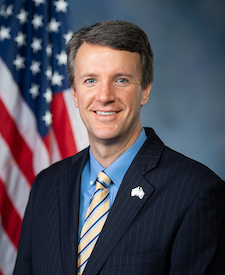
Rep. Ben Cline
Sponsored bills
Broadband for Rural America Act This bill modifies and consolidates Department of Agriculture (USDA) programs for expanding broadband internet in rural areas. Specifically, the bill modifies a program that provides grants, loans, and loan guarantees to support broadband expansion in rural areas. Modifications include revising the criteria used to prioritize applications and projects and changing the name of the program to the ReConnect Rural Broadband Program. Additionally, the bill terminates on June 30, 2022, a Department of Agriculture (USDA) COVID-19 response program that supports broadband expansion in rural areas for distance learning and telemedicine. Any remaining program funds available after the termination date shall be used for the ReConnect Rural Broadband Program. The bill also expands coordination requirements that apply to the Department of Commerce, USDA, the Federal Communications Commission (FCC), and the National Telecommunications and Information Administration. This includes requiring the use of specified FCC maps when assessing a community's access to broadband.
Stop Inflationary Spending Act This bill requires the Congressional Budget Office (CBO) to provide inflation projections for bills that Congress considers using the budget reconciliation process. Specifically, the CBO must estimate the impact on inflation that will occur from implementing each reconciliation bill, including the impact on inflation that will occur during each of the first five years after the enactment of the bill.
Promotion and Expansion of Private Employee Ownership Act of 2021 This bill expands tax incentives and federal assistance for employee stock ownership plans (ESOPs) that are sponsored by S corporations. The bill provides additional tax incentives for ESOPs by (1) extending to all domestic corporations, including S corporations, provisions allowing deferral of tax on gain from the sale of employer securities to an ESOP; and (2) allowing a tax deduction for 50% of the interest received by a bank on loans to S corporation-sponsored ESOPs for the purchase of employer securities. The Department of the Treasury must establish the S Corporation Employee Ownership Assistance Office to foster increased employee ownership of S corporations. The bill defines an ESOP business concern for purposes of the Small Business Act as a business concern that was eligible for a loan, preference, or other program under such Act before more than 49% of the business concern was acquired by an ESOP.
Traditional Cigar Manufacturing and Small Business Jobs Preservation Act of 2021 This bill exempts traditional large and premium cigars from Food and Drug Administration (FDA) regulation and FDA-assessed user fees.
Aluminum Pricing Examination Act or the APEX Act This bill extends the jurisdiction of the Commodity Futures Trading Commission (CFTC) to include the markets for aluminum premiums. Specifically, the CFTC has jurisdiction over (1) the process and manner in which reference prices for such premiums are set or reported, and (2) whether the mechanism for setting such reference prices is fair and transparent. Additionally, the CFTC must consult with the Department of Justice regarding relevant information, including allegations of anticompetitive conduct.
Flexible Financing for Rural America Act This bill allows rural utility service providers to submit to the Department of Agriculture (USDA) a request to adjust the interest rate or modify the terms of certain loans. The request shall include a report summarizing how the adjustment or modification will assist the borrower in providing critical utility services to a rural community. Specifically, on receipt of a request, USDA or the Department of the Treasury (in the case of a loan owned by the Federal Financing Bank) must adjust the interest rate on the loan to match certain interest rates for obligations of comparable maturity to the term remaining on the loan (or a higher rate requested by the borrower), and make modifications to the loan terms as necessary to address changes in the financial position of the borrower due to the COVID-19 public health emergency and to promote the financial sustainability of the borrower. In carrying out the adjustments or modifications, USDA or Treasury shall not impose or collect any fee from, or impose any penalty on, a borrower. The bill also provides funding to implement the adjustments and modifications and for the liquidation of residual intragovernmental amounts owed by the Federal Financing Bank in connection with certain loans.
Hamas International Financing Prevention Act This bill imposes sanctions targeting Hamas, the Palestinian Islamic Jihad, and any affiliate or successor groups. The President shall periodically report to Congress a list of each foreign person or instrumentality that knowingly assists, provides significant support or services to, or is involved in a significant transaction with a senior member or supporter of any of the targeted groups. The President shall impose two or more sanctions on the named persons. Specifically, the person may be (1) denied credit and services from the Export-Import Bank, (2) barred from purchasing certain controlled defense articles, (3) denied exports of items on the U.S. Munitions List, (4) prevented from receiving exports of certain goods or technology controlled for national security reasons, (5) prohibited from receiving financing of more than $10 million from any U.S. financial institution, or (6) subject to property-blocking restrictions. The President shall periodically report to Congress a list of foreign governments that have repeatedly provided material support for the targeted groups' terrorist activities. The President shall bar these governments from receiving for one year (1) U.S. assistance, or (2) exports of controlled munitions. The Department of Treasury shall instruct U.S. leadership of international financial institutions to oppose the provision of assistance to an identified government for one year. The bill provides for certain exceptions and waivers, such as for transactions that would serve U.S. national interests. The President shall report to Congress and periodically provide briefings on other specified topics related to the targeted groups, such as where these groups secure financing and surveillance equipment.
This resolution calls on the people of the United States to observe Memorial Day to honor the men and women who died in the pursuit of freedom and peace.
This resolution condemns the rocket attacks by Hamas against Israel beginning the week of May 9, 2021. It also states that the United States must continue to invest in and support Israel's security and sovereignty.