

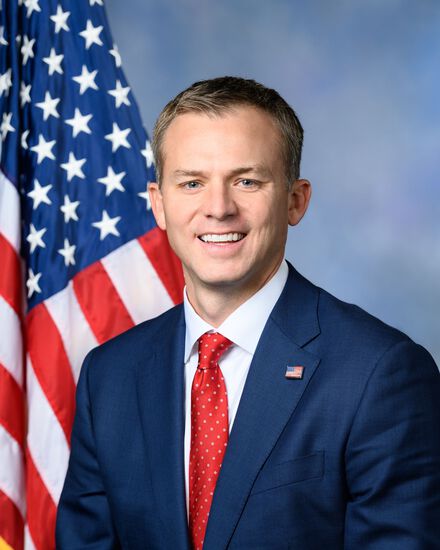
Photo of Blake D. Moore
R United States House · District 1 · Utah On the 2026 ballot

Rep. Blake D. Moore

Compare
Total votes
2,818
all sessions
Attendance
99%
30 missed
Higher than 90% of chamber peers
With party
93%
of cast votes
Near the chamber average
Bipartisan score
4%
crosses aisle rarely
Near the chamber average
Sponsored
722
bills & resolutions
Near the chamber average
Committees
5
assignments
722 bills and resolutions

Sponsored bills

Total
722
Primary
95
Co-sponsor
627
This page
722
matching current filters
Co-sponsor HR 2547
In committee · Utah House · Co-sponsor
Secure Family Futures Act of 2025

Maddy summaryThis bill, titled "Secure Family Futures Act of 2025" but actually focused on tax code changes, primarily affects a specific subset of insurance companies. It amends the Internal Revenue Code to exclude certain debts (like bonds or notes) held by these companies from being counted as capital assets (Section 2), and extends their capital loss carryover period to 10 years for losses from foreign expropriation or losses incurred by these companies (Section 3). The changes apply to debts acquired and losses arising after December 31, 2025. The bill's title is misleading, as it does not relate to family policy but is a technical tax amendment targeting defined insurance industry entities.

In committee Apr 1, 2025 1 co-sponsor
Co-sponsor HR 2548
In committee · Utah House · Co-sponsor
Sanctioning Russia Act of 2025

Sanctioning Russia Act of 2025   This bill imposes penalties on certain persons (individuals and entities) if the President determines that the Russian government or a person acting at Russia's direction is involved with (1) refusing to negotiate a peace agreement with Ukraine; (2) violating a negotiated peace agreement; (3) initiating another invasion of Ukraine; or (4) overthrowing, dismantling, or seeking to subvert the Ukrainian government.   If the President makes such a determination, the bill requires certain actions including the President must impose visa- and property-blocking sanctions on specified persons such as the Russian president, certain Russian military commanders, and any foreign person that knowingly provides defense items to the Russian armed forces; the President must increase the rate of duty on all goods and services imported from Russia into the United States to at least 500% relative to the value of such goods and services; the President must increase the rate of duty on all goods and services imported into the United States from countries that knowingly engage in the exchange of Russian-origin uranium and petroleum products to at least 500% relative to the value of such goods and services; the Department of the Treasury must impose property-blocking sanctions on any financial institution organized under Russian law and owned wholly or partly by Russia, and any financial institution that engages in transactions with those entities; and the Department of Commerce must prohibit the export, reexport, or in-country transfer to or in Russia of any U.S.-produced energy or energy product.

In committee Apr 1, 2025 1 co-sponsor
Co-sponsor HR 2457
In committee · Utah House · Co-sponsor
Mining Schools Act of 2025

Maddy summaryHR 2457, the Mining Schools Act of 2025, establishes a competitive grant program to fund education and training programs for the U.S. mining industry. It directs the Secretary of Energy to award up to 10 annual grants to eligible "mining schools" - defined as accredited engineering programs (including Tribal Colleges) or specific geology/engineering departments at public universities in states with significant mining GDP - to recruit students and enhance curriculum. Grants must support education in critical areas like critical mineral extraction, environmental reclamation, rare earth element processing, and reducing reliance on foreign mineral supplies. The program requires geographic diversity in grant selection and mandates an advisory board (with industry and academic members) to review applications and ensure funds are used for specified educational purposes, with no new federal funds authorized.

In committee Mar 27, 2025 1 co-sponsor
Co-sponsor HR 2410
In committee · Utah House · Co-sponsor
Revitalizing Downtowns and Main Streets Act

Maddy summaryHR 2410 creates a 20% federal tax credit for developers converting older non-residential buildings (at least 20 years old) into affordable housing. The credit applies to qualified conversion costs, requiring that 20% of units be rent-restricted for residents earning 80% or less of the area median income for 30 years. It establishes a $12 billion national credit limit, with $3 billion reserved for conversions in economically distressed areas, and mandates state-level allocation plans prioritizing projects near transit and employment. The bill directly affects developers seeking tax incentives for downtown revitalization, not tenants or local governments.

In committee Mar 27, 2025 1 co-sponsor
Co-sponsor HR 2423
In committee · Utah House · Co-sponsor
Unfair Tax Prevention Act

Maddy summaryHR 2423, the Unfair Tax Prevention Act, amends the U.S. tax code to modify how the base erosion tax applies to certain foreign-owned businesses. It directly affects foreign-controlled entities operating under specific foreign tax systems that impose taxes based on ownership chains, such as those linked to foreign corporations. Key provisions include treating these entities as "applicable taxpayers" for tax purposes, changing a deadline from December 31, 2025, to the bill's enactment date, and counting 50% of their cost of goods sold as a tax benefit while excluding certain other tax rules. The changes apply to taxable years beginning after the bill becomes law.

In committee Mar 27, 2025 1 co-sponsor
Primary HR 2355
In committee · Utah House · Lead sponsor
Collegiate Housing and Infrastructure Act of 2025

Maddy summaryThis bill amends the tax code to allow charitable organizations (501(c)(3) nonprofits) to provide grants for college student housing without losing their tax-exempt status. It specifically permits grants to improve or maintain "collegiate housing property" (where most residents are full-time students at a nearby college) but excludes grants for fitness facilities. The change affects charities seeking to fund student housing infrastructure, clarifying that such grants qualify as charitable under existing tax rules. The policy change applies to grants made after the bill's enactment date.

In committee Mar 26, 2025 0 co-sponsors
Primary HR 2354
In committee · Utah House · Lead sponsor
Restoring Temporary to TANF Act

Maddy summaryThis bill requires states receiving Temporary Assistance for Needy Families (TANF) funds to spend at least 25% of their annual grant amount on work-related services. Specifically, states must use these funds for job training, education programs, apprenticeships, short-term benefits, and case management to help individuals create employment plans. The requirement applies to all states administering TANF programs and takes effect October 1, 2026. It directly affects TANF recipients by prioritizing workforce development support through mandatory state spending.

In committee Mar 26, 2025 0 co-sponsors
Co-sponsor HR 2369
In committee · Utah House · Co-sponsor
PHIT Act of 2025

Maddy summaryThe PHIT Act of 2025 allows taxpayers to deduct certain fitness-related expenses as medical costs on their federal tax returns. It directly affects individuals and families who pay for qualifying physical activity programs, such as gym memberships, fitness classes, or approved equipment. Key provisions include setting annual limits ($1,000 per person or $2,000 for joint returns), defining eligible fitness facilities (excluding golf courses or private clubs), and specifying that equipment must be used exclusively for physical activity. The bill amends the Internal Revenue Code to treat these expenses as deductible medical costs, effective for taxable years after its enactment.

In committee Mar 26, 2025 1 co-sponsor
Co-sponsor HR 2251
In committee · Utah House · Co-sponsor
Protecting Individuals with Down Syndrome Act

Maddy summaryThis bill prohibits doctors from performing abortions based solely on a Down syndrome diagnosis. It requires providers to ask patients about such diagnoses before an abortion and inform them of the ban. Violations could result in criminal penalties (up to 5 years in prison) or civil lawsuits seeking damages for the patient or family. The law applies to all abortions performed in the U.S. or transported across state lines for this specific purpose. It does not restrict other abortion procedures or create a new right to abortion.

In committee Mar 21, 2025 1 co-sponsor
Co-sponsor HR 2198
In committee · Utah House · Co-sponsor
To amend the Internal Revenue Code of 1986 to restore the taxable REIT subsidiary asset test.

Maddy summaryThis bill changes a tax rule for Real Estate Investment Trusts (REITs) that use taxable subsidiaries. It increases the percentage limit for assets held in these subsidiaries from 20% to 25% of a REIT's total assets, directly affecting REIT companies that operate through such subsidiaries. The key provision amends the Internal Revenue Code to restore this higher asset threshold, which had been reduced earlier. The change applies to taxable years starting after December 31, 2025.

In committee Mar 18, 2025 1 co-sponsor
Showing 201 to 210 of 722 bills
Previous 1 20 21 22 73 Next