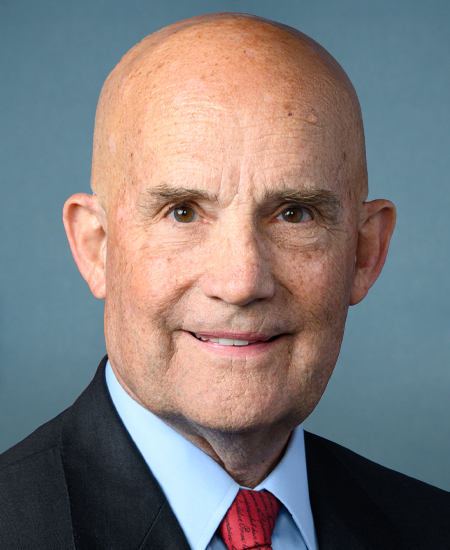
Photo of Keith Self
R United States House · District 3 · Texas On the 2026 ballot

Rep. Keith Self

Compare
Total votes
1,860
all sessions
Attendance
99%
23 missed
Near the chamber average
With party
86%
of cast votes
Lower than 98% of chamber peers
Bipartisan score
8%
crosses aisle rarely
Higher than 97% of chamber peers
Sponsored
699
bills & resolutions
Near the chamber average
Committees
8
assignments
699 bills and resolutions

Sponsored bills

Total
699
Primary
82
Co-sponsor
617
This page
699
matching current filters
Co-sponsor HR 7442
In committee · Utah House · Co-sponsor
National Bridge Funding Reform Act

Maddy summaryHR 7442 establishes a new National Bridge Program under federal highway law to allocate funding for bridge replacement, rehabilitation, and construction. It changes how funds are distributed: 75% based on the total deck area of bridges on federal-aid highways in each state, and 25% based on the deck area of bridges in poor condition. This directly affects state transportation departments managing federal-aid highway bridges, requiring them to prioritize projects using this updated formula starting after December 31, 2024. The bill eliminates prior programs (Carbon Reduction and PROTECT) and revises related funding mechanisms.

In committee Feb 10, 2026 1 co-sponsor
Co-sponsor HR 260
Passed · Utah House · Co-sponsor
No Tax Dollars for Terrorists Act

Maddy summaryThe No Tax Dollars for Terrorists Act requires the U.S. State Department to identify foreign countries and organizations receiving U.S. foreign aid that have provided financial or material support to the Taliban, including the amounts of aid they receive and the support they give to the Taliban. It mandates a strategy to use U.S. aid to discourage such support, with initial and follow-up reports to Congress on the strategy and its implementation. The bill also demands detailed reports on U.S. cash assistance programs in Afghanistan and the Afghan Fund, explaining how funds are transferred (including traditional money transfer systems) and how safeguards prevent Taliban access.

Passed Feb 10, 2026 1 co-sponsor
Co-sponsor HR 7359
In committee · Utah House · Co-sponsor
Somalia Immigration Moratorium Act

Maddy summaryThis bill prohibits most Somali citizens and nationals from obtaining U.S. visas or immigration status for 25 years after enactment. It amends immigration laws to block new admissions while allowing exceptions for those already lawfully admitted, lawful permanent residents, and individuals with specific diplomatic visas (A-1, G-1, etc.). The law directly affects Somali nationals seeking to immigrate to the U.S. and takes effect immediately upon passage. It creates a permanent policy change to restrict immigration from Somalia, with limited exceptions for existing residents and certain travelers.

In committee Feb 4, 2026 1 co-sponsor
Co-sponsor HR 5438
In committee · Utah House · Co-sponsor
Incentivize Savings Act

Maddy summaryThis bill modifies federal budget rules for unspent agency funds. It requires federal agencies to allocate 49% of unused funds to the next fiscal year, 49% toward paying the national debt, and 2% for retention bonuses (capped at 10% of an employee's base pay). Agencies must also limit future budget requests to the previous year's amount adjusted for inflation. The bill directly affects all executive branch agencies (excluding the Red Cross), altering how they manage leftover budget authority. It does not create new savings programs for individuals but changes government fiscal management procedures.

In committee Feb 4, 2026 1 co-sponsor
Co-sponsor HR 6675
In committee · Utah House · Co-sponsor
DISPOSAL Act

Maddy summaryHR 6675, the DISPOSAL Act, requires the General Services Administration (GSA) to sell or lease six specific federal buildings in Washington, D.C. (including the Frances Perkins, Forrestal, and Humphrey buildings) at fair market value or for up to 99 years. The bill mandates relocating federal agencies currently occupying these buildings to other locations, prohibits foreign ownership of the properties, and exempts the disposal from certain environmental and historic preservation requirements. Proceeds from sales must first cover relocation costs and GSA implementation expenses before any remaining funds go to deficit reduction. The law expires on December 31, 2028, and does not allow judicial review of GSA actions under this bill.

In committee Feb 2, 2026 1 co-sponsor
Co-sponsor HR 7296
In committee · Utah House · Co-sponsor
SAVE America Act

Safeguard American Voter Eligibility Act or the SAVE America Act This bill requires individuals to provide documentary proof of U.S. citizenship when registering to vote, and requires photo identification to vote, in federal elections. Specifically, the bill prohibits states from accepting and processing an application to register to vote in a federal election unless the applicant presents documentary proof of U.S. citizenship. The bill specifies what documents are considered acceptable proof of U.S. citizenship, such as identification that complies with the REAL ID Act of 2005 that indicates U.S. citizenship. Further, the bill (1) prohibits states from registering an individual to vote in a federal election unless, at the time the individual applies to register to vote, the individual provides documentary proof of U.S. citizenship; and (2) requires states to establish an alternative process to demonstrate U.S. citizenship. Each state must take affirmative steps on an ongoing basis to ensure that only U.S. citizens are registered to vote, which shall include establishing a program to identify individuals who are not U.S. citizens using information supplied by certain sources. Additionally, states must remove noncitizens from their official lists of eligible voters. The bill (1) provides for a private right of action for certain violations, and (2) establishes criminal penalties for certain offenses. Individuals voting in federal elections must present an eligible photo identification document. An individual who votes by absentee ballot must submit a copy of their identification document with both the request for, and the submission of, the absentee ballot.


In committee Jan 30, 2026 1 co-sponsor
Co-sponsor HR 4323
Signed into law · Utah House · Co-sponsor
Trafficking Survivors Relief Act

Maddy summaryThe Trafficking Survivors Relief Act (HR 4323) allows victims of human trafficking to petition courts to vacate convictions for non-violent federal crimes (level A offenses) or expunge arrest records if those offenses were directly related to their trafficking victimization. The bill establishes clear procedures for filing these motions, requires courts to consider testimony from anti-trafficking service providers, and ensures confidentiality for petitioners. It also adds a new "human trafficking defense" that permits defendants to claim duress due to trafficking victimization in criminal cases. The law mandates reports to Congress on implementation, including the number of petitions filed and outcomes, to assess its impact on trafficking survivors.

Signed into law Jan 23, 2026 1 co-sponsor
Co-sponsor HR 7199
In committee · Utah House · Co-sponsor
Gerald’s Law Act

Maddy summaryHR 7199, the Gerald’s Law Act, expands burial benefits for veterans who die at home while receiving VA hospice care. It adds a new eligibility category allowing burial allowances for veterans who were in VA hospice care at home *only if* they previously received VA hospital or nursing home care. The bill amends existing law to include this scenario under the veterans' burial allowance program. This change directly affects veterans receiving VA hospice care at home after prior VA facility-based care, ensuring they qualify for burial benefits similar to those who die in VA facilities. The policy change takes effect as if included in the 2020 Veterans Health Care Act.

In committee Jan 22, 2026 1 co-sponsor
Co-sponsor HR 6875
In committee · Utah House · Co-sponsor
AI OVERWATCH Act

Maddy summaryThe AI OVERWATCH Act requires U.S. exporters to obtain a license for sending certain high-performance integrated circuits (defined by specific technical specifications like processing power or bandwidth) to countries designated as "concerns," including China, Russia, Iran, and North Korea. Before approving such licenses, the Commerce Department must submit detailed certifications to Congress, including assurances the export won’t support military/intelligence capabilities of the recipient country and won’t harm U.S. semiconductor availability or AI leadership. The bill also creates an exemption for U.S. companies meeting strict security and ownership standards ("trusted United States persons") to export these chips to non-target countries without a license. Additionally, it mandates a national security strategy assessing how such exports affect U.S. AI competitiveness, particularly regarding China’s semiconductor production and capabilities.

In committee Jan 21, 2026 1 co-sponsor
Primary HR 6411
In committee · Utah House · Lead sponsor
Preshevo Valley Discrimination Assessment Act

Maddy summaryHR 6411, the Preshevo Valley Discrimination Assessment Act, requires the U.S. Secretary of State to submit a report within 180 days of enactment assessing potential discrimination against ethnic Albanians in Serbia's Preshevo Valley. The report must examine specific issues including whether Serbian authorities deactivate ethnic Albanians' registered homes (passivation), restrict Albanian language use in public documents and schools, limit access to identity documents, and provide unequal funding to majority-Albanian municipalities. It also covers whether Serbia disregards proportional integration of ethnic Albanians in public institutions, restricts cultural symbols, or uses law enforcement to intimidate residents. The bill mandates a detailed, unclassified report covering these 13 specific areas of concern. This is a procedural reporting requirement, not a policy change affecting U.S. law or funding.

In committee Jan 21, 2026 0 co-sponsors
Showing 101 to 110 of 699 bills
Previous 1 10 11 12 70 Next