Thin Blue Line Act This bill expands the list of statutory aggravating factors in death penalty determinations to also include killing or targeting a law enforcement officer, firefighter, or other first responder.
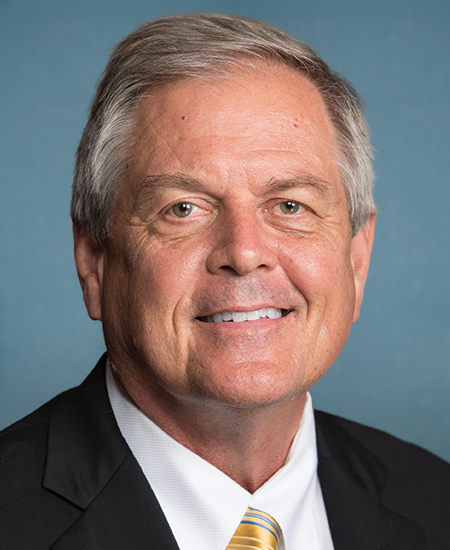
Rep. Ralph Norman
Sponsored bills
Fund and Complete the Border Wall Act This bill establishes funding for a U.S.-Mexico border barrier and revises how border patrol agents are compensated for overtime. The Department of the Treasury shall set up an account for funding the design, construction, and maintenance of the barrier. The funds in the account are appropriated only for that purpose and for vehicles and equipment for border patrol agents. For each fiscal year, financial assistance to a country shall be reduced by $2,000 for each citizen or national of that country apprehended for illegally entering the United States through its southern border. The reduced amount shall be transferred to the border barrier account. The Department of State may opt not to reduce amounts appropriated to Mexico for various military and law enforcement-related activities. This bill establishes a 5% fee on foreign remittance transfers and increases the fee for the arrival/departure I-94 form for various aliens entering the United States, with part of the fees to go into the border barrier account. By December 31, 2021, DHS shall (1) take all actions necessary, including constructing barriers, to prevent illegal crossings along the U.S.-Mexico barrier; and (2) achieve operational control over all U.S. international borders. The bill changes how border patrol agents receive overtime pay when working up to 100 hours in a two-week period. For hours worked above 80, an agent shall receive at least 150% of the agent's regular hourly rate.
Birthright Citizenship Act of 2021 This bill limits birthright citizenship by redefining what it means to be subject to the jurisdiction of the United States. Currently, a person born in the United States and subject to U.S. jurisdiction is entitled to citizenship. Under the bill, a person is subject to U.S. jurisdiction if he or she is born to a parent who is (1) a U.S. citizen or national, (2) a lawful permanent resident residing in the United States, or (3) an alien performing active service in the Armed Forces. The bill does not affect the citizenship or nationality status of any person born before the bill's enactment date.
Visa Overstay Enforcement Act of 2021 This bill imposes various penalties on aliens who overstay a visa or lawful immigration status. An alien who overstays shall be fined or imprisoned for up to six months, or both. Such an individual may not be admitted into the United States for 5 years, and may not be granted a visa for 10 years. For subsequent offenses, the alien shall be fined or imprisoned for up to two years, or both, and shall not be admitted into the United States or granted a visa. The Department of Homeland Security shall make case-by-case exceptions for aliens who overstay due to medical necessity, public safety, or national security reasons.
Terrorist Deportation Act of 2021 This bill establishes that aliens identified in the terrorist screening database, except for permanent residents, shall be deportable and inadmissible into the United States. The Department of Homeland Security (DHS) may temporarily waive the inadmissibility of such an alien if it is in the national security interests of the United States. DHS shall grant such a waiver only with the unanimous concurrence of the Department of Justice, the Federal Bureau of Investigation, the Office of the Director of National Intelligence, and the Department of State. An alien identified in the terrorist screening database shall be ineligible for various immigration benefits, including asylum, withholding or cancellation of removal, voluntary departure, or adjustment of status. DHS shall determine on an expedited basis the removal of an alien identified in the terrorist screening database, if the alien has not received a waiver and does not have permanent residence status. The alien shall be entitled to various protections, including the privilege of representation by counsel and judicial review.
Build up Illegal Line Defenses with Assets Lawfully Lifted Act of 2021 This bill directs certain amounts from the Department of Justice (DOJ) Assets Forfeiture Fund to the deployment of additional border security measures. Specifically, DOJ must report annually on the amount of total deposits into the fund that are derived from Mexican cartels. The bill makes available 50% of that amount for the construction of additional physical barriers and roads near the border to deter illegal crossings into the United States. Additionally, the bill prohibits the release of seized currency or contraband that likely belongs to or supports a foreign illegal trafficking organization while a civil forfeiture action is pending.
Jurists United to Stop Trafficking Imitation Child Exploitation Act of 2021 or the JUSTICE Act of 2021 This bill broadens the prohibition on importation or transportation of obscene materials. Specifically, the bill makes it a crime to import, or knowingly use a common carrier or interactive computer service to transport, a child sex doll.
Hearing Protection Act This bill removes silencers from the definition of firearms for purposes of the National Firearms Act. It also treats persons acquiring or possessing a firearm silencer as meeting any registration and licensing requirements of such Act. The Department of Justice must destroy certain records relating to the registration, transfer, or making of a silencer. The bill also revises the definitions of firearm silencer and firearm muffler under the federal criminal code and includes such items in the 10% excise tax category.
Mobilizing Against Sanctuary Cities Act This bill imposes penalties on certain state and local governments that do not assist federal immigration enforcement actions. Specifically, a state or local government shall be ineligible for federal financial assistance for at least one year if it restricts or prohibits an agency or official from (1) communicating with the responsible federal immigration agency regarding an individual's citizenship or immigration status, or (2) maintaining or exchanging information about an individual's status. Such governmental entities are sometimes referred to as sanctuary cities or jurisdictions. The bill restores assistance eligibility upon a Department of Justice (DOJ) determination that the jurisdiction no longer takes such actions. DOJ shall determine each year which state or local jurisdictions are not in compliance with immigration requirements and report such determination to Congress.
Legal Workforce Act This bill directs the Department of Homeland Security (DHS) to create an electronic employment eligibility confirmation system modeled after and to replace the E-Verify system, which allows employers and recruiters to verify the immigration status of individuals. The bill also mandates the use of such a system, where currently only some employers, such as those with federal contracts, are required to use E-Verify. The bill specifies documents that can establish an individual's identity and employment authorization. During the period starting when a job offer is made until three business days after hiring, the individual must attest to his or her employment authorization, and the employer or recruiter must attest that it has examined the individual's required documents. Employers shall reverify certain types of employees who were not previously verified using E-verify. The Social Security Administration shall notify employees if their Social Security number has been used multiple times in an unusual manner. DHS shall establish programs for blocking and suspending misused numbers. Employers that are required to use the verification system shall not be liable for any employment-related action based on a good-faith reliance on the information from the system. The bill establishes a phased-in participation deadline for different categories of employers, including agricultural employers. The bill increases civil penalties related to hiring individuals without work authorization. It also preempts state laws relating to hiring and employment eligibility verification, but states may use their authority of business licensing to penalize employers for failing to comply with the bill's provisions.