

Let States Cut Taxes Act This bill removes a prohibition on states and territories using COVID-19 (i.e., coronavirus disease 2019) relief funding under the American Rescue Plan Act of 2021 to offset a reduction in revenue resulting from a reduction in taxes or a delay in the imposition of a tax or tax increase.
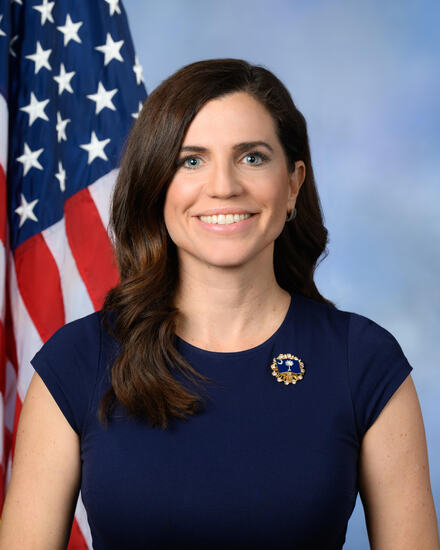
Rep. Nancy Mace
Sponsored bills
Cost Openness and Spending Transparency Act of 2021 or the COST Act This bill requires recipients of federal funds to disclose financing information relating to programs, projects, or activities carried out using such funds. Specifically, such a recipient (including a state or local government or a recipient of a federal research grant) must clearly state in any press release, request for proposal, bid solicitation, or other document describing the activity the amount and percentage of federal funding and the amount and percentage of nongovernmental funding. If the Office of Management and Budget determines that a recipient is failing to comply, it may direct each agency providing federal funds to withhold up to 25% of the funds until the recipient complies.
Pharmacy Benefit Manager Accountability Study Act of 2021 This bill requires the Government Accountability Office to report on the role of pharmacy benefit managers in the pharmaceutical supply chain and recommend legislative actions to lower the cost of prescription drugs. The report must address the use of rebates and fees, the average prior authorization approval time, and the use of step therapy within the 10 largest pharmacy benefit managers.
Highway Formula Fairness Act This bill modifies the formula that the Department of Transportation uses to apportion federal highway funds among the states for the national highway performance program, the surface transportation block grant program, the highway safety improvement program, the congestion mitigation and air quality improvement program, the national highway freight program, and metropolitan transportation planning.
Developing Responsible Individuals for a Vibrant Economy Act or the DRIVE-SAFE Act This bill directs the Department of Transportation to promulgate regulations to implement an apprenticeship program for licensed commercial motor vehicle drivers under the age of 21. Under the program, an apprentice must complete two probationary periods that total 400 hours of on-duty time, of which at least 240 hours must be driving time in a commercial motor vehicle. Additionally, the apprentice must be accompanied in the cab of the commercial motor vehicle by an experienced driver. Further, the bill requires all commercial motor vehicles used in the program for training to be equipped with safety technology such as active braking collision mitigation systems and video event capturing systems. An employer shall not knowingly allow, require, permit, or authorize a driver under the age of 21 to operate a commercial motor vehicle unless the driver is participating in, or has completed, an apprenticeship program that meets the requirements set forth in this bill.
Death Tax Repeal Act This bill repeals the estate and generation-skipping transfer taxes. It also makes conforming amendments related to the gift tax.
This joint resolution proposes a constitutional amendment limiting Representatives to three terms and Senators to two terms. Terms beginning before the ratification of this amendment do not count towards these term limits.
This joint resolution proposes an amendment to the Constitution to require that the Supreme Court consist of nine Justices.
Sand Acquisition, Nourishment, and Development Act or the SAND Act This bill allows the Department of the Army to acquire fill material for beach erosion and nourishment purposes from non-domestic sources even if such materials are available from domestic sources.
This bill invalidates certain provisions of the District of Columbia Municipal Regulations as added by the final rulemaking of the State Superintendent of Education of the District of Columbia issued on December 7, 2016, that require a staff member of a child development facility to have a degree, a certificate, or a minimum number of credit hours from an institution of higher education. The requirements of this rulemaking apply to personnel including child development center directors, teachers, and assistant teachers; expanded child development home caregivers; and out-of-school time program directors and group leaders.