

Motor Carrier Safety Selection Standard Act This bill establishes a standard of care for the selection of brokers and other entities that contract with motor carriers for the shipment of goods or household goods. A broker is a person, other than a motor carrier or an employee or agent of a motor carrier, that as a principal or agent sells, offers for sale, negotiates for, or holds itself out by solicitation, advertisement, or otherwise as selling, providing, or arranging for, transportation by motor carrier for compensation. Specifically, the bill requires such entities to verify that a transporting motor carrier (1) is properly registered with the Department of Transportation (DOT); (2) has obtained the minimum required insurance coverage; and (3) is not determined unfit to safely operate commercial motor vehicles, or otherwise ordered to discontinue operations by the Federal Motor Carrier Safety Administration or a state. DOT must prescribe by regulation a process for revoking the registration of an owner or operator determined unfit to safely operate a commercial motor vehicle.
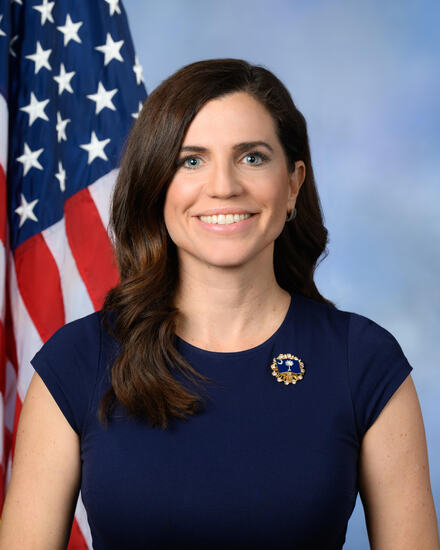
Rep. Nancy Mace
Sponsored bills
This bill eliminates the 10-year time limit on the availability of the Department of Veterans Affairs Survivors' and Dependents' Educational Assistance program for certain spouses who become eligible for such benefit on or after August 1, 2022.
Fairness for All Act This bill prohibits discrimination on the basis of sex, sexual orientation, or gender identity, while providing certain benefits and exemptions to religious providers. An otherwise qualified religious provider shall be eligible to receive federal financial assistance for a particular service without regard to the provider's religious views or teachings. The bill expands the definition of public accommodation to which sex discrimination laws apply, including to cover providers of financial services, medical services, and providers of transportation services. Exceptions from these sex discrimination prohibitions are made for (1) religious camps or religious retreat centers unless they also discriminate based on race, color, or national origin; and (2) providers of funeral services or burial plots that primarily limit their services or facilities to those of a particular religion unless the provider discriminates based on those factors. Agencies authorized to administer federal financial assistance for the support of adoption and foster care services shall issue final rules within two years of this bill's enactment to create an indirect funding program that delivers such assistance to eligible prospective parents for the purpose of obtaining adoption and foster care services through a qualified private agency that they select. The bill (1) exempts a church or religious organization from claims of employment discrimination because of sexual orientation or gender identity under specified circumstances; and (2) prohibits sanctions for certain employee speech regarding the employee's religious, political, or moral beliefs in the workplace. The bill establishes certain anti-bullying policies for public elementary and secondary schools, including cyber bullying. Any determination of the tax-exempt status of a charitable organization shall be made without regard to the organization's religious beliefs or practices concerning marriage, family, or sexuality, except insofar as such practices pertain to race or criminal sexual offenses punishable under constitutionally valid federal or state law.
Informed Consent Act This bill establishes new federal criminal offenses related to the performance of abortions and sterilization procedures. First, the bill prohibits knowingly performing an abortion or sterilization procedure without obtaining informed consent. It provides exceptions, including for an abortion or sterilization procedure that is necessary to save a mother whose life is endangered by a physical (but not psychological or emotional) disorder, illness, or condition. An individual who performs a prohibited abortion or sterilization procedure is subject to criminal penalties—a fine, a prison term of up to 10 years, or both. Second, the bill requires federal employees and contractors, as well as employees and contractors of certain federally funded entities, who know about a prohibited abortion or sterilization procedure to report it as soon as possible. An individual who knows about a prohibited abortion or sterilization procedure but fails to report it is subject to a fine, a prison term of up to three years, or both.
EAGLES Act of 2021 This bill reauthorizes the National Threat Assessment Center (NTAC) within the U.S. Secret Service. It reauthorizes the functions of NTAC through FY2025 and expands them to include the establishment of a national program on targeted school violence prevention.
Pain-Capable Unborn Child Protection Act This bill establishes a new criminal offense for performing or attempting to perform an abortion if the probable post-fertilization age of the fetus is 20 weeks or more. A violator is subject to criminal penalties—a fine, a prison term of up to five years, or both. The bill provides exceptions for an abortion (1) that is necessary to save the life of the pregnant woman, or (2) when the pregnancy is the result of rape or incest. A physician who performs or attempts to perform an abortion under an exception must comply with specified requirements. A woman who undergoes a prohibited abortion may not be prosecuted for violating or conspiring to violate the provisions of this bill.
Veterans Access to Direct Primary Care Act This bill requires the Department of Veterans Affairs (VA) to implement a five-year pilot program to provide eligible veterans with the option to receive primary care services from a non-VA health care provider under a direct primary care service arrangement through the use of a veteran health savings account. Eligible veterans are those enrolled in the VA health care system.
Animal Cruelty Enforcement Act of 2021 This bill establishes a new section in the Environmental and Natural Resources Division of the Department of Justice to enforce federal laws concerning animal cruelty.
Life at Conception Act This bill declares that the right to life guaranteed by the Constitution is vested in each human being at all stages of life, including the moment of fertilization, cloning, or other moment at which an individual comes into being. Nothing in this bill shall be construed to authorize the prosecution of any woman for the death of her unborn child.
Protect Our Military Families' 2nd Amendment Rights Act This bill broadens the scope of allowable firearms transactions involving active duty service members and their spouses. Specifically, the bill allows a licensed gun dealer, importer, or manufacturer to sell or ship a firearm or ammunition to the spouse of a member of the Armed Forces on active duty outside the United States. Current law already allows a licensed dealer, importer, or manufacturer to sell or ship a firearm or ammunition to a member of the Armed Forces on active duty outside the United States. The bill also specifies that, for purposes of federal firearms laws, a member of the Armed Forces on active duty, or his or her spouse, is a resident of the state in which (1) the member or spouse maintains legal residence, (2) the permanent duty station of the member is located, and (3) the member maintains a home from which he or she commutes to the permanent duty station.