

Maddy summaryThis bill removes regulatory barriers for certain investment funds. It amends the Investment Company Act of 1940 to allow "closed-end companies" (investment funds that don't issue new shares after launch) to invest all their assets in "private funds" (like venture capital or hedge funds) without SEC restrictions, provided the restriction isn't related to the fund's nature. It also prevents stock exchanges from blocking the listing or trading of these funds' securities. The bill preserves existing fiduciary duties, valuation rules, and liquidity requirements for these funds.
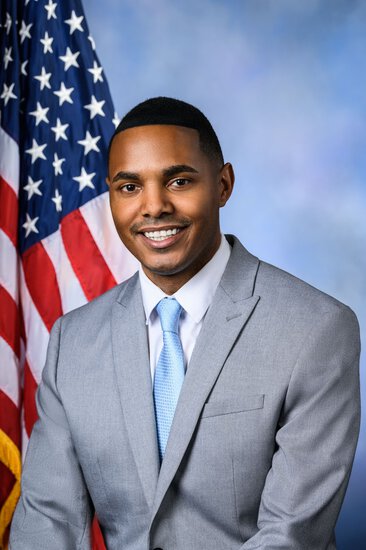
Rep. Ritchie Torres
Sponsored bills
Maddy summaryThe Protect America's Workforce Act cancels an executive order issued on March 27, 2025, that excluded certain groups from federal labor-management relations programs, making it legally unenforceable. It also ensures that all collective bargaining agreements between federal agencies and labor unions, which were active as of March 26, 2025, remain fully effective until their agreed terms expire. This directly affects federal agencies, labor unions, and the employees covered by these agreements. The bill prevents federal funds from being used to implement the canceled executive order while preserving existing labor agreements.
Maddy summaryThis bill (HR 6694) designates the U.S. Postal Service facility at 130 North Winton Road in Rochester, New York, as the "Lieutenant James N. Lyons Post Office." It updates all official federal references to the location to reflect this new name. The change is purely ceremonial and affects how the post office is identified in government documents and records.
Maddy summaryThis resolution (HRES 946) formally honors Rita Moreno, a pioneering Puerto Rican actress and cultural icon, for her historic achievements and advocacy. It recognizes her as the first Latina to win an Academy Award (1962), her EGOT status (Emmy, Grammy, Oscar, Tony), and her lifelong work advancing civil rights and Latino representation in the arts. The resolution calls on the U.S. public to celebrate her legacy, which embodies the American dream and cultural contributions of Latinas. As a commemorative resolution, it has no legal effect but symbolically celebrates her impact on American culture and the performing arts.
Maddy summaryThis bill amends the Higher Education Act to extend the loan limits for graduate and professional students indefinitely. It removes the previous expiration date (June 30, 2026) for these limits, meaning graduate and professional students will continue to have access to the same federal loan amounts without a set end date. The key change modifies Section 455(a) by eliminating the sunset provision and updating the effective date language in the law. This directly affects students pursuing advanced degrees who rely on federal loans for tuition and living expenses. The bill makes a technical adjustment to existing student loan policy without creating new benefits or altering eligibility criteria.
Maddy summaryHR 6603, the "Our Parks Act," amends the Federal Lands Recreation Enhancement Act to require the Secretary to waive entrance fees at all National Park System and National Wildlife Refuge System sites that normally charge fees, on every federal holiday listed in 5 U.S.C. § 6103. This means visitors entering these parks on designated federal holidays like New Year's Day or Independence Day will not be charged an entrance fee. The provision directly affects park visitors on those specific holidays, eliminating a standard cost for entry. The change is automatic and applies to all qualifying federal holidays without requiring visitor action.
Maddy summaryThis bill requires all health insurers and federal health programs to cover annual lung cancer screenings (using low-dose CT scans or equivalent) with no out-of-pocket costs for eligible adults. It directly affects adults aged 50-80 who are deemed at increased lung cancer risk by their healthcare provider due to personal, environmental, or family factors. The law prohibits prior authorization, step-therapy, or annual screening limits stricter than one per year, ensuring immediate access to screening without administrative barriers. Federal health agencies must issue implementing rules within 180 days of the bill's enactment to ensure compliance.
Maddy summaryThis bill prohibits health plans and insurers from imposing arbitrary time limits on paying for anesthesia services during medically necessary procedures. It requires payment to be based solely on a provider's assessment of medical necessity (by an anesthesiologist or certified nurse anesthetist), not fixed time caps. The law applies to both private insurance and Medicaid, preventing denials of payment simply because care duration exceeded a preset limit. It also mandates annual oversight reports from the Health and Human Services Inspector General to monitor compliance.
Maddy summaryThis bill prohibits Department of Homeland Security (DHS) officers from arresting or detaining immigrants at immigration court facilities during hearings or while arriving/departing for hearings, except with a judicial warrant. It applies to all pending immigration cases, appeals, and motions to reopen, covering anyone whose removal order isn't final. Exceptions allow arrests only to prevent imminent threats to life, safety, or national security. The bill also requires DHS to report scheduled check-in arrests to the Inspector General and mandates annual oversight reports to Congress on compliance.
Maddy summaryThis bill directs the American Battle Monuments Commission to correct historical errors by identifying Jewish World War I and II veterans buried overseas under incorrect Christian markers (Latin crosses) and replacing them with appropriate markers. It establishes a 10-year program to contact families of affected veterans, with the Commission funding the effort at $500,000 annually through nonprofit contracts. The program specifically targets veterans buried in foreign U.S. military cemeteries with markers indicating non-Jewish faith, addressing a documented mistake affecting approximately 900 Jewish servicemembers. This directly affects Jewish veterans' families by honoring their heritage and correcting past burial inaccuracies.