

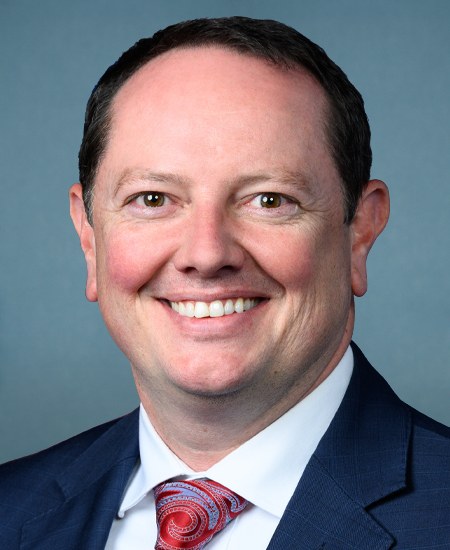
Photo of Eric Burlison
R United States House · District 7 · Missouri On the 2026 ballot

Rep. Eric Burlison

Compare
Total votes
1,860
all sessions
Attendance
97%
63 missed
Lower than 77% of chamber peers
With party
85%
of cast votes
Lower than 98% of chamber peers
Bipartisan score
8%
crosses aisle rarely
Higher than 97% of chamber peers
Sponsored
441
bills & resolutions
Lower than 85% of chamber peers
Committees
8
assignments
441 bills and resolutions

Sponsored bills

Total
441
Primary
48
Co-sponsor
393
This page
441
matching current filters
Primary HR 7388
Passed · Utah House · Lead sponsor
Smart Space Act of 2026

Maddy summaryHR 7388 (Smart Space Act of 2026) requires the General Services Administration (GSA) to identify private financing options for federal building projects to reduce government costs. Within 90 days, GSA must hold public meetings with real estate experts and submit a project list within 120 days, focusing on buildings critical to core government functions that meet 60% occupancy or consolidate inefficient space. The bill mandates public reporting of recommendations, project details, and timelines, with transparency requirements for Congress and the public. It does not grant GSA new legal authorities and defines "public-private partnerships" to include private financing for building design, construction, and maintenance.

Passed Mar 25, 2026 0 co-sponsors
Primary HR 2409
In committee · Utah House · Lead sponsor
Guidance Clarity Act of 2025

Maddy summaryThe Guidance Clarity Act requires federal agencies to include a clear statement on all guidance documents, explaining that the guidance does not have the force of law and is not binding on the public or the agency. This statement must be prominently displayed on the first page of the document and specify that it is intended only to clarify existing legal requirements. Agencies must begin using this statement 30 days after the Office of Management and Budget (OMB) issues implementing guidance, which OMB must provide within 90 days of the bill's enactment. The bill directly affects all federal agencies that issue guidance under specific legal authority, ensuring transparency about the non-binding nature of such communications.

In committee Mar 24, 2026 0 co-sponsors
Co-sponsor HR 5525
In committee · Utah House · Co-sponsor
Stop DC CAMERA Act

Maddy summaryHR 5525, the Stop DC CAMERA Act, repeals two specific traffic enforcement provisions in Washington D.C. law. It removes the District's authority to use automated traffic enforcement systems (like red-light cameras) and to erect signage prohibiting right turns at red lights. This bill directly affects D.C. traffic enforcement policies and drivers who would be subject to those specific enforcement methods. The legislation makes a concrete policy change by eliminating these two existing enforcement tools from D.C. traffic regulations.

In committee Mar 18, 2026 1 co-sponsor
Co-sponsor HR 7678
In committee · Utah House · Co-sponsor
Gun Owner Registration Information Protection Act

Maddy summaryHR 7678, the Gun Owner Registration Information Protection Act, prohibits federal funding for state or local databases that track lawfully owned firearms or their owners. The bill allows federal funding for databases recording lost or stolen firearms but bans it for databases listing legal gun ownership. This means states cannot use federal money to create or maintain systems that compile information about legally owned guns. The bill directly affects state and local governments that rely on federal funds for firearm ownership databases.

In committee Feb 25, 2026 1 co-sponsor
Co-sponsor HR 2189
Passed · Utah House · Co-sponsor
To modernize Federal firearms laws to account for advancements in technology and less-than-lethal weapons, and for other purposes.

Law-Enforcement Innovate to De-Escalate Act This bill removes less-than-lethal projectile devices (e.g., certain TASERs) from regulation under the Gun Control Act. The term less-than-lethal projectile device means a device that (1) is not designed or intended to expel (and may not be readily converted to discharge) commonly used ammunition or projectiles exceeding a velocity of 500 feet per second; (2) is designed and intended to be used in a manner not likely to cause death or serious bodily injury; and (3) does not accept (and cannot be readily modified to accept) an ammunition feeding device. The bill also requires the Bureau of Alcohol, Tobacco, Firearms and Explosives to determine whether a device satisfies the definition of a less-than-lethal projectile device within 90 days of a request.

Passed Feb 24, 2026 1 co-sponsor
Co-sponsor HR 1319
In committee · Utah House · Co-sponsor
Modern Worker Empowerment Act

This bill specifies a legal standard for determining whether an individual is considered an independent contractor rather than an employee for the purposes of federal labor laws that address issues such as the federal minimum wage, overtime compensation, and collective bargaining. The rights and protections provided by these laws exclusively apply to employees. Under the bill, an individual is considered an independent contractor if (1) another individual or entity does not exercise significant control over the details of how the individual's work is performed, without regard to any control the other individual or entity may exercise over the final result of the work performed; and (2) while performing such work, the individual has opportunities and risks inherent with entrepreneurship (for example, the discretion to exercise professional judgment). The bill also sets forth factors that may not be used to determine whether an individual is an employee. Specifically, factors such as whether another individual or entity requires the individual to meet certain legal, health and safety, insurance, or performance requirements may not be used to make such a determination.

In committee Feb 20, 2026 1 co-sponsor
Co-sponsor HR 1028
In committee · Utah House · Co-sponsor
Protection of Women in Olympic and Amateur Sports Act of 2026

Protection of Women in Olympic and Amateur Sports Act This bill requires certified national governing bodies (NGBs) of amateur sports (e.g., USA Gymnastics) to prohibit a person whose sex is male from participating in an amateur athletic competition that is designated for females, women, or girls. Under the bill, male  means an individual who has, had, will have—or would have, but for a developmental or genetic anomaly or historical accident—the reproductive system that at some point produces, transports, and utilizes sperm for fertilization.

In committee Feb 17, 2026 1 co-sponsor
Primary HR 7525
In committee · Utah House · Lead sponsor
Counter Drone State and Local Defender Act

Maddy summaryThe Counter Drone State and Local Defender Act (HR 7525) authorizes state, local, tribal, and territorial law enforcement agencies to use approved counter-drone technology to detect, track, and mitigate drone threats at "covered facilities or assets" identified as high-risk by jurisdiction leaders. The bill establishes two pilot programs: a general 3-year program for law enforcement agencies and a special program for security around the 2026 FIFA World Cup, requiring FAA approval of equipment and training. It mandates privacy protections for communications, requires written policies and reporting to Congress about drone mitigation activities, and creates a permanent authorization framework after the pilot programs conclude. The law aims to strengthen security against drone threats while incorporating oversight mechanisms and privacy safeguards for law enforcement operations.

In committee Feb 13, 2026 0 co-sponsors
Co-sponsor HR 260
Passed · Utah House · Co-sponsor
No Tax Dollars for Terrorists Act

Maddy summaryThe No Tax Dollars for Terrorists Act requires the U.S. State Department to identify foreign countries and organizations receiving U.S. foreign aid that have provided financial or material support to the Taliban, including the amounts of aid they receive and the support they give to the Taliban. It mandates a strategy to use U.S. aid to discourage such support, with initial and follow-up reports to Congress on the strategy and its implementation. The bill also demands detailed reports on U.S. cash assistance programs in Afghanistan and the Afghan Fund, explaining how funds are transferred (including traditional money transfer systems) and how safeguards prevent Taliban access.

Passed Feb 10, 2026 1 co-sponsor
Showing 31 to 40 of 441 bills
Previous 1 3 4 5 45 Next