Fiscal State of the Nation Resolution This concurrent resolution requires the congressional budget committees to conduct an annual joint hearing to receive a presentation from the Comptroller General regarding (1) the Government Accountability Office's audit of the financial statement of the executive branch, and (2) the financial position and condition of the federal government.
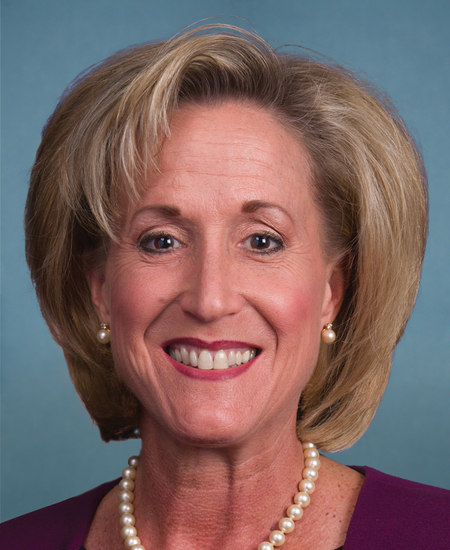
Rep. Ann Wagner
Sponsored bills
Financial Readiness of America's Servicemembers Act of 2021 This bill modifies the financial literacy training program for servicemembers (and spouses of such members) and requires the Federal Retirement Thrift Investment Board to submit a plan to Congress on improving the access of members to certain information about the Thrift Savings Plan.
Stop Foreign Funds in Elections Act This bill prohibits contributions or donations by foreign nationals in connection with state or local ballot initiatives or referenda.
Saving Workers by Eliminating Economic Tampering and Ensuring Reliability Act or the SWEETER Act This bill eliminates certain Department of Agriculture (USDA) sugar subsidy programs. Specifically, the bill eliminates (1) the price support loan program available to processors of domestically grown sugarcane and sugar beets; (2) the sugar marketing allotments and tariff-rate quotas that limit the quantities of domestically produced sugar that processors may sell and the sugar that may be imported under lower tariff rates; and (3) the feedstock flexibility program for bioenergy producers, which operates to avoid loan forfeitures to the USDA's Commodity Credit Corporation by requiring USDA to purchase surplus sugar from domestic processors for resale to bioenergy producers.
Maddy summaryHRES 754 is a non-binding resolution expressing the House of Representatives' opposition to proposed "punitive natural gas taxes" on U.S. businesses, families, and workers. It cites claims that such taxes would raise average energy bills by 17%, reduce GDP by $9 billion, and eliminate 90,000 jobs, while disproportionately harming low-income households. The resolution argues that opposing these taxes supports U.S. energy security, national security, and continued leadership in reducing emissions through domestic natural gas production. As a procedural resolution, it does not create law but formally states the House's position against this policy approach.
Exposing China's Belt and Road Investment in America Act of 2021 This bill requires the Committee on Foreign Investment in the United States to review certain investments made by China in the United States. Specifically, the committee must review any investment by a foreign person that (1) involves the acquisition of real estate in the United States and the establishment of a U.S. business on such real estate, and (2) could result in direct or indirect control of that U.S. business by China. A party to any such investment must submit to the committee a declaration containing basic information regarding the transaction.
New Parents Act of 2021 This bill allows parents to use a portion of their Social Security benefits for up to three months of paid parental leave after the birth or adoption of a child. To receive the parental leave benefit, parents must choose to either increase their retirement age or temporarily receive a reduction in Social Security benefits upon retirement, as specified.
Help End Abusive Living Situations Act or the HEALS Act This bill modifies factors the Department of Housing and Urban Development (HUD) must consider when awarding grants under the Continuum of Care Program, which provides funding for nonprofit providers and state and local governments to quickly rehouse homeless individuals and families. Specifically, when awarding Continuum of Care grants, HUD must (1) consider the needs of survivors of domestic violence, dating violence, sexual assault, and stalking; (2) consider transitional housing projects on an even basis with any other project; and (3) score applicants for grants without prioritizing or deprioritizing rapid-rehousing, permanent supportive housing, transitional housing, or short-term emergency shelter projects based solely on those project categories.
State, Local, Tribal, and Territorial Fiscal Recovery, Infrastructure, and Disaster Relief Flexibility Act This bill allows states, tribes, territories, and localities to use certain COVID-19 relief funds for new categories of spending, including for natural disasters and infrastructure projects. It also makes changes to expenditure deadlines and other aspects of this funding. Specifically, recipients may use funds for emergency relief from natural disasters and associated negative economic impacts of natural disasters. In addition, recipients may use a portion of their COVID-19 relief funds for designated infrastructure projects, such as nationally significant freight and highway projects. Furthermore, the bill allows recipients to expend COVID-19 relief funds on these types of infrastructure projects until September 30, 2026. Under current law, recipients must expend the funds by December 31, 2024. Other changes in the bill include (1) modifying eligibility and allocation requirements for funding set aside for counties and Indian tribes that are near public lands, (2) allowing Indian tribes an additional year to expend their COVID-19 relief funds, and (3) establishing a process for government entities to decline COVID-19 relief funds and requiring any declined funds to be used to reduce the federal deficit.

Financial Exploitation Prevention Act of 2021 This bill allows for the delay of the redemption of a security issued by an open-end investment management company if the company or transfer agent reasonably believes the redemption involves the financial exploitation of an individual age 65 or older or an individual age 18 or older who is unable to protect his or her own interests. Open-end investment management companies offer securities in pooled investment vehicles such as mutual funds. Additionally, the Securities and Exchange Commission must make legislative and regulatory recommendations to address the financial exploitation of such adults.