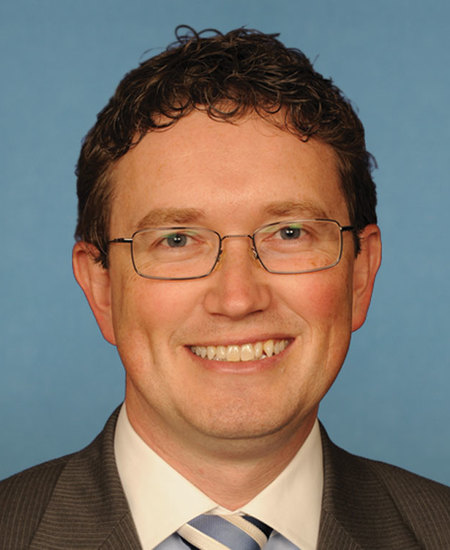
Photo of Thomas Massie
R United States House · District 4 · Kentucky

Rep. Thomas Massie

Compare
Total votes
2,818
all sessions
Attendance
93%
184 missed
Lower than 83% of chamber peers
With party
72%
of cast votes
Lower than 100% of chamber peers
Bipartisan score
14%
some cross-party votes
Higher than 99% of chamber peers
Sponsored
368
bills & resolutions
Lower than 92% of chamber peers
Committees
7
assignments
368 bills and resolutions

Sponsored bills

Total
368
Primary
65
Co-sponsor
303
This page
368
matching current filters
Co-sponsor HR 6189
In committee · Utah House · Co-sponsor
Service Members Tax Relief Act

Maddy summaryThis bill exempts active and reserve uniformed service members' military compensation from federal income tax. It directly affects service members by excluding their active-duty pay from taxable income under a new Section 139J in the tax code, while explicitly excluding retirement pensions from this benefit. The key mechanism is a tax exclusion for current service pay, effective for taxable years after enactment. The bill does not alter retirement pay taxation or apply to civilian employees.

In committee Nov 20, 2025 1 co-sponsor
Co-sponsor HR 6190
In committee · Utah House · Co-sponsor
Tax Cuts for Veterans Act of 2025

Maddy summaryHR 6190, the Tax Cuts for Veterans Act of 2025, makes military retirement pay and disability-related benefits tax-free for veterans and active-duty service members. The bill amends the tax code to exclude all retirement pay (under Titles 10 and 14 U.S. Code) and disability compensation (under Titles 10, 14, 37, or 38 U.S. Code) from taxable income. This directly affects veterans receiving retirement or disability benefits, including those with combat-related injuries, by eliminating federal income tax on these payments. The policy change applies to taxable years beginning after the bill's enactment.

In committee Nov 20, 2025 1 co-sponsor
Primary HRES 581
In committee · Utah House · Lead sponsor
Providing for consideration of the bill (H.R. 185) to advance responsible policies.

Maddy summaryHRES 581 is a procedural resolution that establishes rules for the House to consider H.R. 185, the Epstein Files Transparency Act. It waives all points of order against the bill, adopts a specific amendment (the full text of the Epstein Files Transparency Act), and limits debate to one hour equally divided between the Judiciary Committee's chair and ranking minority member. The resolution also requires the Attorney General to release unclassified DOJ records related to Jeffrey Epstein within 30 days, with limited exceptions for privacy or national security.

In committee Nov 19, 2025 0 co-sponsors
Co-sponsor HR 4405
Signed into law · Utah House · Co-sponsor
Epstein Files Transparency Act

Maddy summaryHR 4405, the Epstein Files Transparency Act, requires the U.S. Attorney General to publicly release all unclassified Department of Justice documents related to Jeffrey Epstein within 30 days of the law’s enactment. This includes investigations, flight logs, immunity deals, internal communications, and records about Epstein’s detention or death, while prohibiting redactions for "embarrassment" or political sensitivity. The law allows limited redactions only for victim privacy, child sexual abuse materials, active investigations, or national security (with justification), and mandates an unclassified summary for withheld classified information. The Attorney General must submit a detailed report to Congress within 15 days of release, listing all redactions and naming any government officials referenced in the materials.

Signed into law Nov 19, 2025 1 co-sponsor
Primary HR 5811
In committee · Utah House · Lead sponsor
Restoring America’s Leadership in Innovation Act of 2025

Restoring America's Leadership in Innovation Act of 2025 This bill revises several aspects of patent law. The bill changes the U.S. patent system back to a first-to-invent system, in which the first inventor to conceive of an invention is entitled to a patent. Currently, the first person to file an application that meets all the necessary requirements is entitled to the patent. Several types of administrative patent challenge proceedings are abolished, as well as the U.S. Patent and Trademark Office (USPTO) body that decides those proceedings. The bill relaxes the standard for what constitutes patent-eligible subject matter. The only ineligible inventions shall be those that exist in nature independent or prior to human activity or that exist solely in the human mind. The bill also makes it easier for a patent owner that has won an infringement case in court to secure a permanent injunction against the infringing defendant. Specifically, there shall be a presumption that further infringement would cause irreparable harm to the prevailing patent owner, and the burden shall be on the infringer to prove otherwise. (Currently, a prevailing patent owner seeking a permanent injunction must prove, among other things, that further infringement would cause irreparable harm.) The bill limits what types of publications shall be treated as prior art that could be used to make an invention be considered to be anticipated or obvious (and therefore not patentable). The bill authorizes the USPTO to keep and spend all the fees that it collects.


In committee Oct 24, 2025 0 co-sponsors
Co-sponsor HR 5819
In committee · Utah House · Co-sponsor
Balancing Incentives Act of 2025

Maddy summaryHR 5819, the Balancing Incentives Act of 2025, requires patent owners to explicitly consent before a petition for inter-partes review or post-grant review of their patent can be filed. This bill amends sections 312(a) and 322(a) of U.S. patent law to add a new requirement that the patent owner must consent to the filing of such petitions. The change directly affects patent owners by giving them control over whether their patents face these administrative reviews. The bill makes no other policy changes and focuses solely on modifying the procedural requirement for initiating these patent reviews.

In committee Oct 24, 2025 1 co-sponsor
Primary HR 5704
In committee · Utah House · Lead sponsor
Repeal the Smith-Mundt Modernization Act of 2013

Maddy summaryHR 5704 would repeal the Smith-Mundt Modernization Act of 2013, restoring the original 1948 law that prohibits U.S. government agencies like the State Department and U.S. Agency for Global Media (USAGM) from sharing materials intended for foreign audiences within the United States. The bill requires such materials to be made available in English for review by the press and Congress but blocks domestic distribution, mandates they be archived by the National Archives for 20 years before public access with clear disclaimers about their origin, and bans using federal funds to influence domestic public opinion. This would directly affect how these agencies produce and handle international communications.

In committee Oct 8, 2025 0 co-sponsors
Co-sponsor HR 2462
In committee · Utah House · Co-sponsor
Black Vulture Relief Act

Maddy summaryThe Black Vulture Relief Act authorizes livestock producers and their employees to remove or kill black vultures (Coragyps atratus) that are causing or likely to cause harm to livestock, bypassing standard protections under the Migratory Bird Treaty Act. It prohibits using poison for this purpose and requires annual reports to the U.S. Fish and Wildlife Service about such actions, using a simplified form. The law specifically targets vultures threatening livestock as defined in existing federal agriculture law, with reporting deadlines starting after a form is developed by the Fish and Wildlife Service.

In committee Oct 3, 2025 1 co-sponsor
Co-sponsor HRES 719
Passed · Utah House · Co-sponsor
Honoring the life and legacy of Charles Charlie James Kirk.

Maddy summaryHRES 719 is a House resolution honoring Charles "Charlie" James Kirk, the founder of Turning Point USA who was assassinated on September 10, 2025. The resolution condemns his assassination and all political violence, extends condolences to his family, and calls on Americans to reject violence while promoting civil discourse. It specifically recognizes Kirk's legacy as a defender of constitutional principles and his role in inspiring youth through free speech and faith-based civic engagement. As a commemorative resolution, it does not enact policy changes but formally expresses the House's stance on honoring his life and legacy.

Passed Sep 19, 2025 1 co-sponsor
Co-sponsor HCONRES 48
In committee · Utah House · Co-sponsor
Authorizing the use of the rotunda of the Capitol for the lying in honor of the remains of the late Charles James Kirk, a lifelong advocate for freedom of speech, civil political discourse, and the political engagement of youth.

Maddy summaryThis bill (HCONRES 48) is a ceremonial resolution authorizing the use of the U.S. Capitol rotunda for a "lying in honor" ceremony for Charles James Kirk, a recognized advocate for free speech, civil discourse, and youth political engagement. It grants permission for his remains to be displayed in the rotunda, with timing and duration to be determined by the House Speaker, Senate President pro tempore, and the Capitol Architect. The resolution does not create new laws or policies but formally permits a traditional honor reserved for individuals who have made significant contributions to the nation. It affects no specific group or legislation, serving only as a commemorative gesture for Kirk's legacy.

In committee Sep 15, 2025 1 co-sponsor
Showing 41 to 50 of 368 bills
Previous 1 4 5 6 37 Next