This concurrent resolution declares that Congress should not impose any new performance fee, tax, royalty, or other charge relating to the public performance of sound recordings on a local radio station for broadcasting sound recordings over the air, or on any business for such public performance of sound recordings.
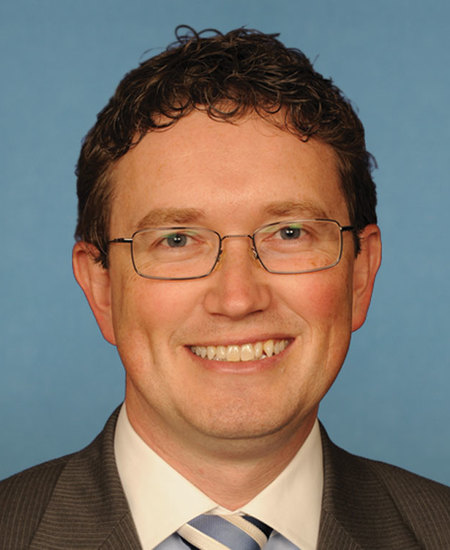
Rep. Thomas Massie
Sponsored bills
National Patient ID Repeal Act This bill repeals the requirement that the Department of Health and Human Services adopt a standard unique health identifier for each individual, employer, health plan, and health care provider. The provision has not been implemented to date because language included in annual appropriations acts has prohibited the use of federal funds for developing a unique identifier. However, some appropriations bills introduced in recent years have not included this funding restriction.
Saving Workers by Eliminating Economic Tampering and Ensuring Reliability Act or the SWEETER Act This bill eliminates certain Department of Agriculture (USDA) sugar subsidy programs. Specifically, the bill eliminates (1) the price support loan program available to processors of domestically grown sugarcane and sugar beets; (2) the sugar marketing allotments and tariff-rate quotas that limit the quantities of domestically produced sugar that processors may sell and the sugar that may be imported under lower tariff rates; and (3) the feedstock flexibility program for bioenergy producers, which operates to avoid loan forfeitures to the USDA's Commodity Credit Corporation by requiring USDA to purchase surplus sugar from domestic processors for resale to bioenergy producers.
Nullify Occupational Safety and Health Administration Act or the NOSHA Act This bill abolishes the Occupational Safety and Health Administration (OSHA). OSHA, which is part of the Department of Labor, sets and enforces workplace safety and health standards and provides related training, outreach, education, and assistance.
This bill prohibits the use of federal funds to require a member of the Armed Forces to receive a COVID-19 vaccination. The bill also prohibits adverse action (e.g., punishment) being taken against a member of the Armed Forces because the member refuses to receive a COVID-19 vaccination.
Fire Fauci Act This bill reduces the annual rate of pay of the Director of the National Institute of Allergy and Infectious Diseases (NIAID) to $0. This reduction applies until there is a new director who is not Anthony Fauci, MD. In addition, the Government Accountability Office must audit digital correspondence, policy memoranda, and financial transactions of the Office of the Director of NIAID from October 1, 2019, through December 31, 2021.
This resolution recognizes the ultimate sacrifice of the unknown soldiers interred at Arlington National Cemetery and expresses gratitude and appreciation of all the members of the Armed Forces who have served during wars and peacetime. Additionally, the resolution commends all members of the 3d Infantry Regiment, specifically those who guard the Tomb of the Unknown Solider.
Second Amendment For Every Registrable Voter Act or the SAFER Voter Act This bill reduces the minimum age—from 21 years to 18 years—at which an individual may obtain a handgun from a federally licensed gun dealer, manufacturer, importer, or collector.
Fifth Amendment Integrity Restoration Act of 2021 or the FAIR Act This bill revises federal laws governing civil asset forfeiture. Specifically, the bill makes various changes to the general rules governing civil forfeiture proceedings. Among the changes, the bill requires counsel for an indigent property owner regardless of whether the owner requests counsel, raises the evidentiary standard from preponderance of the evidence to clear and convincing evidence, and sets forth factors courts must consider in determining whether a forfeiture of facilitating property is excessive. Additionally, the bill eliminates statutory authority for equitable sharing and directs forfeiture proceeds to be deposited into the general fund of the Treasury instead of the Department of Justice Assets Forfeiture Fund. Finally, the bill makes changes with respect to the civil forfeiture of money involved in structuring offenses (i.e., structuring currency transactions to evade currency reporting requirements). Among the changes, the bill specifies an evidentiary standard of knowingly for structuring offenses, and requires a prompt probable cause hearing following the seizure of money involved in a structuring offense.

Protecting Financial Privacy Act of 2021 This bill prohibits a federal agency from creating, implementing, or administering a program that requires financial institutions or individuals to report on the balances of, transactions involving, or transfers into and out of financial accounts. This prohibition does not apply to laws or regulations in effect on September 1, 2021, or to the Bank Secrecy Act (laws that require financial institutions and other entities to report on certain financial transactions to prevent money laundering, the financing of terrorism, and other criminal activity). This prohibition does apply, however, to regulations issued under the Bank Secrecy Act after September 1, 2021.