

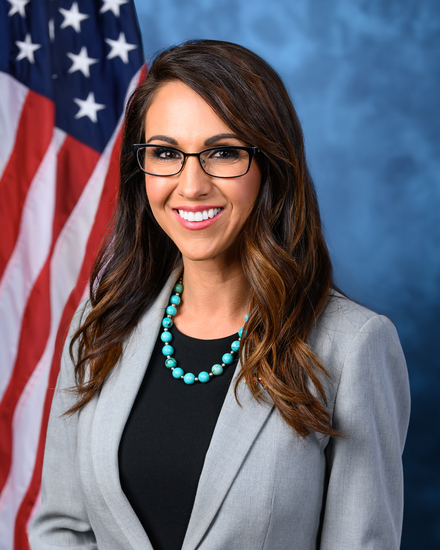
Photo of Lauren Boebert
R United States House · District 4 · Colorado On the 2026 ballot

Rep. Lauren Boebert

Compare
Total votes
2,818
all sessions
Attendance
96%
118 missed
Near the chamber average
With party
82%
of cast votes
Lower than 95% of chamber peers
Bipartisan score
9%
crosses aisle rarely
Higher than 94% of chamber peers
Sponsored
1,019
bills & resolutions
Near the chamber average
Committees
7
assignments
1,019 bills and resolutions

Sponsored bills

Total
1,019
Primary
88
Co-sponsor
931
This page
1,019
matching current filters
Co-sponsor HR 5891
In committee · Utah House · Co-sponsor
Withhold Member Pay During Shutdowns Act

Maddy summaryThis bill requires that U.S. Representatives and Senators have their pay withheld for each day a government shutdown occurs during their pay period. If a shutdown happens, Congress's payroll office would withhold an amount equal to one day's salary for each full day of the shutdown, either reducing the current pay or holding funds in a special account until after the November 2026 election (for shutdowns before that date). The law applies to all federal agency shutdowns and specifies that withheld funds must be released to members on the 2026 election date to comply with constitutional pay protections. It takes effect for shutdowns occurring after the 2026 election.

In committee Mar 18, 2026 1 co-sponsor
Co-sponsor HR 1422
Passed · Utah House · Co-sponsor
Enhanced Iran Sanctions Act of 2025

Enhanced Iran Sanctions Act of 2025 This bill imposes sanctions on certain foreign persons (individuals and entities) that are involved in Iran's petroleum sector as well as certain associated persons. The bill also requires or authorizes actions to facilitate the enforcement of sanctions on Iran. Specifically, the bill requires the President to impose visa- and property-blocking sanctions on any foreign person that, after the bill's enactment, knowingly engages in any transaction related to the processing, export, or sale of oil, condensates, gas, liquefied natural gas, or other petrochemical products in whole or in part from Iran. The President must also impose sanctions on certain foreign persons associated with a sanctioned individual or entity. For example, the President must sanction the subsidiaries and corporate officers of a sanctioned business. The bill provides certain exceptions to these sanctions, including specifying that sanctions do not apply to the importation of goods or to conducting or facilitating transactions for humanitarian assistance. The Department of State must establish an interagency working group that shall seek to establish a multilateral contact group to coordinate international efforts to enforce sanctions on Iran. The bill expands the State Department rewards program to authorize a reward payment to any individual who furnishes information leading to the identification of a person (1) subject to sanctions under this bill, or (2) that has attempted or is attempting to evade sanctions under this bill.

Passed Mar 17, 2026 1 co-sponsor
Co-sponsor HR 7925
In committee · Utah House · Co-sponsor
American Families First Assistance Act

Maddy summaryThis bill, titled the American Families First Assistance Act, would restrict eligibility for Temporary Assistance for Needy Families (TANF) benefits for most aliens in the United States. It directly affects non-citizen immigrants by removing their ability to receive federal cash assistance for low-income families under the existing welfare program. The key provision amends the Personal Responsibility and Work Opportunity Reconciliation Act of 1996 to disqualify qualified aliens from TANF block grants, with specific exceptions for certain categories of immigrants including nationals of Cuba. This change would limit access to financial support for families with children who are not U.S. citizens or lawful permanent residents.

In committee Mar 12, 2026 1 co-sponsor
Co-sponsor HR 7880
In committee · Utah House · Co-sponsor
Interstate Milk Freedom Act of 2026

Maddy summaryThis bill, titled the Interstate Milk Freedom Act of 2026, would prevent federal agencies from blocking the sale of unpasteurized milk and milk products across state lines. It allows such products to be shipped interstate if they are packaged for direct human consumption, produced in a state that permits their sale, and intended for another state that also allows their distribution. The legislation defines specific terms like "cowshare" to include ownership interests in dairy animals and clarifies what constitutes pasteurization. Importantly, the bill does not override state laws and only restricts federal interference when the product meets the stated conditions.

In committee Mar 9, 2026 1 co-sponsor
Primary HR 7817
In committee · Utah House · Lead sponsor
No Federal Tax Dollars for Illegal Aliens Health Insurance Act of 2026

Maddy summaryThis bill, titled the No Federal Tax Dollars for Illegal Aliens Health Insurance Act of 2026, amends the Affordable Care Act to restrict the use of federal taxpayer funds for health insurance coverage. It directly affects states that receive funding under the ACA and individuals seeking health insurance coverage through federal programs. The key provision prohibits states from using pass-through funding to pay for health insurance or related benefits for individuals who are not U.S. citizens, nationals, or lawfully present aliens. Additionally, the bill requires the Secretary of Health and Human Services to rescind any existing waivers that would have allowed such funding for unauthorized individuals had the new restrictions been in place at the time of approval.

In committee Mar 5, 2026 0 co-sponsors
Co-sponsor HR 7678
In committee · Utah House · Co-sponsor
Gun Owner Registration Information Protection Act

Maddy summaryHR 7678, the Gun Owner Registration Information Protection Act, prohibits federal funding for state or local databases that track lawfully owned firearms or their owners. The bill allows federal funding for databases recording lost or stolen firearms but bans it for databases listing legal gun ownership. This means states cannot use federal money to create or maintain systems that compile information about legally owned guns. The bill directly affects state and local governments that rely on federal funds for firearm ownership databases.

In committee Feb 25, 2026 1 co-sponsor
Co-sponsor HR 2189
Passed · Utah House · Co-sponsor
To modernize Federal firearms laws to account for advancements in technology and less-than-lethal weapons, and for other purposes.

Law-Enforcement Innovate to De-Escalate Act This bill removes less-than-lethal projectile devices (e.g., certain TASERs) from regulation under the Gun Control Act. The term less-than-lethal projectile device means a device that (1) is not designed or intended to expel (and may not be readily converted to discharge) commonly used ammunition or projectiles exceeding a velocity of 500 feet per second; (2) is designed and intended to be used in a manner not likely to cause death or serious bodily injury; and (3) does not accept (and cannot be readily modified to accept) an ammunition feeding device. The bill also requires the Bureau of Alcohol, Tobacco, Firearms and Explosives to determine whether a device satisfies the definition of a less-than-lethal projectile device within 90 days of a request.

Passed Feb 24, 2026 1 co-sponsor
Primary HR 7604
In committee · Utah House · Lead sponsor
Contracting America First Act

Maddy summaryThis bill prohibits U.S. federal agencies from entering into, renewing, or extending contracts for "covered software systems" with internationally owned software companies. It directly affects federal agencies (which must comply) and internationally owned software companies (which are barred from these contracts). Agencies must require contractors to certify under penalty of perjury that they are not internationally owned, with limited national security waivers allowed. "Covered software systems" include those storing sensitive personal information (like Social Security numbers or medical records) for 500+ federal employees. The law requires updating federal contracting rules within 180 days to implement these changes.

In committee Feb 20, 2026 0 co-sponsors
Co-sponsor HR 7601
In committee · Utah House · Co-sponsor
No Immunity for Glyphosate Act

Maddy summaryHR 7601, the "No Immunity for Glyphosate Act," removes legal protections for manufacturers of glyphosate-based herbicides and elemental phosphorus products. It allows individuals harmed by exposure to these chemicals - through physical injury, illness, disease, or death - to file civil lawsuits against manufacturers, distributors, or sellers in federal court, without requiring proof of fault. The bill explicitly blocks manufacturers from using the "Federal contractor defense" (claiming compliance with government orders) as a shield from liability and preserves all existing lawsuits filed under federal or state law. It does not change the use of these chemicals but ensures victims can seek compensation through courts for damages, including medical costs, lost wages, and punitive damages.

In committee Feb 20, 2026 1 co-sponsor
Co-sponsor HR 260
Passed · Utah House · Co-sponsor
No Tax Dollars for Terrorists Act

Maddy summaryThe No Tax Dollars for Terrorists Act requires the U.S. State Department to identify foreign countries and organizations receiving U.S. foreign aid that have provided financial or material support to the Taliban, including the amounts of aid they receive and the support they give to the Taliban. It mandates a strategy to use U.S. aid to discourage such support, with initial and follow-up reports to Congress on the strategy and its implementation. The bill also demands detailed reports on U.S. cash assistance programs in Afghanistan and the Afghan Fund, explaining how funds are transferred (including traditional money transfer systems) and how safeguards prevent Taliban access.

Passed Feb 10, 2026 1 co-sponsor
Showing 71 to 80 of 1,019 bills
Previous 1 7 8 9 102 Next