

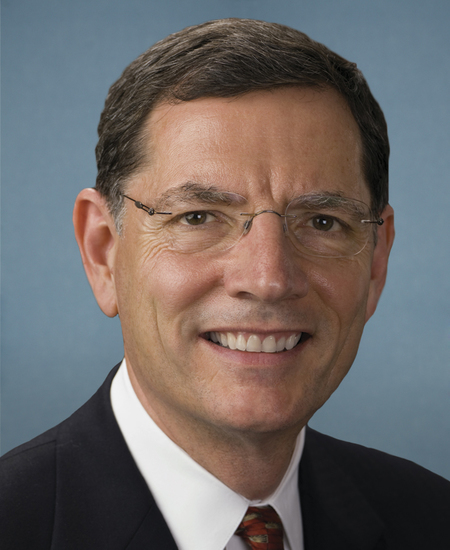
Photo of John Barrasso
R United States Senate · Wyoming

Sen. John Barrasso

Compare
Total votes
1,044
all sessions
Attendance
94%
61 missed
Higher than 92% of chamber peers
With party
96%
of cast votes
Higher than 78% of chamber peers
Bipartisan score
2%
crosses aisle rarely
Lower than 80% of chamber peers
Sponsored
1,036
bills & resolutions
Near the chamber average
Committees
13
assignments
1,036 bills and resolutions

Sponsored bills

Total
1,036
Primary
171
Co-sponsor
865
This page
1,036
matching current filters
Co-sponsor S 415
In committee · United States Senate · Co-sponsor
Food and Energy Security Act

Maddy summaryThis bill requires federal financial regulators (like the Federal Reserve or SEC) to analyze how new rules would affect food, electricity, and fuel prices before implementing them. Specifically, it mandates that regulators provide detailed, multi-year price impact estimates - broken down by Consumer Price Index categories - when proposing rules affecting agricultural or energy supply chain businesses. Regulators cannot adopt such rules if the analysis shows price increases, unless the annual Consumer Price Index growth is below 4.5%. The law directly affects businesses in food/energy supply chains and the federal agencies that write financial regulations.

In committee Feb 14, 2023 1 co-sponsor
Co-sponsor SJRES 7
In committee · United States Senate · Co-sponsor
A joint resolution providing for congressional disapproval under chapter 8 of title 5, United States Code, of the rule submitted by the Department of the Army, Corps of Engineers, Department of Defense and the Environmental Protection Agency relating to "Revised Definition of 'Waters of the United States'".

Maddy summaryThis joint resolution (SJRES 7) seeks congressional disapproval of a 2023 rule defining "Waters of the United States" (WOTUS), which would have changed how federal agencies regulate wetlands and waterways. It targets a rule jointly issued by the Army Corps of Engineers, EPA, and other agencies (88 Fed. Reg. 3004, Jan. 18, 2023), directly affecting landowners, developers, and environmental regulators by altering jurisdiction over water resources. If passed, the resolution would nullify the rule under a specific disapproval process in Title 5 of U.S. Code, preventing it from taking effect. The resolution does not create new regulations but aims to block an existing federal rule. This is a procedural step, not a new law.

In committee Feb 13, 2023 1 co-sponsor
Co-sponsor SJRES 13
In committee · United States Senate · Co-sponsor
A joint resolution proposing an amendment to the Constitution of the United States relative to balancing the budget.

Maddy summaryThis proposed constitutional amendment (SJRES 13) would require the federal government to balance its annual budget, meaning spending could not exceed revenue unless Congress passes a specific exception with a two-thirds vote. It also sets a limit of 18% of GDP for total government spending, with similar supermajority requirements to exceed this cap. The bill would mandate the President to submit a balanced budget proposal to Congress each year and require a two-thirds vote for tax increases or debt limit hikes. As a proposed amendment, it would only take effect if ratified by three-fourths of state legislatures.

In committee Feb 9, 2023 1 co-sponsor
Co-sponsor SJRES 12
In committee · United States Senate · Co-sponsor
A joint resolution disapproving the action of the District of Columbia Council in approving the Revised Criminal Code Act of 2022.

Maddy summaryThis joint resolution (SJRES 12) seeks congressional disapproval of the District of Columbia Council’s approval of the Revised Criminal Code Act of 2022 (D.C. Act 24-789). It directly affects D.C. residents and local government, as the resolution targets the District’s newly enacted criminal code. The mechanism is a formal congressional disapproval under the District of Columbia Home Rule Act, requiring passage by both chambers to block the D.C. law from taking effect. The resolution does not alter the D.C. code itself but aims to halt its implementation through federal action.

In committee Feb 9, 2023 1 co-sponsor
Co-sponsor SRES 45
In committee · United States Senate · Co-sponsor
A resolution expressing the sense of the Senate that the current influx of migrants is causing a crisis at the southern border.

Maddy summarySRES 45 is a non-binding Senate resolution introduced on February 9, 2023, by a group of senators expressing the Senate's view that the current migration levels at the U.S. southern border constitute a crisis. This resolution does not create new laws or policies, nor does it directly affect any individuals or groups - it serves solely as a symbolic statement of the Senate's position. It contains no concrete policy mechanisms or implementation plans, as resolutions of "sense" are typically used for expressing opinions rather than enacting change. The resolution was referred to the Senate Judiciary Committee but has no legal effect.

In committee Feb 9, 2023 1 co-sponsor
Co-sponsor S 312
In committee · United States Senate · Co-sponsor
Outpatient Surgery Quality and Access Act of 2023

Maddy summaryThis bill updates Medicare payment rules for outpatient surgery centers to improve quality transparency and patient affordability. It requires Medicare to publish side-by-side quality comparisons for surgery centers and hospitals on Medicare.gov, and limits patient copayments for these services to the inpatient hospital deductible amount. The bill also mandates that Medicare explain in writing why certain surgical procedures are excluded from coverage, citing specific federal criteria. These changes directly affect Medicare beneficiaries receiving outpatient surgeries and the surgery centers providing those services.

In committee Feb 9, 2023 1 co-sponsor
Co-sponsor S 348
In committee · United States Senate · Co-sponsor
Asylum Abuse Reduction Act

Maddy summaryThis bill changes asylum procedures for people entering the U.S. from Mexico or Canada after traveling through other countries. It requires such individuals to first get an interview at a U.S. embassy in Mexico or Canada to prove they face credible fear of persecution or torture before being allowed to apply for asylum in the U.S. The bill also blocks asylum eligibility for those who transited through other nations without seeking protection there, unless they meet specific exceptions like being trafficked or traveling through countries without refugee treaties. Additionally, it creates criminal warrants for immigration violations and removes limits on detaining asylum seekers under the Flores agreement. These changes primarily affect asylum seekers crossing the southern border after traveling through other countries.

In committee Feb 9, 2023 1 co-sponsor
Co-sponsor S 378
In committee · United States Senate · Co-sponsor
Protect Camp Lejeune VETS Act

Maddy summaryThis bill limits attorneys' fees for claims related to water contamination at Camp Lejeune, North Carolina, affecting veterans, civilians, and their attorneys filing under the Camp Lejeune Justice Act. It caps fees at 12% of administrative claim payments or 17% of court settlements/judgments, prohibits additional fees/costs, and requires attorneys to certify fee amounts. The bill also mandates annual reporting to Congress on all fees paid, including attorney names and amounts. These changes apply to all pending and future claims under the Camp Lejeune Justice Act.

In committee Feb 9, 2023 1 co-sponsor
Co-sponsor S 332
In committee · United States Senate · Co-sponsor
WALL Act of 2023

WALL Act of 2023 This bill appropriates $25 billion for the construction of a wall on the U.S.-Mexico border and addresses other issues related to immigration. As offsets to this spending, the bill restricts the child tax credit, earned income credits, and lifetime learning credits to those with Social Security numbers and not prohibited from employment in the United States. Also, individuals who file taxes using an individual taxpayer identification number (ITIN) instead of a Social Security number must pay a fee ($300 for each individual on the tax return using an ITIN). The bill restricts eligibility for certain federally-funded benefits, including unemployment compensation, supplemental nutrition assistance, and housing benefits, to those eligible to work in the United States. Agencies administering such benefits must use the E-Verify program to confirm the eligibility of applicants for such benefits. This bill also sets fines for non-U.S. nationals ( aliens under federal law) who improperly enter the United States or overstay their visas.

In committee Feb 9, 2023 1 co-sponsor
Co-sponsor S 319
In committee · United States Senate · Co-sponsor
POWER Act

Maddy summaryThis bill prohibits the President from blocking or delaying new oil, gas, coal, or mineral leases on federal lands (including national forests, public lands, and the outer continental shelf) without explicit congressional approval. It specifically prevents the President from imposing moratoria on new energy leases or withdrawing federal lands from energy development without an act of Congress. The law applies directly to federal land management decisions, requiring Congress to authorize any action that would restrict energy leasing or development on these lands. This is a procedural change affecting how federal energy leasing and land use decisions are made.

In committee Feb 9, 2023 1 co-sponsor
Showing 661 to 670 of 1,036 bills
Previous 1 … 66 67 68 … 104 Next