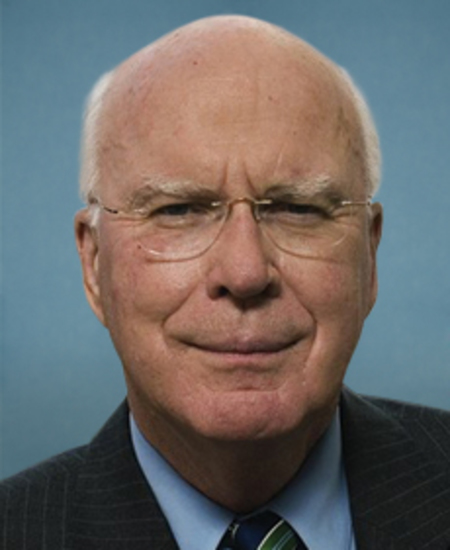
Photo of Patrick J. Leahy
D United States Senate · Vermont

Sen. Patrick J. Leahy

Compare
Total votes
380
all sessions
Attendance
96%
15 missed
Lower than 85% of chamber peers
With party
99%
of cast votes
Higher than 92% of chamber peers
Bipartisan score
1%
crosses aisle rarely
Lower than 91% of chamber peers
Sponsored
366
bills & resolutions
Near the chamber average
Committees
0
assignments
366 bills and resolutions

Sponsored bills

Total
366
Primary
28
Co-sponsor
338
This page
366
matching current filters
Co-sponsor S 2023
In committee · United States Senate · Co-sponsor
Relief for America's Small Farmers Act

Relief for America's Small Farmers Act This bill provides loan forgiveness of up to $250,000 for certain borrowers who are actively engaged in farming, have an average annual adjusted gross income of $300,000 or less over the previous five years, and have certain Department of Agriculture farm loans. The loan forgiveness is subject to the condition that the applicable borrower must continue to be actively engaged in farming for at least two years after receiving such forgiveness. The bill provides emergency funding for loan forgiveness.

In committee Jun 10, 2021 1 co-sponsor
Co-sponsor S 2014
In committee · United States Senate · Co-sponsor
Refund Equality Act of 2021

Refund Equality Act of  2021 This bill permits legally married same sex couples to amend their tax returns to file as married filing jointly for returns outside of the statute of limitations.

In committee Jun 10, 2021 1 co-sponsor
Co-sponsor S 2005
In committee · United States Senate · Co-sponsor
Hunger-Free Summer for Kids Act of 2021

Hunger-Free Summer for Kids Act of 2021 This bill revises the Summer Food Service Program to direct the Department of Agriculture to permanently establish electronic benefit transfer (EBT) cards and off-site consumption as two alternative delivery options for certain children through schools and service institutions in the program. These options shall be available to a child only if (1) the child lives or attends school in a rural area or outside of an area in which poor economic conditions exist, and (2) the child is eligible for a free or reduced price lunch and breakfast. In the case of off-site consumption, the option is also available if the summer program is available to the child at a congregate feeding site but (1) the site is closed due to extreme weather conditions, (2) violence or other public safety concerns in the area prevent the child from traveling safely to the site, (3) the site is open not more than four days a week, or (4) the site provides only one meal per day. A state may not operate the EBT card option and the off-site consumption option simultaneously in the same area. Each state desiring to participate in the summer food service program shall include in its annual management and administration plan the state's plans for using one or both of these alternative delivery options.

In committee Jun 10, 2021 1 co-sponsor
Co-sponsor S 2037
In committee · United States Senate · Co-sponsor
Protecting Access to Ground Ambulance Medical Services Act of 2021

Protecting Access to Ground Ambulance Medical Services Act of 2021 This bill modifies Medicare payment of ground ambulance services in rural areas. Specifically, the bill extends the specialized rate increase for such services for an additional five years (until January 1, 2028). The bill also requires the Centers for Medicare & Medicaid Services to (1) allow an area that has 1,000 or fewer individuals per square mile to retain its status as a rural area even if it would otherwise no longer qualify, and (2) establish an appeals process for providers to seek reconsideration of a change in an area's status.

In committee Jun 10, 2021 1 co-sponsor
Co-sponsor S 2032
In committee · United States Senate · Co-sponsor
Afghan Allies Protection Act of 2021

Afghan Allies Protection Act of 2021 This bill modifies a program providing special immigrant visas to eligible citizens or nationals of Afghanistan who assisted U.S. efforts there and addresses related issues. The bill extends the program through 2023 and increases the number of visas available. An individual may become eligible for a visa after assisting U.S. efforts in Afghanistan for one year, whereas currently some individuals must have served for two years. Furthermore, for an applicant qualifying for a visa by performing duties with a NATO mission in Afghanistan, the bill eliminates a requirement that the duties performed qualify as sensitive and trusted duties. The bill removes a requirement that the individual has experienced or is facing an ongoing serious threat due to their assistance to the United States or NATO. The Department of State or the Department of Homeland Security may postpone the program's medical examination requirement. An individual who received a postponement must undergo a medical exam within 90 days of admission into the United States. The bill also expands surviving family member benefits for the Afghanistan program (and a similar program for Iraq) to a surviving spouse or child of an individual who submitted an application to the Chief of Mission that would have been approved but for the individual's death. Currently, such survivor benefits only apply if the deceased individual's petition was approved.

In committee Jun 10, 2021 1 co-sponsor
Co-sponsor S 1996
In committee · United States Senate · Co-sponsor
Greater Leadership Overseas for the Benefit of Equality Act of 2021

Greater Leadership Overseas for the Benefit of Equality Act of 2021 or the GLOBE Act of 2021 This bill contains provisions related to (1) the protection of LGBTQI individuals globally; and (2) immigration protections for vulnerable individuals. The bill establishes (1) an interagency group to respond to urgent threats to LGBTQI people in foreign countries, and (2) a permanent Special Envoy for the Human Rights of LGBTQI Peoples in the Department of State. The President shall impose visa-blocking sanctions on foreign persons responsible for violating the human rights of individuals based on sexual orientation, gender identity, or sex characteristics. The State Department shall establish the Global Equality Fund to provide assistance to nongovernmental organizations working to advance and protect human rights. The U.S. Agency for International Development shall establish the LGBTQI Global Development Partnership to work with the private sector and nongovernmental organizations to support LGBTQI rights. The bill contains several immigration-related provisions, such as those  establishing that persecution based on sexual orientation or gender identity may form the basis of an asylum request, allowing certain applicants to file asylum claims more than a year after their arrival in the United States, including a permanent partnership between two partners as a marriage for immigration law purposes, providing for free counsel in certain immigration proceedings, and granting U.S. citizenship to a child born abroad through assistive reproductive technology from a U.S. citizen who is the child's nonbiological parent.

In committee Jun 9, 2021 1 co-sponsor
Co-sponsor SRES 261
In committee · United States Senate · Co-sponsor
A resolution recognizing June 2021 as "LGBTQ Pride Month".

This resolution expresses support for the rights, freedoms, and equal treatment of lesbian, gay, bisexual, transgender, and queer (LGBTQ) individuals. The resolution r ecognizes that LGBTQ rights are human rights and protected by the laws of the United States and international treaties. Additionally, the resolution encourages the celebration of LGBTQ Pride Month in June.

In committee Jun 8, 2021 1 co-sponsor
Co-sponsor S 1975
In committee · United States Senate · Co-sponsor
Women’s Health Protection Act of 2021

Women's Health Protection Act of 2021 This bill prohibits governmental restrictions on the provision of, and access to, abortion services. Specifically, governments may not limit a provider's ability to prescribe certain drugs, offer abortion services via telemedicine, or immediately provide abortion services when the provider determines a delay risks the patient's health. Furthermore, governments may not require a provider to perform unnecessary medical procedures, provide medically inaccurate information, comply with credentialing or other conditions that do not apply to providers whose services are medically comparable to abortions, or carry out all services connected to an abortion. In addition, governments may not (1) require patients to make medically unnecessary in-person visits before receiving abortion services or disclose their reasons for obtaining such services, or (2) prohibit abortion services before fetal viability or after fetal viability when a provider determines the pregnancy risks the patient's life or health. The bill also prohibits other governmental measures that are similar to the bill's specified restrictions or that otherwise single out and impede access to abortion services, unless a government demonstrates that the measure significantly advances the safety of abortion services or health of patients and cannot be achieved through less restrictive means. The Department of Justice, individuals, or providers may bring a lawsuit to enforce this bill, and states are not immune from suits for violations. The bill applies to restrictions imposed both prior and subsequent to the bill's enactment.


In committee Jun 8, 2021 1 co-sponsor
Co-sponsor S 1891
In committee · United States Senate · Co-sponsor
NO BAN Act

National Origin-Based Antidiscrimination for Nonimmigrants Act or the NO BAN Act This bill imposes limitations on the President's authority to suspend or restrict aliens from entering the United States. It also prohibits religious discrimination in various immigration-related decisions, such as whether to issue an immigrant or nonimmigrant visa, unless there is a statutory basis for such discrimination. The President may temporarily restrict the entry of any aliens or class of aliens after the Department of State determines that the restriction would address specific and credible facts that threaten U.S. interests such as security or public safety. The bill also imposes limitations on such restrictions, such as requiring the President, State Department, and the Department of Homeland Security (DHS) to (1) only issue a restriction when required to address a compelling government interest, and (2) narrowly tailor the suspension to use the least restrictive means to achieve such an interest. Before imposing a restriction, the State Department and DHS shall consult with Congress. The State Department and DHS shall report to Congress about the restriction within 48 hours of the restriction's imposition. If such a report is not made, the restriction shall immediately terminate. Individuals or entities present in the United States and unlawfully harmed by such a restriction may sue in federal court. DHS may suspend the entry of aliens traveling to the United States on a commercial airline that failed to comply with regulations related to detecting fraudulent travel documents.

In committee May 27, 2021 1 co-sponsor
Showing 211 to 220 of 366 bills
Previous 1 … 21 22 23 … 37 Next