

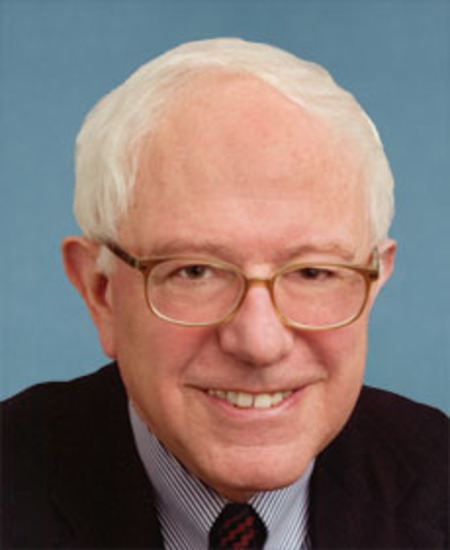
Photo of Bernard Sanders
I United States Senate · Vermont

Sen. Bernard Sanders

Compare
Total votes
1,044
all sessions
Attendance
98%
21 missed
Near the chamber average
With party
-
no party-line votes scored
Bipartisan score
-
no party-line votes scored
Sponsored
1,562
bills & resolutions
Higher than 77% of chamber peers
Committees
14
assignments
1,562 bills and resolutions

Sponsored bills

Total
1,562
Primary
142
Co-sponsor
1,420
This page
1,562
matching current filters
Co-sponsor SJRES 54
In committee · United States Senate · Co-sponsor
A joint resolution providing for congressional disapproval of the proposed foreign military sale to the Government of the United Arab Emirates of certain defense articles and services.

Maddy summaryThis joint resolution (SJRES 54) seeks to block a specific proposed U.S. military sale to the United Arab Emirates government. It targets a $1.2 billion deal involving defense articles and services, including 6 CH-47F Chinook helicopters, missile warning systems, communication equipment, and related support services. The resolution would prohibit the sale under the Arms Export Control Act, requiring congressional disapproval before the transaction can proceed. This directly affects the UAE government as the intended recipient and the U.S. government as the seller.

In committee Jun 11, 2025 1 co-sponsor
Co-sponsor SJRES 53
In committee · United States Senate · Co-sponsor
A joint resolution providing for congressional disapproval of the proposed foreign military sale to the Government of Qatar of certain defense articles and services.

Maddy summaryThis joint resolution (SJRES 53) would block a specific proposed U.S. foreign military sale to Qatar. It targets defense articles and services detailed in Transmittal No. 25-16, including 8 MQ-9B drones, missiles (like AGM-114R2 Hellfire II), radar systems, communication equipment, and related support services. The resolution directly affects Qatar's government, which sought this military package. If passed, it would prohibit the sale under congressional disapproval authority granted by the Arms Export Control Act.

In committee Jun 11, 2025 1 co-sponsor
Co-sponsor S 2035
In committee · United States Senate · Co-sponsor
Protect IVF Act

Maddy summaryS 2035, the "Protect IVF Act," establishes federal rights to access and provide fertility treatment, including IVF, under widely accepted medical standards defined by the American Society for Reproductive Medicine. It directly affects patients seeking fertility care, health care providers offering IVF services, health insurance issuers covering such care, and manufacturers of fertility-related drugs or devices. The bill preempts state laws that restrict IVF access in ways inconsistent with medical standards - such as mandating unnecessary procedures, limiting telemedicine, or imposing discriminatory barriers - and allows federal court enforcement against violating state actions. This focuses on protecting existing access rather than creating new benefits or altering insurance coverage requirements.

In committee Jun 11, 2025 1 co-sponsor
Co-sponsor S 2006
In committee · United States Senate · Co-sponsor
Fit to Serve Act

Maddy summaryS 2006, the Fit to Serve Act, prohibits the U.S. military from discriminating against service members or applicants based on gender identity. It directly affects all current and prospective members of the Armed Forces by banning specific discriminatory actions, including denying medically necessary health care, requiring service in a sex assigned at birth, or separating members due to gender identity (including gender dysphoria diagnosis). The bill amends Title 10 of the U.S. Code to add new protections, explicitly stating that the military cannot deny service, reenlistment, or health coverage based on gender identity. These changes apply uniformly across all branches and service statuses, ensuring equal treatment under military policy.

In committee Jun 10, 2025 1 co-sponsor
Co-sponsor S 1994
In committee · United States Senate · Co-sponsor
Protecting Community Television Act

Maddy summaryThis bill amends the Communications Act to clarify that "franchise fee" means only monetary assessments paid to local authorities for cable or community television services. It removes the word "includes" and adds "other monetary" before "assessment" in the definition. This technical change ensures franchise fees are strictly defined as cash payments, not other types of fees or non-monetary obligations. It directly affects cable operators and local governments that collect these fees under existing law. The bill makes no new policy changes but refines the legal definition for clarity.

In committee Jun 9, 2025 1 co-sponsor
Co-sponsor S 1984
In committee · United States Senate · Co-sponsor
Striking and Locked Out Workers Healthcare Protection Act

Maddy summaryThis bill prevents employers from dropping health insurance coverage for workers during strikes or lockouts. It amends the National Labor Relations Act to prohibit employers from terminating group health plan coverage for employees who are either locked out (during bargaining disputes) or participating in a lawful strike. Employers who violate this rule face civil penalties of up to $75,000 per violation for lockout-related actions (doubling to $150,000 for repeat offenses) or $50,000 for strike-related actions (doubling to $100,000 for repeat offenses). The law directly affects workers engaged in strikes or locked out by employers, ensuring their healthcare coverage continues during these labor disputes.

In committee Jun 5, 2025 1 co-sponsor
Co-sponsor S 1955
In committee · United States Senate · Co-sponsor
Equal Access to Justice for Victims of Gun Violence Act

Maddy summaryThis bill repeals key protections in the Protection of Lawful Commerce in Arms Act that shielded gun manufacturers from civil lawsuits. It allows victims of gun violence to use federal gun trace data (from the Firearms Trace System database) as evidence in civil court cases against gun sellers or manufacturers. The law makes this trace information discoverable, admissible, and usable in any civil action in state or federal courts, including the District of Columbia. This change directly affects victims seeking legal recourse and gun industry entities previously protected by the repealed law.

In committee Jun 4, 2025 1 co-sponsor
Co-sponsor S 1957
In committee · United States Senate · Co-sponsor
No Place for LGBTQ+ Hate Act

Maddy summaryS 1957, the "No Place for LGBTQ+ Hate Act," repeals five specific executive orders that the bill identifies as harming LGBTQI+ rights. It prohibits federal funding for implementing or enforcing those orders, which include policies restricting transgender healthcare, military service, school sports participation, and requiring schools to deny transgender identities. The bill directly affects LGBTQI+ individuals by reversing discriminatory executive actions in key areas like employment, education, healthcare, and military service. It does not create new policies but formally nullifies existing executive actions through legislative repeal and funding restrictions.

In committee Jun 4, 2025 1 co-sponsor
Co-sponsor SRES 255
Passed · United States Senate · Co-sponsor
A resolution honoring the life, achievements, and legacy of former United States Senator Christopher "Kit" Bond of Missouri.

Maddy summaryThis resolution (SRES 255) is a ceremonial Senate measure honoring former U.S. Senator Christopher "Kit" Bond of Missouri, who died on May 13, 2025. It recognizes his 40+ years of public service, including his roles as Missouri Governor (1973-1977, 1981-1985) and U.S. Senator (1987-2011). The resolution directs the Senate to adjourn briefly as a mark of respect and transmit a copy to his family. It has no policy impact or direct effect on constituents, as it is purely commemorative.

Passed May 22, 2025 1 co-sponsor
Co-sponsor S 1881
In committee · United States Senate · Co-sponsor
Public Service Worker Protection Act

Maddy summaryThis bill expands workplace safety protections under the Occupational Safety and Health Act to cover public employees, including those working for federal, state, or local government agencies. It amends the law to explicitly include "the United States, a State, or a political subdivision of a State" in the definition of covered workers, removing previous exclusions. The key provision requires all public workplaces to follow OSHA safety standards, with a 36-month transition period for states or localities without their own OSHA-approved plans. This directly affects government workers like teachers, police, and sanitation staff who were previously excluded from federal OSHA coverage.

In committee May 22, 2025 1 co-sponsor
Showing 351 to 360 of 1,562 bills
Previous 1 … 35 36 37 … 157 Next