

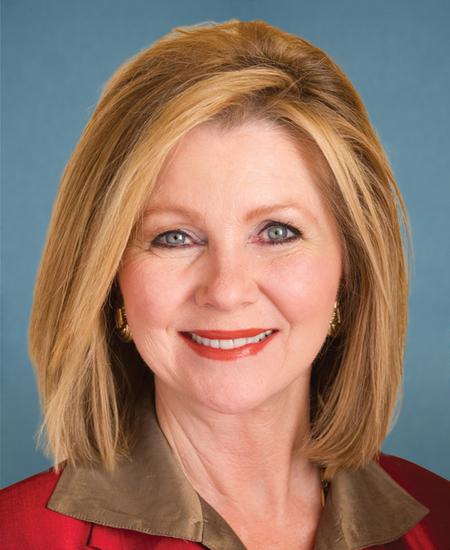
Photo of Marsha Blackburn
R United States Senate · Tennessee

Sen. Marsha Blackburn

Compare
Total votes
1,054
all sessions
Attendance
94%
65 missed
Lower than 96% of chamber peers
With party
94%
of cast votes
Higher than 83% of chamber peers
Bipartisan score
3%
crosses aisle rarely
Lower than 85% of chamber peers
Sponsored
1,896
bills & resolutions
Higher than 88% of chamber peers
Committees
15
assignments
1,896 bills and resolutions

Sponsored bills

Total
1,896
Primary
313
Co-sponsor
1,583
This page
1,896
matching current filters
Primary S 882
In committee · United States Senate · Lead sponsor
Patients Before Middlemen Act

Maddy summaryThe Patients Before Middlemen Act (S 882) improves pharmacy access for Medicare beneficiaries by requiring prescription drug plans to allow any pharmacy meeting standard contract terms to join their networks. It establishes "essential retail pharmacies" in medically underserved areas or regions with limited pharmacy access (such as rural areas with no other pharmacies within 10 miles), and creates standards for reasonable and relevant contract terms between drug plans and pharmacies. The bill also increases transparency requirements for pharmacy benefit managers, mandating detailed annual reports on drug costs, rebates, and pricing practices, with many provisions taking effect for plan years beginning January 1, 2028.

In committee Mar 6, 2025 0 co-sponsors
Co-sponsor S 832
In committee · United States Senate · Co-sponsor
EPIC Act of 2025

Maddy summaryThe EPIC Act of 2025 extends the required time period for negotiating drug prices under the federal program for biologic drugs. It changes the rule so that biologic drug manufacturers must wait at least 11 years after FDA approval before their drug can be included in price negotiations, starting with the 2028 initial price applicability year. This specifically affects biologic drug manufacturers, as the change applies only to biologics (not small-molecule drugs, which already have different rules). The bill modifies Section 1192(e)(1)(A)(ii) of the Social Security Act to implement this longer waiting period. This is a concrete policy change to the timing of drug price negotiations, not a new program or broader policy shift.

In committee Mar 4, 2025 1 co-sponsor
Co-sponsor S 371
In committee · United States Senate · Co-sponsor
SBA Disaster Transparency Act

Maddy summaryThe SBA Disaster Transparency Act (S 371) requires the Small Business Administration (SBA) to publish specific disaster assistance reports on its website. It amends existing law to mandate that the SBA "publish on the website of the Administration" reports related to disaster loans and assistance, which previously only needed to be submitted to Congress. This change directly affects the SBA by altering its reporting process and makes disaster aid data more accessible to the public without creating new programs or eligibility rules. The bill focuses solely on increasing transparency through online publication of existing reports.

In committee Mar 4, 2025 1 co-sponsor
Co-sponsor S 298
In committee · United States Senate · Co-sponsor
Returning SBA to Main Street Act

Maddy summaryThis bill requires the Small Business Administration (SBA) to relocate at least 30% of its Washington, D.C.-based headquarters employees to offices outside the Washington metropolitan area within one year of enactment. Employees moving must switch to local pay rates for their new location and can no longer work full-time remotely. The SBA must also reduce its Washington headquarters office space by 30% within two years. The bill mandates annual reports to Congress detailing employee locations, telework status, and compliance with these requirements.

In committee Mar 4, 2025 1 co-sponsor
Co-sponsor S 9
Introduced · United States Senate · Co-sponsor
Protection of Women and Girls in Sports Act of 2025

Maddy summaryThis bill amends federal education law to prohibit federally funded athletic programs from allowing individuals assigned male at birth to participate in sports designated for women or girls. It defines "sex" for this purpose as biological sex at birth, based on reproductive anatomy and genetics. The law directly affects schools, colleges, and sports organizations receiving federal funding. Violations would constitute a breach of Title IX, requiring programs to exclude individuals whose sex is male from women's or girls' athletic teams.

Introduced Mar 3, 2025 1 co-sponsor
Co-sponsor S 767
In committee · United States Senate · Co-sponsor
HIDTA Enhancement Act

Maddy summaryThe HIDTA Enhancement Act updates the High Intensity Drug Trafficking Area (HIDTA) program to prioritize fentanyl trafficking. It requires HIDTA programs to submit annual reports detailing fentanyl seizures, trafficking patterns, and law enforcement data, and increases annual funding to $333 million for fiscal years 2025-2030. The bill also directs the Attorney General to allocate additional prosecutorial resources, including temporarily reassigning U.S. attorneys to focus on fentanyl-related cases, to support investigations and prosecutions. This affects HIDTA programs, federal and local law enforcement, and the Office of National Drug Control Policy.

In committee Feb 27, 2025 1 co-sponsor
Primary S 762
In committee · United States Senate · Lead sponsor
No Immigration Benefits for Hamas Terrorists Act

Maddy summaryThis bill prohibits immigration benefits for individuals who participated in, planned, financed, or supported Hamas attacks against Israel beginning October 7, 2023. It amends U.S. immigration law to make such individuals inadmissible to the United States and ineligible for any immigration relief, including asylum or other protections. The law requires the Department of Homeland Security to annually report to Congress on how many people were denied entry or removed under these provisions. It directly affects aliens involved in specific Hamas attacks against Israel since October 7, 2023, and modifies existing immigration inadmissibility and relief standards.

In committee Feb 27, 2025 0 co-sponsors
Primary S 774
In committee · United States Senate · Lead sponsor
WHO is Accountable Act

Maddy summaryS 774, the "WHO is Accountable Act," prohibits U.S. federal funds from being used to seek U.S. membership in or contribute to the World Health Organization (WHO) until the Secretary of State certifies the WHO meets eight specific conditions. These conditions require the WHO to adopt reforms ensuring humanitarian aid isn't politicized, end perceived Chinese Communist Party influence, address pandemic response transparency, grant Taiwan observer status, stop diverting supplies to certain countries, improve transparency, cease funding for issues like gender-affirming care, climate change, and abortion access, and agree that WHO directives won't bind U.S. citizens. The bill directly affects all U.S. federal departments and agencies that manage funding for international organizations. This provision halts U.S. financial support to the WHO until these conditions are met, pending congressional certification.

In committee Feb 27, 2025 0 co-sponsors
Co-sponsor S 796
In committee · United States Senate · Co-sponsor
Book Minimum Tax Repeal Act

Maddy summaryS 796, the Book Minimum Tax Repeal Act, repeals a corporate minimum tax provision in the Internal Revenue Code that previously applied to certain businesses. The bill removes the requirement for corporations to pay a minimum tax based on their alternative minimum taxable income, effectively eliminating this specific tax obligation for affected corporations. Key provisions amend Section 55 of the tax code to delete corporate minimum tax calculations and related references, treating corporations as having a zero tentative minimum tax. This change directly affects corporations that would have been subject to this minimum tax, with the repeal taking effect for taxable years beginning after December 31, 2024.

In committee Feb 27, 2025 1 co-sponsor
Co-sponsor S 807
In committee · United States Senate · Co-sponsor
Guarding Readiness Resources Act

Maddy summaryS 807, the Guarding Readiness Resources Act, clarifies how the National Guard Bureau handles reimbursement funds from states and territories. It requires that money received from states (like California or Puerto Rico) for using military property must be returned to the specific account that covered the original costs or a similar account. These funds can only be used by the Department of Defense for repairing, maintaining, replacing, or similar upkeep of assets directly used by National Guard units during state duty. The bill directly affects the National Guard Bureau and state/territorial governments managing these reimbursements.

In committee Feb 27, 2025 1 co-sponsor
Showing 511 to 520 of 1,896 bills
Previous 1 … 51 52 53 … 190 Next