

VOCA Fix to Sustain the Crime Victims Fund Act of 2021 This bill adds a new source of revenue for the Crime Victims Fund and makes changes to formula grants supported by the fund. Specifically, the bill directs revenues collected from deferred prosecution and non-prosecution agreements to be deposited into the Crime Victims Fund. Currently, such revenues are deposited into the general fund of the Treasury. Additionally, the bill increases the percentage—from 60% to 75%—of state compensation payments to crime victims in the prior fiscal year used to calculate formula grants for state victim compensation programs. Finally, the bill directs states to waive the matching requirement for recipients of state victim assistance formula grants during and for one year after a pandemic-related national emergency. It also allows states to waive the matching requirement pursuant to a policy established by the state.
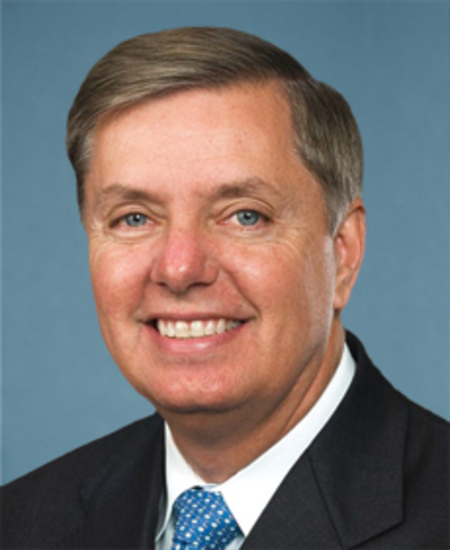
Sen. Lindsey Graham
Sponsored bills
Iran Sanctions Relief Review Act of 2021 This bill restricts the President's authority to unilaterally undertake certain actions with respect to Iran and increases congressional oversight of those actions. Specifically, the President must report to Congress before terminating or waiving sanctions related to Iran or taking a licensing action that significantly alters U.S. foreign policy with respect to Iran. Each report must (1) describe the proposed action and its rationale, and (2) indicate whether or not the action is intended to significantly alter foreign policy concerning Iran. If the intention is to alter that policy, the report must provide additional information about the policy objectives and anticipated effects of the action. After the President submits a report, the bill provides Congress with a 30-day period to review it; this period is extended to 60 days for reports submitted between July 10 and September 7. During this period, Congress may enact a joint resolution approving or disapproving the action. During the review period, the President may not take the action unless Congress passes a joint resolution of approval; if Congress enacts a joint resolution of disapproval, the bill prohibits the President from taking the action. The bill also outlines procedures for the introduction and consideration of these types of joint resolutions.
This resolution recognizes Black History Month as an opportunity to reflect on U.S. history and to commemorate the contributions of African Americans. It calls for the United States to (1) honor the contribution of pioneers who helped to ensure its legacy; and (2) move forward as a nation "indivisible, with liberty and justice for all."
Fair and Open Competition Act or the FOCA Act This bill prohibits federal construction contracts or controlling documents for federally supported construction projects from requiring or prohibiting project labor agreements. Such documents also may not discriminate against or give preference to a bidder or contractor who signs or refuses to sign a project labor agreement. An agency may exempt a project from this prohibition to avert an imminent threat to public health or safety or to serve the national security.
Traditional Cigar Manufacturing and Small Business Jobs Preservation Act of 2021 This bill exempts traditional large and premium cigars from Food and Drug Administration (FDA) regulation and FDA-assessed user fees.
National Right-to-Work Act This bill repeals those provisions of the National Labor Relations Act and the Railway Labor Act that permit employers to make an agreement with a labor union to require employees to join such union as a condition of employment. Currently, at least 27 states have enacted laws prohibiting employers from compelling employees to become members of a union as a condition of employment.
Libya Stabilization Act This bill provides for sanctions and aid related to the conflict in Libya. The bill provides statutory authority for an April 19, 2016, executive order imposing property- and visa-blocking sanctions on persons contributing to the violence in Libya. The President must impose property- and visa-blocking sanctions on any foreign person that (1) knowingly supports or engages in a significant transaction with a foreign person knowingly operating in Libya on behalf of Russia in a military capacity, (2) engages in significant actions threatening peace or stability in Libya, (3) misappropriates Libyan state assets or natural resources, or (4) is knowingly responsible for or complicit in serious human rights abuses in Libya. These sanctions shall expire on December 31, 2026. The bill authorizes the U.S. Agency for International Development to provide humanitarian assistance to individuals and communities in Libya, including health assistance, food, shelter, and support for an effective COVID-19 (i.e., coronavirus disease 2019) response. The Department of State must work to strengthen Libya's democratic governance, including by providing assistance to (1) unify Libya's financial and governing institutions, and (2) ensure free and credible future elections in Libya. The Department of the Treasury must vote and argue for international financial institutions to support an economic recovery in Libya that complements the establishment of democratic institutions and rule of law.
EAGLES Act of 2021 This bill reauthorizes the National Threat Assessment Center (NTAC) within the U.S. Secret Service. It reauthorizes the functions of NTAC through FY2025 and expands them to include the establishment of a national program on targeted school violence prevention.
This resolution recognizes Black History Month as an opportunity to reflect on U.S. history and to commemorate the contributions of African Americans. It calls for the United States to (1) honor the contribution of pioneers who helped to ensure its legacy; and (2) move forward as a nation "indivisible, with liberty and justice for all."
Dream Act of 2021 This bill directs the Department of Homeland Security (DHS) to cancel removal and grant lawful permanent resident status on a conditional basis to an alien who is inadmissible or deportable or is in temporary protected status who (1) has been continuously physically present in the United States for four years preceding this bill's enactment, (2) was younger than 18 years of age on the initial date of U.S. entry, (3) is not inadmissible on various grounds such as those related to crime or security, and (4) has fulfilled specified educational requirements. DHS shall cancel the removal of, and adjust to the status of an alien lawfully admitted for permanent residence on a conditional basis, an alien who was granted Deferred Action for Childhood Arrivals (DACA) status unless the alien has engaged in conduct that would make the alien ineligible for DACA. DHS shall remove the conditional basis of the permanent resident status granted under this bill if the alien meets various requirements, such as (1) maintaining residence in the United States, and (2) acquiring a degree from an institution of higher education or serving in the uniformed services. DHS may not disclose or use information provided in applications filed under this bill or in DACA requests for immigration enforcement purposes. The bill repeals a restriction barring states from providing higher education benefits to undocumented aliens unless those benefits are available to all U.S. citizens.