

Asset Seizure for Ukraine Reconstruction Act This bill authorizes the President to confiscate the property of certain foreign persons (i.e., individuals or entities) that derive wealth through political support for or corruption linked to Russian President Vladimir Putin. The President may also liquidate the confiscated property and use the resulting funds to provide assistance to Ukraine. Specifically, upon a declaration of a national emergency relating to Russia's invasion of Ukraine, the President may confiscate the property of such a person if (1) the property is valued at more than $2 million; and (2) the person is subject to U.S. sanctions relating to corruption, human rights violations, Russia's malign influence, or conflicts in Ukraine.
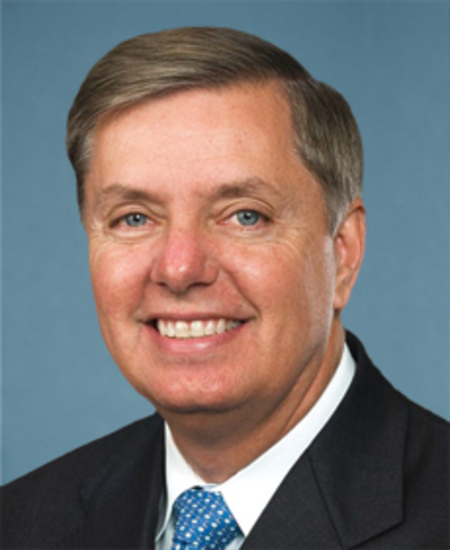
Sen. Lindsey Graham
Sponsored bills
"Six Triple Eight" Congressional Gold Medal Act of 2021 This bill provides for the award of a Congressional Gold Medal to the women of the 6888th Central Postal Directory Battalion (commonly known as the Six Triple Eight) in recognition of their pioneering military service, devotion to duty, and contributions to increase the morale of personnel stationed in the European theater of operations during World War II.
Ban Russian Energy Imports Act This bill declares that a national emergency exists with respect to the aggression of Russia against Ukraine. During this emergency, the President must prohibit the importation of crude oil, petroleum, petroleum products, liquefied natural gas, and coal in which Russia or a Russian national has any interest. The bill exempts products that are already loaded or in transit at the time of this bill's enactment.
This resolution strongly condemns the ongoing violence, war crimes, crimes against humanity, and systematic human rights abuses being carried out by Russia's military and its proxies at the direction of Russian President Vladimir Putin. It also encourages the U.S. government and partner nations to use their influence and vote in international organizations to hold those responsible for such crimes and abuses accountable.
American Innovation and Choice Online Act This bill prohibits certain large online platforms from engaging in specified acts, including giving preference to their own products on the platform, unfairly limiting the availability on the platform of competing products from another business, or discriminating in the application or enforcement of the platform's terms of service among similarly situated users. Further, a platform may not materially restrict or impede the capacity of a competing business user to access or interoperate with the same platform, operating system, or hardware or software features. The bill also restricts the platform's use of nonpublic data obtained from or generated on the platform and prohibits the platform from restricting access to platform data generated by the activity of a competing business user. The bill also provides additional restrictions related to installing or uninstalling software, search or ranking functionality, and retaliation for contact with law enforcement regarding actual or potential violations of law. The bill establishes affirmative defenses for the prohibited conduct. The Federal Trade Commission and the Department of Justice must designate whether an entity is a platform covered by the bill, and both must carry out enforcement activities. The bill also provides for civil penalties, injunctions, and the forfeit of profits for repeat offenders.
This resolution supports the designation of February 19-February 26, 2022, as National FFA Week. It also (1) recognizes the important role of the National FFA Organization (Future Farmers of America) in developing the next generation of leaders who will change the world, and (2) celebrates 70 years of the National FFA Organization's membership magazine.
Maddy summaryThis Senate resolution (SRES 526) formally condemns the antisemitic terrorist attack at Congregation Beth Israel Synagogue in Colleyville, Texas, on January 15, 2022, where hostages were held at gunpoint. It expresses gratitude that no lives were lost, applauds law enforcement and emergency responders for their actions, and condemns antisemitism in the United States. The resolution does not create new policies or allocate funds; it is a symbolic expression of support for the Jewish community and law enforcement. It directly affects the congregation and local community by affirming their safety and the importance of religious freedom.
This resolution recognizes Black History Month as an opportunity to reflect on U.S. history and to commemorate the contributions of African Americans. It calls for the United States to (1) honor the contribution of pioneers who helped to ensure its legacy; and (2) move forward as a nation "indivisible, with liberty and justice for all."
This resolution commends the courage, resolve, and restraint shown by the Ukrainian people in their pursuit of sovereignty and democracy and reaffirms unwavering U.S. support for a secure, democratic, and independent Ukraine. It also condemns Russia's attempted annexation of Crimea in 2014 and denounces Russia's military buildup of over 150,000 troops on Ukraine's border.
Open App Markets Act This bill establishes rules related to the operation of an app store by a covered company (i.e., the owner or controller of an app store with more than 50 million U.S. users). An app is a software application or electronic service that may be run or directed by a user on a computer or mobile device. An app store is a publicly available website, software application, or other electronic service that distributes apps from third-party developers to users. The bill prohibits a covered company from (1) requiring developers to use an in-app payment system owned or controlled by the company as a condition of distribution or accessibility, (2) requiring that pricing or conditions of sale be equal to or more favorable on its app store than another app store, or (3) taking punitive action against a developer for using or offering different pricing terms or conditions of sale through another in-app payment system or on another app store. A covered company may not interfere with legitimate business communications between developers and users, use non-public business information from a third-party app to compete with the app, or unreasonably prefer or rank its own apps (or those of its business partners) over other apps. The bill provides for enforcement of its provisions by the Federal Trade Commission and the Department of Justice, as well as through suits brought by developers that are injured by reason of anything prohibited by this bill.