Homicide Victims' Families' Rights Act of 2022 This bill establishes a framework for immediate family members of a victim of murder under federal law to request a review of the victim's case file if the murder was committed more than three years prior, the murder was investigated by a federal law enforcement entity, all probative investigative leads have been exhausted, and no likely perpetrator has been identified.
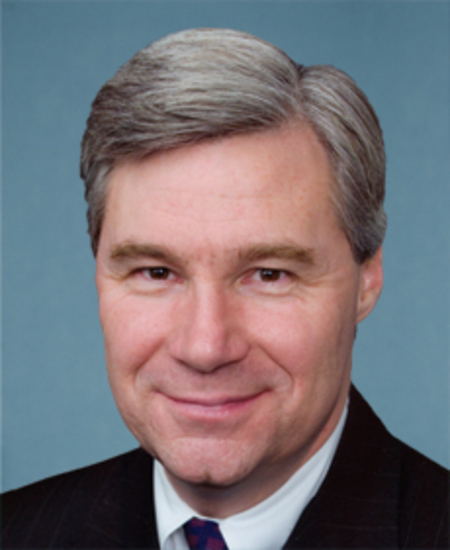
Sen. Sheldon Whitehouse
Sponsored bills
Respect for Marriage Act This bill provides statutory authority for same-sex and interracial marriages. Specifically, the bill repeals and replaces provisions that define, for purposes of federal law, marriage as between a man and a woman and spouse as a person of the opposite sex with provisions that recognize any marriage that is valid under state law. (The Supreme Court held that the current provisions were unconstitutional in United States v. Windsor in 2013.) The bill also repeals and replaces provisions that do not require states to recognize same-sex marriages from other states with provisions that prohibit the denial of full faith and credit or any right or claim relating to out-of-state marriages on the basis of sex, gender, race, ethnicity, or national origin. (The Supreme Court held that state laws barring same-sex marriages were unconstitutional in Obergefell v. Hodges in 2015; the Court held that state laws barring interracial marriages were unconstitutional in Loving v. Virginia in 1967.) The bill allows the Department of Justice to bring a civil action and establishes a private right of action for violations.
Expanding Access to Family Planning Act This bill provides, subject to specified conditions, funding through FY2032 for federally funded family planning services and clinics. In particular, the funds must be used for (1) grants and contracts that support the provision of family planning services, and (2) clinic infrastructure (e.g., construction and renovation of clinics). Clinics that receive funding to provide family planning services must offer each patient with a positive pregnancy test the opportunity for nondirective counseling on (1) prenatal care and delivery; (2) infant care, foster care, and adoption; and (3) pregnancy termination. This counseling must include referrals if requested by a patient. Additionally, if a funding recipient makes subawards for the provision of family planning services, the recipient may not prohibit an entity from participating in a subaward program for reasons other than the entity's inability to provide family planning services.
Democracy Is Strengthened by Casting Light On Spending in Elections Act of 2021 or the DISCLOSE Act of 2021 This bill addresses campaign finance, including by expanding the prohibition on campaign spending by foreign nationals, requiring additional disclosures of campaign expenditures, and requiring additional disclosures regarding certain political advertisements. First, the bill prohibits foreign nationals from participating in the decision-making process regarding an election expenditure. Additionally, the bill expands existing foreign money prohibitions to include disbursements for paid web-based or digital communications and federal judicial nomination communications. It also prohibits foreign nationals from contributing to campaigns related to ballot initiatives and referenda. The Federal Election Commission (FEC) must conduct an audit after each federal election cycle to determine the incidence of illicit foreign money. Next, the bill makes it unlawful to establish or use a corporation, company, or other entity with the intent to conceal an election contribution or donation by a foreign national. A violator is subject to criminal penalties—a fine, a prison term of up to five years, or both. Covered organizations (e.g., corporations, labor organizations, and political organizations) must, within 24 hours, file reports with the FEC to disclose campaign expenditures of more than $10,000 during an election cycle. Finally, the bill requires organizations to provide additional disclosures regarding political advertisements, including the donors who contributed the most money to that organization in the last year.

This joint resolution directs the President to remove U.S. Armed Forces from hostilities against the Houthis in Yemen within 30 days of the enactment of this joint resolution unless Congress authorizes a later withdrawal date, issues a declaration of war, or specifically authorizes the use of the Armed Forces. Prohibited activities include sharing intelligence or providing logistical support to enable offensive strikes by the coalition led by Saudi Arabia. This joint resolution shall not affect any military operations directed at Al Qaeda or forces associated with Al Qaeda.
This resolution recognizes the critical role the Equal Employment Opportunity Commission plays in addressing long-standing issues including the wage gap, combating workplace harassment, and ensuring all workers are treated with dignity and respect in the workplace.
Tax Filing Simplification Act of 2022 This bill directs the Internal Revenue Service (IRS) to establish a free on-line tax preparation and filing service and allows taxpayers to access third-party provided tax return information and information held by the IRS. The bill prohibits the IRS from entering into any agreement that restricts its legal right to provide tax return preparation services or to provide tax return filing services. The bill requires the IRS to establish and operate programs to (1) facilitate claims for the child care and the earned income tax credits, (2) provide software for the preparation and filing of individual income tax returns for taxable years beginning after 2022, (3) allow taxpayers to download third-party provided return information and IRS-held information to their tax returns, and (4) allow taxpayers to elect to have their tax returns prepared by the IRS. The bill also requires verification of taxpayer identity and requires the IRS to conduct an outreach campaign to provide the public with information about this bill's programs and software.
Freedom to Travel for Health Care Act of 2022 This bill prohibits anyone from interfering with a person's ability to access out-of-state reproductive health care. (Reproductive health care is defined as medical, surgical, counseling, or referral services related to pregnancy, the termination of a pregnancy, contraception services, and other reproductive care.) Specifically, the bill prohibits anyone from restricting, discriminating against, or otherwise disadvantaging anyone who receives, provides, or assists with out-of-state reproductive health care that is legal in the state in which it is provided. The bill allows the Department of Justice to bring a civil action and establishes a private right of action for violations. The bill specifically waives any applicable governmental immunity and preempts any contravening state laws.
Youth Voting Rights Act This bill expands voting access for youth. Specifically, the bill establishes a private right of action to enforce the Twenty-Sixth Amendment, which prohibits denying or abridging the right to vote based on age. Additionally, the bill directs each state to designate as voter registration agencies all offices within public institutions of higher education (IHEs) that provide assistance to students, implement a preregistration process to allow minors who are 16 years or older to register to vote in federal elections that take place when or after the preregistered individual turns age 18, and ensure the availability of polling places on campuses of IHEs (with the availability of waivers). The bill prohibits durational residency requirements for voting in all federal elections. Currently, this prohibition applies only to voting for the offices of President and Vice President. States and local jurisdictions with voter identification requirements must treat IHE-issued student identification cards as voter identification. The Election Assistance Commission (EAC) must make grants to states to increase the involvement of individuals under age 18 in public election activities. The Government Accountability Office must report to Congress on trends related to voter registration, absentee voting, and provisional voting. The EAC must also collect and make publicly available certain data from states.
Maddy summaryThe Senate resolution SRES 697 designates July 2022 as "Plastic Pollution Action Month" to raise awareness about plastic pollution. It encourages all individuals in the United States to reduce plastic use and participate in activities that decrease plastic waste, referencing existing initiatives like Plastics Free July. The resolution does not create new laws, funding, or mandates but serves as a symbolic recognition of the issue and a call for voluntary action. It highlights statistics on plastic waste (e.g., 17% of global plastic waste generated by the U.S.) to underscore the urgency. This is a non-binding awareness measure, not a policy change.