Maddy summarySRES 484 is a ceremonial Senate resolution honoring the late Senator John "Johnny" Isakson of Georgia. It formally recognizes his 40+ years of public service, including his roles in the Georgia legislature, U.S. House, and U.S. Senate, and his reputation for bipartisan cooperation. The resolution requests the Senate Secretary communicate it to the House and send a copy to Isakson's family. As a commemorative resolution, it has no policy impact or direct effect on any individuals or programs.
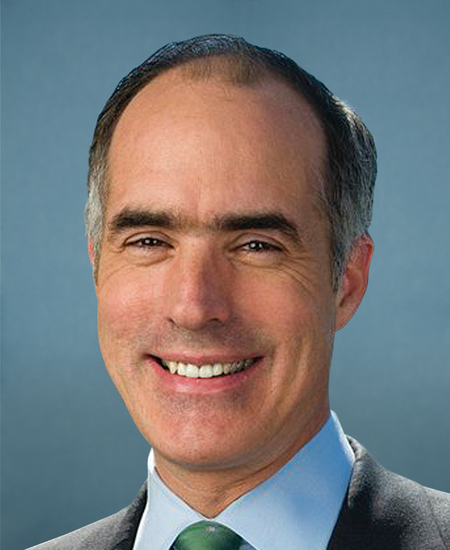
Sen. Robert P. Casey, Jr.
Sponsored bills
Abuse of the Pardon Prevention Act of 2022 This bill restricts the authority of the President with respect to presidential pardons, including by prohibiting the President from pardoning himself or herself and requiring the Department of Justice to conduct oversight and submit materials to Congress regarding certain pardons, such as those arising from an investigation in which the President is a target, subject, or witness.
Revitalizing the Aging Network Act This bill provides FY2022 funding to the Department of Health and Human Services for supportive services, nutrition programs, and other services for older adults.
This resolution requests that the Department of the Interior recognize the crash site of Roberto Clemente's airplane near Piñones in Loíza, Puerto Rico, and the adjacent land by adding the site to the National Register of Historic Places. Roberto Clemente was a renowned baseball player who played for the Pittsburg Pirates baseball team.
This resolution denounces the current Russian military buildup on the Ukraine border as provocative and contrary to established international norms. It also reaffirms the unwavering support of the United States for a secure, democratic, and independent Ukraine.
Comprehensive Addiction Resources Emergency Act of 2021 This bill establishes programs, grants, and other activities to address substance use disorders. Specifically, the Department of Health and Human Services (HHS) must establish a program for purchasing and distributing opioid overdose reversal drugs for states and Indian tribes. HHS must also award grants for and otherwise support addressing substance use, particularly in states, tribes, territories, and localities with disproportionately high drug overdose rates; increasing access to preventive, medical, recovery, and related services; developing innovative models of delivering treatment and harm reduction services; and expanding the treatment capacity of Medicaid providers. In addition, HHS must issue model standards of care for treatment services and recovery residences and may award grants for training health care professionals. The bill also supports prevention and treatment services for workers, addiction and pain management research, and data collection on substance use disorders. Further, dispensers, distributors, and manufacturers of schedule II controlled substances (e.g., oxycodone), with the exception of opioid treatment programs, must certify that they maintain effective drug diversion controls. Violators are subject to specified civil and criminal penalties. Collected penalties shall be used for the grant programs and other substance use disorder activities established under the bill.
Stop Iranian Drones Act of 2021 This bill expands existing provisions requiring sanctions against individuals or entities that provide certain types of weapons to Iran. Specifically, the bill modifies the provisions by adding unmanned combat aerial vehicles to the list of weapons covered by the sanctions.
Latonya Reeves Freedom Act of 2021 This bill prohibits government entities and insurance providers from denying community-based services to individuals with disabilities that require long-term service or support that would enable such individuals to live in the community and lead an independent life. Specifically, these entities may not discriminate against such individuals in the provision of community-based services by such actions as imposing prohibited eligibility criteria, cost caps, or waiting lists or failing to provide a specific community-based service. Additionally, community-based services must be offered to individuals with such disabilities prior to institutionalization. Institutionalized individuals must be notified regularly of community-based alternatives. The bill requires the Department of Justice to issue regulations requiring government entities and insurance providers to offer community-based long-term services to individuals with such disabilities who would otherwise qualify for institutional placement. Government entities must ensure sufficient availability of affordable, accessible, and integrated housing that is not a disability-specific residential setting or a setting where services are tied to tenancy. Regulations shall also (1) require government entities and insurance providers to perform self-evaluation on current services, policies, and practices and concerning compliance with requirements of this bill; and (2) require government entities to submit a transition plan. The bill provides funds for FY2022 for the Department of Health and Human Services to provide technical assistance with respect to transition plans. The bill allows civil actions by individuals subjected to, or about to be subjected to, a violation of its requirements.

Daniel Anderl Judicial Security and Privacy Act of 2021 This bill generally prohibits federal agencies and private businesses from publicly posting certain personal information (e.g., home addresses) of federal judges and their immediate family members. It also (1) requires information to be removed upon written request from the federal judge concerned, (2) prohibits data brokers from purchasing or selling such information, and (3) establishes programs to protect such information at the state and local level and to enhance security for judges.
Great Lakes Winter Commerce Act of 202 1 This bill directs the U.S. Coast Guard to conduct icebreaking operations in the Great Lakes in accordance with specific performance standards. Specifically, the Coast Guard must keep channels and harbors in the Great Lakes open to navigation not less than 90% of the hours that commercial vessels and ferries attempt to transit ice-covered waterways; and in a year in which the Great Lakes are not open to navigation because of ice of a thickness that occurs on average only once every 10 years, keep channels and harbors open to navigation at least 70% of the hours that commercial vessels and ferries attempt to transit ice-covered waterways. Additionally, the Coast Guard must establish and maintain a database for collecting, archiving, and disseminating data on icebreaking operations and commercial vessel transit in the Great Lakes during ice season. The bill also directs the Coast Guard to acquire a Great Lakes icebreaker that is at least as capable as Coast Guard Cutter Mackinaw. The Government Accountability Office must submit to Congress a report on the Coast Guard Great Lakes icebreaking program.