

Maximizing Opioid Recovery Emergency Savings Act or the MORE Savings Act This bill modifies coverage of opioid treatments and recovery support services under Medicare, Medicaid, and private health insurance. Specifically, the bill requires the Center for Medicare and Medicaid Innovation to test a model in which specified opioid treatments and recovery support services are provided under Medicare without cost-sharing (e.g., coinsurance, copayments, and deductibles). The bill also allows state Medicaid programs to cover recovery support services as part of medication-assisted treatment (MAT) and increases the applicable Federal Medical Assistance Percentage for MAT. Private health insurers must also cover specified opioid treatments and MAT-associated recovery support services without cost-sharing.
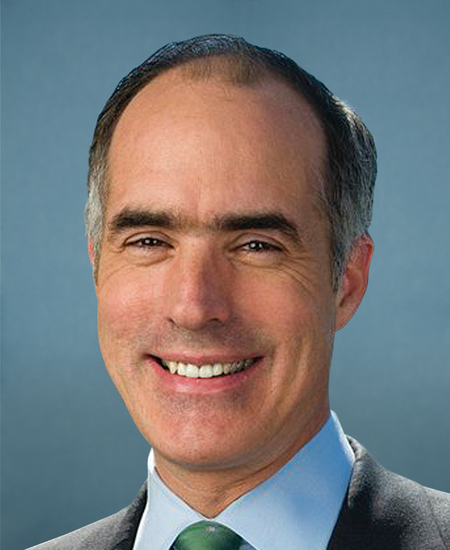
Sen. Robert P. Casey, Jr.
Sponsored bills
National Critical Capabilities Defense Act of 2021 This bill establishes the Committee on National Critical Capabilities to review certain transactions by U.S. businesses, including those transactions that could result in an unacceptable risk to national critical capabilities. Further, the bill authorizes the President to suspend or prohibit transactions that pose an unacceptable risk to national critical capabilities.
Maddy summaryThis Senate resolution (SRES 804) designates September 2022 as "National Childhood Cancer Awareness Month" to highlight childhood cancer in the U.S. It requests federal, state, local governments, and nonprofits to observe the month with awareness programs, encourages ongoing care for childhood cancer survivors, and recognizes the human impact of childhood cancer. The resolution does not create new laws or funding but aims to increase public awareness and support for this cause.
Websites and Software Applications Accessibility Act This bill requires employers, public entities, and public accommodations that provide goods or services through a website or online application to make those websites and applications accessible to individuals with disabilities. The requirement applies even if the good or service is offered only digitally. The Department of Justice (DOJ) must issue standards of accessibility for applicable entities to meet this requirement. The bill provides for enforcement by DOJ, the Equal Employment Opportunity Commission, and individual civil action. It also establishes various review and reporting requirements.
Vote Without Fear Act This bill establishes new federal criminal offenses for possessing a firearm or causing a firearm to be present in or within 100 yards of a federal election site.
International Children with Disabilities Protection Act of 2022 This bill establishes the International Children with Disabilities Protection Program in the Department of State to assist organizations of persons with disabilities and family members of children with disabilities in communicating about and advocating for policies that ensure the family inclusion and transition to independent living of children with disabilities.
This resolution designates September 2022 as National Voting Rights Month, encourages people to uphold the right to vote, encourages Congress to pass certain voting rights legislation, recommends the development of a curriculum in public schools and universities regarding voting, encourages the U.S. Postal Service to issue a special Representative John R. Lewis stamp during the month of September, and invites Congress to allocate funds for public service announcements regarding elections.
Non-Recognition of Russian Annexation of Ukrainian Territory Act This bill prohibits any federal agency from taking any action or extending any assistance that recognizes or implies recognition of Russia's sovereignty over any internationally recognized territory of Ukraine, including its airspace and territorial waters.
Democracy Is Strengthened by Casting Light On Spending in Elections Act of 2022 or the DISCLOSE Act of 2022 This bill addresses campaign finance, including by expanding the prohibition on campaign spending by foreign nationals, requiring additional disclosures of campaign expenditures, and requiring additional disclosures regarding certain political advertisements. Specifically, the bill expands existing foreign money prohibitions to include disbursements for paid web-based or digital communications and federal judicial nomination communications. It also prohibits foreign nationals from contributing to campaigns related to ballot initiatives and referenda. The Government Accountability Office must, for each four-year election cycle, study and report on the incidence of illicit foreign money in federal elections. Next, the bill makes it unlawful to establish or use a corporation, company, or other entity with the intent to conceal an election contribution or donation by a foreign national. A violator is subject to criminal penalties—a fine, a prison term of up to five years, or both. Covered organizations (e.g., corporations, labor organizations, and political organizations) must, within 24 hours, file reports with the Federal Election Commission to disclose campaign expenditures of more than $10,000 during an election cycle. The bill also requires organizations to provide additional disclosures regarding political advertisements, including the donors who contributed the most money to that organization in the last year.
This resolution recognizes (1) the celebration of Hispanic Heritage Month from September 15-October 15, 2022; and (2) the integral role of Latinos and their manifold heritage in the economy, culture, and identity of the United States.