

Maddy summaryThis bill expands health insurance subsidies under the Affordable Care Act for people with household incomes up to 800% of the federal poverty line (up from 400%), directly affecting millions of middle-income Americans purchasing coverage through health insurance marketplaces. Key provisions adjust the sliding-scale subsidy system to lower premium percentages across income tiers - like reducing the maximum payment from 8.5% to 6% for incomes between 300%-400% of poverty - and increase cost-sharing reductions for lower-income enrollees. It also modifies eligibility thresholds, raising the income limit for the highest savings tier from 150% to 200% of poverty and increasing the percentage of out-of-pocket costs covered. These changes aim to make premiums and deductibles more affordable by expanding subsidy eligibility and refining how payments are calculated.
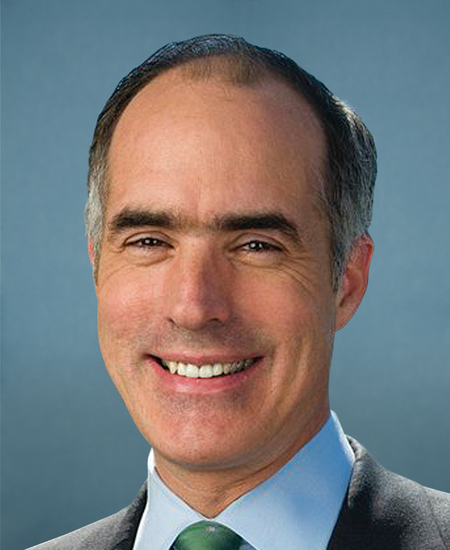
Sen. Robert P. Casey, Jr.
Sponsored bills
Maddy summaryThis bill would ban the sale, manufacture, transfer, and possession of most semiautomatic rifles, pistols, and shotguns meeting specific criteria defined as "assault weapons," as well as large capacity ammunition magazines holding more than 10 rounds. The ban would not apply to weapons already owned before enactment, or to certain types like bolt-action rifles, antique firearms, or weapons used by law enforcement. The bill would require identification markings on new assault weapons and magazines, require background checks for transfers of "grandfathered" weapons, and authorize federal buy-back programs for banned weapons through Byrne grants. It includes exemptions for military, law enforcement, and certain historical firearms.
Maddy summaryThis bill raises the minimum age to purchase or possess certain firearms and large-capacity magazines from 18 to 21 years old. It specifically prohibits sales or transfers of "semiautomatic assault weapons" (including defined rifles, pistols, and shotguns with features like detachable magazines or specific attachments) and large-capacity magazines (holding more than 10 rounds) to anyone under 21. The bill directly affects individuals under 21 who would be barred from purchasing these items from licensed dealers. Limited exceptions exist for hunting, farming, military service, or self-defense, but the core change is a nationwide age restriction on these specific firearm types.
Childhood Cancer Survivorship, Treatment, Access, and Research Reauthorization Act of 2022 or the Childhood Cancer STAR Reauthorization Act This act reauthorizes through FY2028 and modifies pediatric cancer research and related programs, including to expand collection of and access to relevant biospecimens and to support the transition of pediatric cancer survivors to primary care.
Martha Wright-Reed Just and Reasonable Communications Act of 2022 This act requires the Federal Communications Commission (FCC) to ensure that rates and charges for payphone services or other calling devices, including advanced (e.g., audio or video) communications services in correctional institutions, are just and reasonable. When promulgating regulations or otherwise implementing this act, the FCC (1) may use industry-wide average costs related to providing telephone and advanced communications services, and (2) must consider costs for safety and security measures related to providing communications services in correctional facilities.
Emmett Till and Mamie Till-Mobley Congressional Gold Medal Act of 2021 This act provides for the posthumous presentation of a Congressional Gold Medal in commemoration of Emmett Till and Mamie Till-Mobley. After it is awarded, the medal shall be given to the National Museum of African American History and Culture.
Iran Hostages Congressional Gold Medal Act This bill provides for the award of a Congressional Gold Medal to the 53 hostages of the Iran Hostage Crisis (November 4, 1979-January 21, 1981) in recognition of their bravery and endurance throughout their captivity.
Supply Chain Disruptions Relief Act This bill modifies the treatment of liquidations of new motor vehicle inventory as qualified LIFO (last in first out accounting method) inventory. It allows new motor vehicle dealers to elect to wait until the end of 2025 to replace their inventory for purposes of determining income attributable to the sale of such inventory during 2020 and 2021.
Robert C. Byrd Mine Safety Protection Act of 2022 This bill revises requirements governing (1) investigations of mine accidents, (2) miners' rights and protections (e.g., whistle-blower rights and protections), (3) mine health and safety standards, (4) underground coal mines, and (5) health and safety training for miners. The Department of Labor, when investigating coal or other mines, must (1) determine why an accident occurred and whether there were violations of law, mandatory health and safety standards, or other requirements; and (2) make recommendations to avoid a recurrence of an accident. The bill expands Labor's enforcement authority, including by requiring Labor to (1) revoke the approval of mine operators' plans or programs based on certain criteria, and (2) order mine operators to withdraw all persons from a mine until Labor approves a new plan. The bill revises civil and criminal penalties, including by subjecting a mine operator who knowingly violates health or safety standards to a felony punishable by up to five years in prison and a $1 million fine. Underground coal mine operators must implement a communication program to brief miners of current mine conditions and install atmospheric monitoring systems. The bill amends the Occupational Safety and Health Act of 1970 to expand its coverage to government employees and increase civil and criminal penalties for violations of the act. The bill also expands whistle-blower rights and protections against retaliation under the act, establishes employee rights with respect to work-related bodily injuries or death, and establishes procedures for correcting serious, willful, or repeated violations of occupational safety and health standards.
Community-Based Workforce Development Act This bill provides grants to expand workforce training programs for high-skill, high-wage, or in-demand industry sectors.