Mamas First Act This bill requires state Medicaid programs to cover doula and midwife services, including prenatal, delivery, and postpartum services, in a variety of settings.
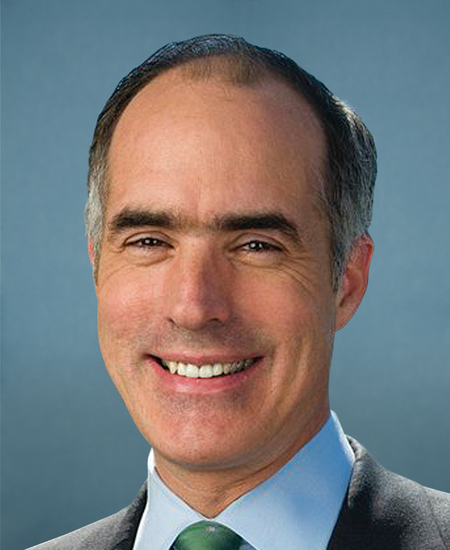
Sen. Robert P. Casey, Jr.
Sponsored bills
Maddy summaryThis resolution (SRES 677) is a symbolic gesture recognizing U.S. teachers' contributions to civic, cultural, and economic well-being. It thanks teachers for their work, especially amid challenges like pandemic learning loss and student mental health support, and encourages students, parents, and officials to observe National Teacher Appreciation Week (May 6-10, 2024). The resolution has no binding effect or policy changes - it solely promotes public acknowledgment of teachers during this annual observance. It directly affects teachers nationwide by affirming their role in national well-being through a non-binding Senate statement.
Maddy summarySRES 679 is a symbolic Senate resolution expressing support for National Child Abuse Prevention Month (observed in March). It does not create new laws or allocate funds but formally affirms the Senate’s backing for efforts to prevent child abuse and neglect, promote family well-being, and support survivors. The resolution highlights key statistics on child abuse and emphasizes the importance of prevention, education, healing, and justice for affected children. It directly affects no individuals or entities but serves as a public statement of legislative support for existing child protection initiatives.
Maddy summaryThis bill establishes grant programs to fund education about alternatives to guardianship for health care workers, educators, family members, and court workers. It aims to increase awareness of less restrictive options like supported decision-making and advance directives, which help people with disabilities or older adults maintain autonomy without losing decision-making rights. The education programs must cover guardianship alternatives, include diverse instructors, and reach underserved communities. States will also be required to collect data on guardianship arrangements to measure the program's impact. The legislation authorizes $10 million annually for these programs from fiscal years 2025 through 2030.
Maddy summaryS 4285 increases the annual funding limit for U.S.-Israel anti-tunnel cooperation from $50 million to $80 million under the National Defense Authorization Act for Fiscal Year 2016. The bill directly affects U.S. defense funding for joint efforts to counter subterranean threats, specifically targeting terrorist tunnel networks used by groups like Hamas in Gaza and Hezbollah in Lebanon. Key provisions include amending the funding cap to support enhanced intelligence sharing and technology development between the U.S. and Israel for detecting, destroying, and navigating terror tunnels. This policy change focuses on scaling bilateral cooperation to address documented tunnel networks used for attacks, weapon storage, and hostage holding, as detailed in the bill's findings. The funding adjustment aims to strengthen U.S. and allied capabilities against subterranean threats globally.
Maddy summary# Summary of the Proposed Substance Use Disorder Treatment and Prevention Bill This document is a comprehensive legislative proposal focused on addressing substance use disorder through a public health approach rather than a criminal justice approach. The key elements include: ## Main Components (Title XXXIV of the Public Health Service Act) **Subtitle A: Local and State Grants** - Establishes a grant program for local and state entities to provide substance use disorder treatment - Requires establishment of a "planning council" for each locality - Specifies funding requirements and administrative structures **Subtitle B: State and Tribal Grants** - Creates a grant program for states and tribes to address substance use disorder - Includes requirements for planning councils and other administrative structures - Provides significant funding for these programs **Subtitle C: Other Grant Program** - Establishes a grant program for public entities, nonprofits, Indian entities, and Medicaid providers - Prioritizes organizations serving underserved populations - Includes specific requirements for applications and service delivery **Subtitle D: Innovation, Training, and Health Systems Strengthening** - Creates "Special projects of national significance" for innovative treatment models - Establishes education and training centers for health professionals - Provides funding to increase substance use disorder treatment provider capacity - Includes programs to support workers with substance use disorder ## Key Funding Authorizations The bill authorizes substantial annual funding across all subtitles: - **Subtitle A:** $4.6 billion annually (2024-2033) - **Subtitle B:** $4.6 billion annually (2024-2033) - **Subtitle C:** $1 billion annually (2024-2033) - **Subtitle D:** - Special projects: $500 million annually - Education/training: $500 million annually - Provider capacity: $50 million annually - Employee support: $40 million annually - Research: $10 million annually ## Additional Key Provisions 1. **Amendments to Controlled Substances Act:** - Requires "covered persons" (dispensers, distributors, manufacturers of schedule II controlled substances) to submit annual certifications regarding diversion controls and misbranding - Establishes civil and criminal penalties for failure to submit or submitting false certifications - Creates a "Comprehensive Addiction Resources Fund" to collect penalties and supplement substance use disorder treatment funding 2. **General Limitations on Fund Use:** - Funds can only be used for public health purposes - Prohibits use of funds for incarceration, institutionalization, or involuntary treatment of individuals with substance use disorder - Prohibits use of funds for activities inconsistent with public health purposes 3. **Federal Drug Demand Reduction Activities:** - Requires the Director of National Drug Control Policy to publish an online list of all drug control program grant programs - Mandates annual review of federally funded demand reduction activities for effectiveness and efficiency ## Overall Approach The bill represents a significant shift toward a public health model for addressing substance use disorder, emphasizing: - Treatment rather than punishment - Prevention and early intervention - Training for health professionals - Support for underserved populations - Evidence-based treatment models - Comprehensive data collection and research This legislation is designed to provide substantial, sustained funding for a comprehensive approach to the opioid crisis and broader substance use disorder treatment, with specific requirements to ensure accountability, effectiveness, and public health focus.

Maddy summarySRES 505 is a Senate resolution condemning Hamas for allegedly using sexual violence and rape as a weapon of war during its October 7, 2023, attacks on Israel. It cites evidence gathered by Israeli authorities, including reports from over 1,500 victims and witnesses, and references the Fourth Geneva Convention which classifies rape in conflict as a war crime. The resolution calls on the international community to prioritize eliminating gender-based violence in conflicts, respond promptly to reports of such violence, and demand accountability for perpetrators. It directly honors victims of the attacks and stands with survivors and families affected by these alleged atrocities.
Maddy summaryS 4272, the Shirley Chisholm Statue Act, directs the Joint Committee on the Library to obtain and permanently place a statue of Shirley Chisholm - the first Black woman elected to Congress - in the U.S. Capitol within two years of the bill’s enactment. The bill authorizes the Architect of the Capitol to negotiate the statue agreement on behalf of the committee and specifies that funds for this purpose must be appropriated and remain available until spent. This procedural bill affects Capitol public spaces and honors Chisholm’s historical significance, with no policy changes beyond the statue’s placement.
Maddy summaryThis bill imposes sanctions on foreign entities that knowingly facilitate Iranian petroleum trade. It targets foreign port owners, vessel operators, refineries, and related individuals (including family members or entities owned by them) involved in transactions with Iranian oil, such as docking vessels carrying Iranian crude or conducting sea-to-sea transfers of petroleum products. Sanctions include banning sanctioned vessels from U.S. ports for up to two years, blocking U.S. assets of targeted entities, and denying visas to involved individuals. The bill also requires a detailed report on Iranian petroleum exports within 120 days, analyzing export volumes, revenue, and key participants.
Maddy summarySRES 673 is a commemorative Senate resolution honoring the late David Hampton Pryor, who served as a U.S. Senator for Arkansas from 1978 to 1997. The resolution expresses the Senate’s "profound sorrow" at his death and directs the Secretary of the Senate to share the resolution with the House and deliver a copy to his family. It does not create new laws or policies - it is purely ceremonial, recognizing Pryor’s career as a legislator, governor, and public servant. The resolution concludes with the Senate adjourning as a mark of respect for his legacy.