

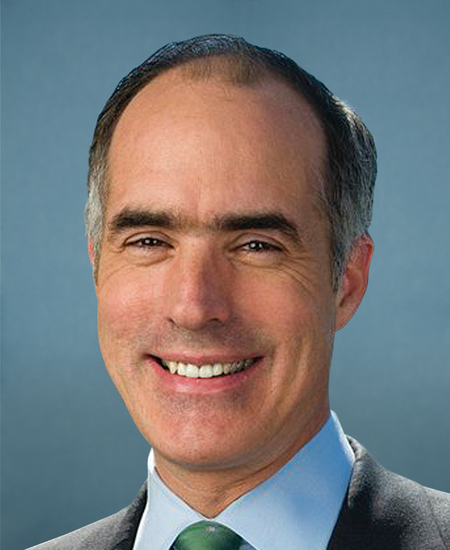
Photo of Robert P. Casey, Jr.
D United States Senate · Pennsylvania

Sen. Robert P. Casey, Jr.

Compare
Total votes
597
all sessions
Attendance
99%
5 missed
Near the chamber average
With party
97%
of cast votes
Higher than 76% of chamber peers
Bipartisan score
2%
crosses aisle rarely
Lower than 77% of chamber peers
Sponsored
1,299
bills & resolutions
Higher than 84% of chamber peers
Committees
0
assignments
1,299 bills and resolutions

Sponsored bills

Total
1,299
Primary
284
Co-sponsor
1,015
This page
1,299
matching current filters
Co-sponsor SRES 706
Passed · United States Senate · Co-sponsor
A resolution recognizing National Foster Care Month as an opportunity to raise awareness about the challenges of children in the foster care system, and encouraging Congress to implement policies to improve the lives of children in the foster care system.

Maddy summaryThis resolution designates May 2024 as National Foster Care Month to raise public awareness about challenges faced by children in foster care. It specifically highlights issues like the 368,530 children currently in foster care, the need for stable placements, and barriers to successful transitions to adulthood for youth aging out of the system. The resolution encourages Congress to develop policies that improve outcomes for these children, including supporting foster parents and preventing unnecessary entry into the system. As a symbolic resolution, it does not create new laws but aims to prompt legislative action through recognition and advocacy.

Passed May 23, 2024 1 co-sponsor
Co-sponsor SRES 712
Passed · United States Senate · Co-sponsor
A resolution designating May 2024 as "Older Americans Month".

Maddy summaryThis resolution designates May 2024 as "Older Americans Month" through a ceremonial Senate action. It does not create new laws or alter existing programs, but rather formally recognizes the contributions and importance of older adults in the U.S. The resolution encourages the public to honor older individuals' achievements, share their wisdom with younger generations, and acknowledge their role as community assets. This designation aligns with the longstanding tradition started by President Kennedy in 1963, which has been observed annually since 1965.

Passed May 23, 2024 1 co-sponsor
Co-sponsor S 4407
In committee · United States Senate · Co-sponsor
Elementary and Secondary School Counseling Act

Maddy summaryThis bill establishes federal grants to improve mental health services in schools by targeting high-need schools (those with high poverty rates). It requires states to use funds to recruit counselors, psychologists, and social workers to meet specific staffing ratios: 250 students per counselor/social worker and 500 students per psychologist. States must provide 20% matching funds and prioritize schools with the greatest need, with annual reporting on progress toward these ratios. The bill authorizes $5 billion for fiscal year 2025 to support these efforts, aiming to increase access to school-based mental health care for students facing mental health challenges.

In committee May 23, 2024 1 co-sponsor
Primary S 3819
In committee · United States Senate · Lead sponsor
Shrinkflation Prevention Act of 2024

Maddy summaryThis bill would require the Federal Trade Commission (FTC) to create rules preventing companies from reducing product sizes without proportionally lowering prices - a practice known as "shrinkflation." It defines shrinkflation as downsizing a product while not decreasing the price commensurately, treating violations as deceptive practices under existing FTC authority. The rules would be finalized within 18 months of the bill's enactment, with enforcement by the FTC and states allowed to sue companies for violations. The measure directly affects consumers, who face deceptive pricing, and manufacturers who would need to adjust product sizing and pricing transparency.

In committee May 22, 2024 0 co-sponsors
Co-sponsor S 3803
In committee · United States Senate · Co-sponsor
Price Gouging Prevention Act of 2024

Maddy summaryThe Price Gouging Prevention Act of 2024 prohibits businesses from selling goods or services at "grossly excessive prices" during normal market conditions. During exceptional market shocks (such as natural disasters, public health emergencies, or other major disruptions), the bill creates a presumption of violation if businesses with "unfair leverage" (defined as companies with $1 billion+ annual revenue or dominant market position) increase prices disproportionately compared to their costs. Small businesses with less than $100 million in annual revenue are exempt from the core prohibition but must demonstrate price increases are due to uncontrollable costs. The bill requires publicly traded companies to disclose detailed pricing information in SEC filings during exceptional market shocks and authorizes the FTC and state attorneys general to enforce the law through civil penalties and injunctions, with the FTC receiving $1 billion in funding for enforcement.

In committee May 22, 2024 1 co-sponsor
Co-sponsor S 1274
In committee · United States Senate · Co-sponsor
REEF Act

Maddy summaryThis bill, S 1274 (REEF Act), amends the 2020 Railroad Unemployment Insurance payment rules to clarify when certain provisions apply. It removes specific paragraphs and changes the effective date to make the payment rules retroactive, as if they had been in place before the end of the federal COVID-19 national emergency. The change directly affects railroad workers receiving unemployment benefits through the Railroad Unemployment Insurance Account. The key mechanism is adjusting the timing of these payment rules without altering the benefits themselves.

In committee May 22, 2024 1 co-sponsor
Primary S 4380
In committee · United States Senate · Lead sponsor
Expanding Disability Access to Higher Education Act

Maddy summaryThe Expanding Disability Access to Higher Education Act aims to improve college access and success for students with disabilities, particularly those who are low-income or first-generation college students. It creates new funding for programs that provide academic support, accommodations, and transition services specifically for these students through amendments to the Higher Education Act. The bill requires institutions to establish or improve disability services offices, mandates data collection on how programs serve students with disabilities, and authorizes $50 million annually for these programs from 2025-2029. It requires at least two-thirds of students served to be low-income and first-generation, while also ensuring accommodations are available and programs incorporate universal design principles. The legislation also establishes new reporting requirements to track outcomes for students with disabilities across different disability categories.

In committee May 21, 2024 0 co-sponsors
Primary S 4379
In committee · United States Senate · Lead sponsor
Higher Education Grant Flexibility Act

Maddy summaryThis bill amends three federal student aid programs (Pell Grants, Supplemental Educational Opportunity Grants, and TEACH Grants) to adjust how enrollment is calculated for students with disabilities. It ensures that students with disabilities who have an approved reduced course load as a reasonable accommodation under the ADA or Rehabilitation Act can have that reduced load (minimum 5 credits) counted as full-time enrollment for calculating their cost of attendance and aid eligibility. This change applies specifically to the cost-of-attendance calculations used to determine grant amounts, not to semester eligibility rules. The bill directly affects qualifying students with disabilities enrolled in postsecondary education who require reduced course loads as part of their accommodations.

In committee May 21, 2024 0 co-sponsors
Primary S 4369
In committee · United States Senate · Lead sponsor
Secure Smartports Act of 2024

Maddy summaryS 4369, the Secure Smartports Act of 2024, requires the Director of the National Counterintelligence and Security Center to develop a strategy and conduct outreach to U.S. shipping companies, port operators, and logistics firms about national security risks associated with Chinese smartport technology. It specifically identifies entities like COSCO, CCCC, ZPMC, and CMG as posing risks to U.S. supply chains, national security, and commercial activity, including potential system access disruptions. The outreach must align with existing executive orders and laws related to supply chain security and port safety. The bill does not impose new restrictions but mandates coordination with agencies like the Coast Guard and FBI to address these identified risks.

In committee May 20, 2024 0 co-sponsors
Co-sponsor SRES 697
Passed · United States Senate · Co-sponsor
A resolution designating the week of May 12 through May 18, 2024, as "National Police Week".

Maddy summarySRES 697 is a commemorative resolution designating the week of May 12-18, 2024, as "National Police Week" in the U.S. Senate. It aligns with the 1962 law authorizing the President to designate this week, honoring law enforcement officers who have died or been injured in the line of duty. The resolution expresses support for officers, recognizes their service in protecting communities, and encourages public observance to honor their mission and sacrifices. It does not create new policies or affect specific groups, as it is purely ceremonial.

Passed May 16, 2024 1 co-sponsor
Showing 131 to 140 of 1,299 bills
Previous 1 … 13 14 15 … 130 Next