

States Achieve Medicaid Expansion Act of 2021 or the SAME Act of 2021 This bill provides an enhanced federal matching rate to every state that expands Medicaid coverage for individuals who are newly eligible under the Patient Protection and Affordable Care Act, regardless of when such expansion takes place. Under current law, the enhanced Federal Medical Assistance Percentage (FMAP) is equivalent to 100% in 2014 through 2016, 95% in 2017, 94% in 2018, 93% in 2019, and 90% thereafter. The bill retains this enhanced FMAP, but bases it on a term of years rather than on specific dates. The bill applies retroactively.
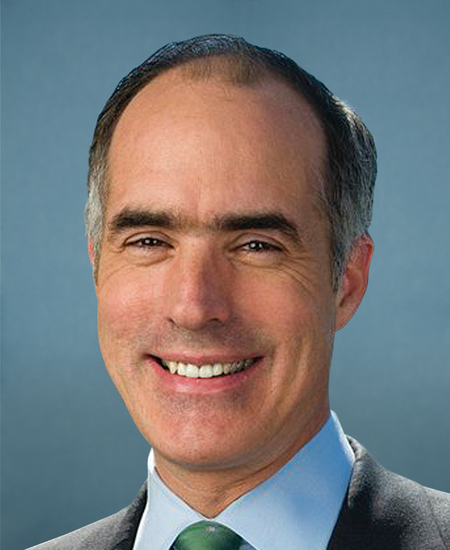
Sen. Robert P. Casey, Jr.
Sponsored bills
Emergency Family Stabilization Act This bill establishes a competitive grant program within the Administration for Children and Families (ACF) for family stabilization agencies to provide emergency relief to children, youth, and families experiencing homelessness. These agencies include current ACF grantees or subgrantees, Indian tribes, tribal organizations, Native Hawaiian organizations, and other organizations with expertise providing direct services to those experiencing homelessness. Recipients may use grant funds for, among other purposes, personnel costs, personal protective equipment, and other supplies to mitigate the spread of COVID-19 (i.e., coronavirus disease 2019), as well as payments for security deposits and other housing-related needs. Additionally, the ACF must award the grants based on factors including the need for the services in the area served by the agency and specified allocation and prioritization requirements.
Paycheck Fairness Act This bill addresses wage discrimination on the basis of sex. Specifically, it (1) limits an employer's defense that a pay differential is based on a factor other than sex to only bona fide job-related factors in wage discrimination claims, (2) enhances nonretaliation prohibitions, (3) makes it unlawful to require an employee to sign a contract or waiver prohibiting the employee from disclosing information about the employee's wages, and (4) increases civil penalties for violations of equal pay provisions. Additionally, the Equal Employment Opportunity Commission (EEOC) and the Office of Federal Contract Compliance Programs must train EEOC employees and other affected parties on wage discrimination. The bill directs the Department of Labor to (1) establish and carry out a grant program for negotiation skills training for girls and women, (2) conduct studies to eliminate pay disparities between men and women, and (3) make available information on wage discrimination to assist the public in understanding and addressing such discrimination. The bill also establishes the Secretary of Labor's National Award for Pay Equity in the Workplace for an employer who has made a substantial effort to eliminate pay disparities between men and women. Finally, the bill requires the EEOC to issue regulations for collecting from employers compensation and other employment data according to the sex, race, and national origin of employees for use in enforcing laws prohibiting pay discrimination.
Spotlight Act This bill renders null and void final Internal Revenue Service (IRS) regulations published on May 28, 2020, relating to the reporting requirements of tax-exempt organizations. The bill requires tax-exempt organizations that fall under sections 501(c)(4), 501(c)(5), and 501(c)(6) of the Internal Revenue Code (e.g., social welfare organizations, labor organizations, business leagues) to disclose the names and addresses of all substantial contributors (persons who contribute more than $5,000 per year to such organizations) on their information returns. The bill also eliminates the authority of the IRS to provide exceptions to the disclosure requirements for tax-exempt organizations. This provision does not apply to determinations made by the IRS before July 16, 2018.
Access Technology Affordability Act of 2021 This bill allows a refundable tax credit equal to the amounts paid for qualified access technology for use by a blind individual who is the taxpayer, the taxpayer's spouse, or a dependent of the taxpayer. Qualified access technology is hardware, software, or other information technology with the primary function of converting or adapting information that is visually represented into forms or formats useable by blind individuals. The credit is limited to (1) costs that are not compensated by insurance or otherwise, and (2) an aggregate amount of $2,000 per blind individual in any period of three consecutive taxable years. The credit must be adjusted for inflation after 2022 and terminates after 2026.
Ethan's Law This bill establishes a framework to regulate the storage of firearms on residential premises at the federal, state, and tribal levels. At the federal level, the bill establishes statutory requirements for firearms on residential premises to be safely stored if a minor is likely to gain access without permission or if a resident is ineligible to possess a firearm. An individual who violates the requirements is subject to criminal penalties. A firearm stored in violation of the requirements is subject to seizure and forfeiture. At the state and tribal levels, the bill requires the Department of Justice to award grants to implement functionally identical requirements for the safe storage of firearms.
Healthy Food Access for All Americans Act This bill allows tax credits and grants for activities that provide access to healthy food in food deserts, which are communities that have limited or no access to grocery stores and meet income requirements. For entities that are certified by the Department of the Treasury as special access food providers using specified criteria, the bill allows tax credits for operating a new grocery store or renovating an existing grocery store in a food desert. The bill also authorizes grants for a portion of (1) the construction costs of building a permanent food bank in a food desert, and (2) the annual operating costs of temporary access merchants (mobile markets, farmers markets, and food banks). Treasury, in coordination with the Department of Agriculture (USDA), must annually allocate the tax credits and grants to special access food providers. Grants authorized by this bill are not considered gross income for tax purposes. The bill also requires USDA to update the Food Access Research Atlas at least annually to account for food retailers that are placed in service during that year.
Ensuring Parity in MA for Audio-Only Telehealth Act of 2021 This bill allows audio-only diagnoses that are made via telehealth to be used for purposes of determining risk adjustments to payments under Medicare Advantage. Additionally, the bill requires payments for Medicare telehealth services that are furnished during the public health emergency relating to COVID-19 (i.e., coronavirus disease 2019) to be made in the same amounts as those for in-person services.
Early Educators Apprenticeship Act This bill establishes a grant program to award to partnerships—which may include employers, institutions of higher education, labor unions, and community-based organizations—the federal share of the costs of apprenticeship programs focused on early childhood education.
Fred Korematsu Congressional Gold Medal Act of 2021 This bill provides for the award of a Congressional Gold Medal posthumously to Fred Korematsu in recognition of his contributions to civil rights, his loyalty and patriotism to the nation, and his dedication to justice and equality.