

Shark Fin Sales Elimination Act of 20 21 This bill makes it illegal to possess, buy, sell, or transport shark fins or any product containing shark fins, except for certain dogfish fins. A person may possess a shark fin that was lawfully taken consistent with a license or permit under certain circumstances. Penalties are imposed for violations under the Magnuson-Stevens Fishery Conservation and Management Act.The maximum civil penalty for each violation shall be $100,000, or the fair market value of the shark fins involved, whichever is greater.
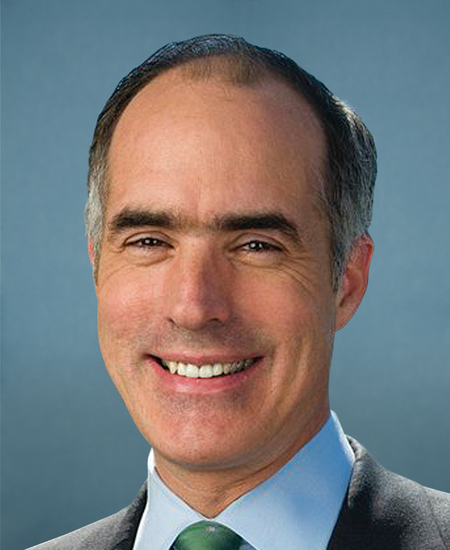
Sen. Robert P. Casey, Jr.
Sponsored bills
This resolution condemns the acts of gun violence that led to the tragic loss of eight lives in Georgia on March 16, 2021.
This resolution congratulates the people of Greece as they celebrate the 200th anniversary of Greece's independence. The resolution also expresses support for the principles of democratic governance to which the people of Greece are committed.
Korematsu-Takai Civil Liberties Protection Act of 2021 This bill modifies the detention authority of the United States. Specifically, it prohibits detention or imprisonment based solely on an actual or perceived protected characteristic of an individual. A protected characteristic includes each of the following: race, ethnicity, national origin, religion, sex, gender identity, sexual orientation, disability, and any additional characteristic that the Department of Justice determines to be a protected characteristic.
Junk Plan Accountability and Disclosure Act of 2021 This bill establishes requirements for certain noncomprehensive health insurance coverage and provides for additional outreach activities to increase enrollment in qualified health plans. Specifically, the bill prohibits online advertisements for health insurance coverage that reasonably mislead an individual (1) to believe that the advertisement is on behalf of a government entity such as a state or federal health insurance exchange, or (2) about the cost or benefits of noncomprehensive coverage (e.g., short-term, limited-duration insurance) compared to a qualified health plan under the Patient Protection and Affordable Care Act. The bill provides authority for the Federal Trade Commission to enforce these prohibitions. The bill also requires certain types of coverage (e.g., coverage for nontraditional benefits or student health insurance coverage) to provide consumers with a clear statement indicating the benefits the coverage provides and that the coverage is not a comprehensive health plan. These plans also must meet specified reporting requirements. In states with a federally administered exchange, the Centers for Medicare & Medicaid Services must conduct outreach and educational activities to individuals about the availability of qualified health plans through the exchange. The bill also provides grants for states to conduct open enrollment outreach with respect to qualified health plans and to explore solutions to promote greater enrollment. The bill provides funding for these outreach activities.
This bill requires the Joint Committee on the Library to enter into an agreement to obtain a statue of Shirley Chisholm, the first African American woman elected to Congress. The committee shall place the statue in a permanent public location in the U.S. Capitol.
Carbon Capture, Utilization, and Storage Tax Credit Amendments Act of 2021 This bill extends the carbon oxide sequestration tax credit through 2030. It also permits taxpayers to elect to receive a payment in lieu of the tax credits for carbon oxide sequestration and qualifying advanced coal projects. The bill also makes other modifications to certain carbon sequestration credits, including (1) an allowance of carbon sequestration credits against the base erosion minimum tax, (2) modifications to sequestration requirements for certain qualifying advanced coal project credit equipment, and (3) increasing the sequestration credit value for direct air capture projects.
Regional Greenhouse Gas Reduction Act of 2021 This bill establishes an Office of Regional Greenhouse Gas Reduction Programs within the Environmental Protection Agency (EPA), a grant program to support regional greenhouse gas reduction programs, and an interagency task force. The office must support existing regional greenhouse gas reduction programs and facilitate the establishment of new regional greenhouse gas reduction programs. Such programs use market-based tools to reduce greenhouse gases across states at the regional level. In addition, the office must establish a program that awards grants to a state, local government, or regional consortium of such governments to take preliminary steps towards developing or participating in a regional greenhouse gas reduction program. Finally, the EPA must establish an interagency task force to support new and existing regional programs.
Healthcare Workforce Resilience Act This bill makes previously unused immigrant visas available to nurses and physicians who petition for such a visa before the date that is 90 days after the end of the declared national emergency relating to the COVID-19 (i.e., coronavirus disease 2019) outbreak. The number of visas available shall be the total number of unused employment-based immigrant visas from FY1992-FY2020, up to 40,000. Of such visas, 25,000 shall be reserved for nurses and 15,000 for physicians. Certain family members may accompany the principal beneficiary of a visa provided under this bill, and visas for such family members shall (1) be made available from the unused visas from FY1992-FY2020, and (2) not be counted against the 40,000 cap. Visas provided under this bill shall be exempt from per-country limitations.
This resolution condemns and denounces all forms of anti-Asian sentiment, including those related to COVID-19 (i.e., coronavirus disease 2019), and calls on federal law enforcement officials, working with state and local agencies, to take specified steps. The resolution calls on federal officials to expeditiously investigate and document all credible reports of hate crimes, harassment, bullying, and threats against the Asian American and Pacific Islander communities; the Attorney General to work with state and local agencies and Asian American and Pacific Islander community-based organizations to prevent discrimination and to expand culturally competent and linguistically appropriate education campaigns on public reporting of hate crimes; and the Department of Health and Human Services to issue guidance describing best practices to mitigate racially discriminatory language in describing the pandemic. The resolution recommits the United States to serving as a model for the world in building a more inclusive, diverse, and tolerant society by (1) prioritizing language access and inclusivity in communication practices, and (2) combating misinformation and discrimination that puts Asian Americans and Pacific Islanders at risk.