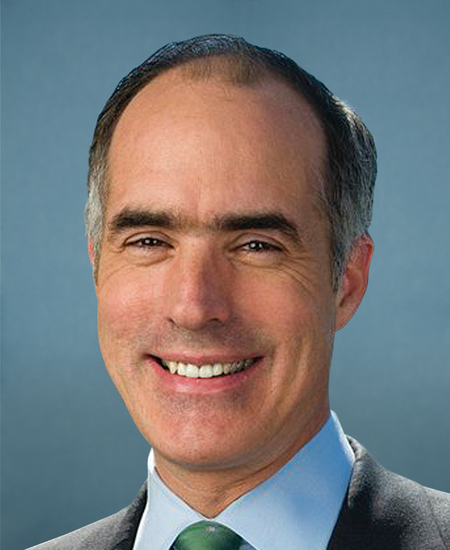
Photo of Robert P. Casey, Jr.
D United States Senate · Pennsylvania

Sen. Robert P. Casey, Jr.

Compare
Total votes
597
all sessions
Attendance
99%
5 missed
Near the chamber average
With party
97%
of cast votes
Higher than 76% of chamber peers
Bipartisan score
2%
crosses aisle rarely
Lower than 77% of chamber peers
Sponsored
1,299
bills & resolutions
Higher than 84% of chamber peers
Committees
0
assignments
1,299 bills and resolutions

Sponsored bills

Total
1,299
Primary
284
Co-sponsor
1,015
This page
1,299
matching current filters
Primary SRES 162
Passed · United States Senate · Lead sponsor
A resolution designating April 14, 2021, as "National Assistive Technology Awareness Day".

This resolution designates April 14, 2021, as National Assistive Technology Awareness Day. Assistive technology refers to tools, equipment, or products that help people with disabilities complete activities at school, home, or work, and in the community.

Passed Apr 15, 2021 0 co-sponsors
Primary S 1162
In committee · United States Senate · Lead sponsor
PACE Plus Act

Program of All-Inclusive Care for the Elderly Plus Act or the PACE Plus Act This bill modifies requirements and establishes programs regarding Programs of All-Inclusive Care for the Elderly (PACE). PACE is a program under Medicare and Medicaid that provides in-home and community services for certain individuals as an alternative to nursing home care. The bill allows Medicare beneficiaries to enroll in a PACE program at any time and provides states with the option to allow Medicaid beneficiaries to do the same. Entities may also apply to become PACE providers at any time, upon specified assurances relating to staffing and other requirements. States that provide Medicaid coverage of long-term care may also choose to expand PACE eligibility for Medicaid beneficiaries who are unable to perform at least two activities of daily living and who meet other specified criteria. Additionally, the bill establishes and provides funds for grant programs for (1) public or nonprofit PACE providers in rural or underserved urban areas for planning, administrative, capital, and other expenses that are necessary for site development; and (2) states that do not have PACE providers for expenses deemed necessary for program establishment. The bill also allows the Center for Medicare and Medicaid Innovation to test a model for expanded PACE eligibility that targets high-need and high-cost populations.

In committee Apr 15, 2021 0 co-sponsors
Co-sponsor S 1190
In committee · United States Senate · Co-sponsor
Direct Support Worker Training Reimbursement Act

Direct Support Worker Training Reimbursement Act This bill establishes a 75% federal matching rate for direct support worker training programs under Medicaid.

In committee Apr 15, 2021 1 co-sponsor
Co-sponsor S 1192
In committee · United States Senate · Co-sponsor
CADSAW Act

Career Advancement for Direct Support Aid Workers Act or the CADSAW Act This bill provides funding through FY2024 to the Department of Health and Human Services (HHS) for demonstration projects to train individuals for careers as home health aides, nursing assistants, or similar direct support aid workers. HHS must award grants, in consultation with the Department of Labor, to states, tribal nations, institutions of higher education, and other organizations to carry out these projects. In addition, the bill increases Medicare payments for services furnished by an individual who has completed training through such a project.

In committee Apr 15, 2021 1 co-sponsor
Co-sponsor S 1196
In committee · United States Senate · Co-sponsor
Mollie Baldwin Upskilling of Personal and Home Care Aides Act

Mollie Baldwin Upskilling of Personal and Home Care Aides Act This bill provides funding through FY2032 to the Department of Health and Human Services (HHS) for grants to train individuals for careers as home health aides, nursing assistants, or similar direct support professionals. HHS must award these grants, in consultation with the Department of Labor, to states, community-based organizations, and other eligible entities.

In committee Apr 15, 2021 1 co-sponsor
Co-sponsor S 1170
In committee · United States Senate · Co-sponsor
Summer Meals Act of 2021

Summer Meals Act of 2021 This bill revises provisions related to the Summer Food Service Program (SFSP) of the Department of Agriculture (USDA), which provides meals to children and teens in low-income areas during the summer months when school is not in session. The bill redefines areas in which poor economic conditions exist , where the SFSP may operate, as areas in which at least 40% (currently, 50%) of the children have been determined to be eligible for free or reduced price school meals under the school lunch and breakfast programs. The bill reimburses service institutions (other than school food authorities) for up to one meal and one snack per child each day during after-school hours, weekends, and school holidays during the regular school calendar. Currently, such institutions are reimbursed for meals and snacks served to children over the summer months or to children who are on vacation under a continuous school calendar. USDA must award competitive grants to service institutions to increase participation in the summer food service program for children who lack the ability to access a congregate feeding site through (1) innovative approaches to limited transportation, (2) mobile meal trucks, and (3) any other method or approach that does not require children to access a congregate feeding site. Service institutions that are participating in the summer food service program for children may serve up to three meals, or two meals and one snack, during each day of operation. Currently, this option is reserved for camps and service institutions that serve meals primarily to migrant children.

In committee Apr 15, 2021 1 co-sponsor
Co-sponsor S 1142
In committee · United States Senate · Co-sponsor
Rohingya Genocide Determination Act of 2021

Rohingya Genocide Determination Act of 2021 This bill requires the Department of State to report to Congress an assessment of the persecution of the Rohingya, a predominantly Muslim group in Burma (Myanmar), by Burma's military and security forces, and whether the situation constitutes genocide under U.S. law. The report shall also contain (1) a description of U.S. government actions to ensure that those responsible are held accountable, and (2) recommendations on further actions to take to ensure accountability and to prevent further mass atrocity crimes in Burma.

In committee Apr 15, 2021 1 co-sponsor
Co-sponsor S 1135
In committee · United States Senate · Co-sponsor
GRACE Act

Guaranteed Refugee Admission Ceiling Enhancement Act or the GRACE Act This bill establishes that the maximum number of refugees admitted each fiscal year shall be no less than 125,000 and that the maximum number shall be treated as the numerical goal for refugee admissions for the applicable fiscal year. The President may set a higher number if it is justified by humanitarian concerns or is otherwise in the national interest. Currently, the number admitted each fiscal year may not exceed 50,000 unless the President determines that a higher number is justified by humanitarian concerns or is otherwise in the national interest. The bill directs the President to take into consideration information from the United Nations High Commissioner for Refugees when establishing the maximum admission number and making certain other related decisions. The President shall report to Congress quarterly on (1) the number of refugees admitted during the preceding quarter, (2) the number of aliens who were security-cleared during the preceding quarter, (3) a plan to reach the numerical goal for admitted refugees for that fiscal year, and (4) other related information.

In committee Apr 15, 2021 1 co-sponsor
Co-sponsor S 1195
In committee · United States Senate · Co-sponsor
Healthy Families Act

Healthy Families Act This bill provides for paid and unpaid sick leave for employees to meet their own medical needs and those of their families. It requires employers with 15 or more employees to provide their employees with at least one hour of earned paid sick leave for every 30 hours worked, up to a maximum of 56 hours of paid sick leave in a year. An employer with fewer than 15 employees may also provide the same amount of paid sick leave, but may opt out of such requirement, in which case such employer must provide its employees at least 56 hours of unpaid leave in a year. An employee may use sick leave for absences (1) resulting from a physical or mental illness, injury or medical condition; (2) resulting from obtaining professional medical diagnosis or care, or preventive medical care; (3) to care for a child, parent, spouse, a domestic partner, or other blood or close relative; and (4) resulting from domestic violence, sexual assault, or stalking. The bill makes it unlawful for any employer to interfere with, restrain, or deny the exercise of an employee's right to accrue sick leave as provided by this bill. An employee may take legal action to enforce the right to sick leave granted by this bill and the Department of Labor must investigate complaints of violations of the requirements of this bill. Labor is authorized to conduct a public awareness campaign to educate and inform the public of the requirements for paid sick leave provided by this bill.


In committee Apr 15, 2021 1 co-sponsor
Co-sponsor S 1187
In committee · United States Senate · Co-sponsor
Eliminating Global Market Distortions To Protect American Jobs Act of 2021

Eliminating Global Market Distortions To Protect American Jobs Act of 2021 This bill addresses unfair trade practices by making various changes to U.S. antidumping and countervailing duty law. Antidumping provides relief to U.S industries and workers that are materially injured or threatened with injury due to imports of like products sold in the U.S. market at less than fair value, while countervailing duty provides such relief from imports of products subsidized by a foreign government or public entity. Specifically, the bill establishes a process for successive antidumping and countervailing duty investigations. Successive investigations may be concurrent (an ongoing investigation of the same product from different countries) or recently completed (not more than two years before the date of the initiation of the successive investigation). Further, the bill establishes a time line for the Department of Commerce to issue determinations in successive investigations. Among other provisions, the bill authorizes Commerce to apply countervailing duty law to subsidies provided by a foreign government or public entity to a company operating in a different country, use another method for calculating the cost of production in specific circumstances, and require importers to provide a certification that the imported merchandise is not subject to an antidumping or countervailing duty order. Additionally, the bill establishes procedures for Commerce to conduct circumvention inquiries, including by specifying the deadlines for preliminary and final determinations.

In committee Apr 15, 2021 1 co-sponsor
Showing 1,141 to 1,150 of 1,299 bills