

Restore Environmental Vitality and Improve Volatile Economy by the Civilian Conservation Corps Act or the REVIVE the CCC Act This bill permits AmeriCorps to establish the Civilian Conservation Corps (CCC) to address unemployment and environmental conservation and requires the Department of Agriculture to establish an agricultural workforce development program to incentivize apprenticeships in agriculture. The CCC must make grants to local host entities to allow those entities to select applicants to participate in conservation-related service projects. Local entities eligible for grants include, among others, state and local offices, nonprofit organizations, sponsors of apprenticeship programs, and individual farmers. A prospective CCC member must apply for placement with an approved local host for a service position hosted by that local entity. Applicants selected are considered CCC members but are not considered employees of the local host. The local host must provide CCC members with an allowance of $15 per hour of service and must provide a basic healthcare plan to full-time members. A CCC member who completes a term of service with a local host may be eligible to receive an award of up to $5,000 from AmeriCorps towards the costs of an apprenticeship program. These awards and allowances are not considered income for purposes of federal income taxation. The bill also requires the Department of Agriculture to establish an agricultural workforce development program to encourage agricultural businesses to employ apprentices by reimbursing up to 50% of apprenticeship costs.
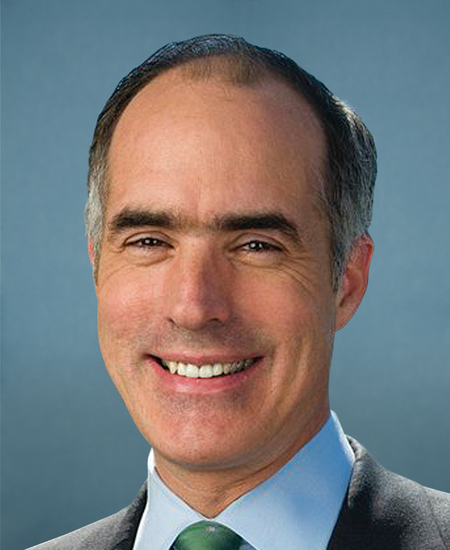
Sen. Robert P. Casey, Jr.
Sponsored bills
United States Call Center Worker and Consumer Protection Act of 2021 This bill establishes restrictions on businesses that relocate call centers or redirect customer service calls to locations outside the United States. Specifically, a business must notify the Department of Labor that it intends to move its customer service call center overseas and Labor must maintain a publicly available list of such businesses. Subject to narrow exceptions, a business appearing on such list is ineligible to receive federal grants or guaranteed loans for five years after the business is added to the list. Further, agencies must condition the awarding of government contracts on the requirement that any call center activity pursuant to the contract must be performed in the United States. Additionally, the bill requires call center employees to disclose their physical location at the beginning of each call initiated or received, unless all employees of the business participating in the communication are located in the United States, among other exceptions.
Cyber Incident Notification Act of 2021 This bill requires federal agencies and certain entities to report cybersecurity intrusion incidents to the Cybersecurity and Infrastructure Security Agency (CISA) and addresses related issues. Within 24 hours of a confirmed intrusion (or potential intrusion), the targeted agency or entity must report the intrusion to CISA. CISA must promulgate rules relating to the bill, including the information that must be included in each incident report and the entities that must comply with the reporting requirements. At minimum, the covered entities must include federal contractors and owners or operators of critical infrastructure. Similarly, such rules must at minimum require federal agencies and covered entities to report all intrusions involving a nation-state, advanced persistent threat cyber actor, or transnational organized crime group. If a covered entity fails to meet the bill's requirements, CISA may assess a civil penalty of up to 0.5% of the entity's gross revenue for each day the violation lasts. If the violating entity has federal contracts, the General Services Administration may impose additional penalties, including removal from the Federal Contracting Schedule. A violation by a federal agency must be referred to that agency's office of the inspector general, which must treat the case as a matter of urgent concern. CISA, the Department of Justice, and the Office of the Director of National Intelligence must provide periodic reports to Congress concerning the current cyber threat picture facing federal agencies and covered entities.
Safe Schools Improvement Act of 2021 This bill requires states to direct their local educational agencies (LEAs) to establish policies that prevent and prohibit bullying and harassment of elementary and secondary school students. In particular, these policies must prohibit bullying and harassment based on race, color, national origin, sex, sexual orientation, gender identity, disability, or religion. Further, LEAs must provide (1) students, parents, and educational professionals with annual notice of the conduct prohibited in their disciplinary policies; (2) students and parents with grievance procedures that target such conduct; and (3) the public with annual data on the incidence and frequency of that conduct at the school and LEA level. The Department of Education must conduct and report on an independent biennial evaluation of programs and policies to combat bullying and harassment in elementary and secondary schools. The National Center for Education Statistics must collect state data to determine the incidence and frequency of the conduct prohibited by LEA disciplinary policies.
Semiquincentennial Commemorative Coin Act This bill directs the Department of the Treasury to mint and issue $25.00 gold coins, $2.50 silver coins, 25 cent clad coins, and proof silver $2.50 coins in commemoration of the 250th anniversary of the establishment of the United States. The designs of the coins shall be emblematic of the semiquincentennial anniversary of the establishment of the United States of America and celebrate 250 years of our nation. On each coin there shall be a designation of the value of the coin; an inscription of the years 1776-2026; and inscriptions of the words Liberty , In God We Trust , United States of America , and E Pluribus Unum . Treasury may issue coins under this bill only during the period beginning on January 1, 2026, and ending on December 31, 2026. All sales of coins issued shall include a surcharge as prescribed by this bill. All surcharges received by Treasury from the sale of such coins shall be paid to the America 250 Foundation to fund the restoration, rehabilitation, and interpretation of units of the U.S. National Park System and its related areas, as a legacy of the semiquincentennial commemoration.
Support Through Loss Act This bill provides employees with 24 hours of paid leave time each year for an absence resulting from a pregnancy loss or other specified circumstance related to pregnancy, fertility, or an unsuccessful assisted reproductive procedure or adoption match. Employers must notify each employee about the availability of this paid leave and may not discriminate or discharge an employee for exercising or attempting to exercise the right to such paid leave. The bill provides for enforcement of this requirement by the Department of Labor and through civil action brought by an employee or individual. Further, the bill requires specified federal agencies to conduct research and publish information about pregnancy loss and related evidence-based treatment options.
Intelligence Community Workforce Agility Protection Act of 2021 This bill allows a current tax deduction for the moving expenses of an employee or new appointee of the intelligence community who moves due to a change in assignment that requires relocation. It also allows a current tax exclusion for such employees or appointees for moving expense reimbursements. Under current law, the tax deduction and exclusion for the moving expenses of other taxpayers are suspended for the period beginning in 2018 through 2025.
Supporting Our Direct Care Workforce and Family Caregivers Act This bill requires the Department of Health and Human Services (HHS) to set up a national technical assistance center and grant program to support the direct care workforce and family caregivers. HHS must consult with the Department of Labor, the Department of Education, and the Centers for Medicare & Medicaid Services on these efforts. Specifically, HHS must establish a national technical assistance center to develop recommendations for curricula to educate and train direct care workers and family caregivers, disseminate strategies to strengthen the direct care workforce, and carry out related activities. Additionally, HHS must award grants for recruiting, training, and retaining direct care workers and supporting family caregivers. Eligible grantees include state and tribal governments, certain labor unions and employers, institutions of higher education, and other nonprofits, as well as partnerships of such entities. Grant recipients must agree to consult with the state Medicaid agency unless that agency receives the grant directly or as part of a partnership.
3D Printed Gun Safety Act of 2021 This bill makes it unlawful to intentionally publish digital instructions for programming a three-dimensional printer to make a firearm.
This joint resolution nullifies the Oil and Natural Gas Sector: Emission Standards for New, Reconstructed, and Modified Sources Review rule published by the Environmental Protection Agency on September 14, 2020. The rule finalized amendments to new source performance standards under the Clean Air Act for the oil and natural gas sector, such as an amendment that removed limitations on methane emissions from such sector.