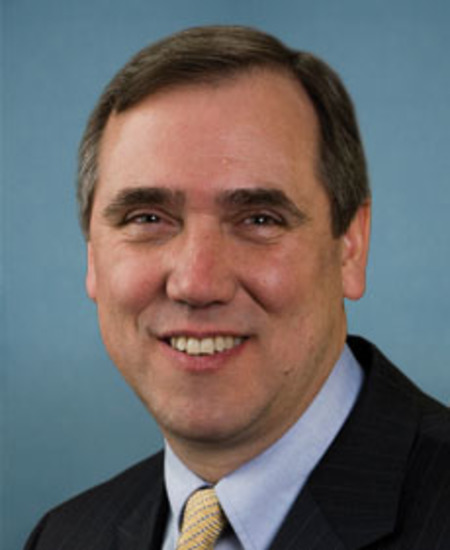
Photo of Jeff Merkley
D United States Senate · Oregon On the 2026 ballot

Sen. Jeff Merkley

Compare
Total votes
1,044
all sessions
Attendance
99%
10 missed
Higher than 75% of chamber peers
With party
93%
of cast votes
Lower than 78% of chamber peers
Bipartisan score
4%
crosses aisle rarely
Higher than 76% of chamber peers
Sponsored
2,249
bills & resolutions
Higher than 97% of chamber peers
Committees
18
assignments
2,249 bills and resolutions

Sponsored bills

Total
2,249
Primary
324
Co-sponsor
1,925
This page
2,249
matching current filters
Co-sponsor SRES 170
Passed · United States Senate · Co-sponsor
A resolution relating to the death of Walter Frederick Mondale, former Vice President of the United States.

This resolution extends condolences to the family and friends of former Vice President Walter Mondale. The resolution acknowledges Mondale's lifetime service to the United States, including as a U.S. Senator and as the first presidential candidate from a major party to select a woman, Geraldine Ferraro, as his running mate.

Passed Apr 21, 2021 1 co-sponsor
Co-sponsor S 1271
In committee Apr 21, 2021 1 co-sponsor
Co-sponsor S 1263
In committee · United States Senate · Co-sponsor
Debt-Free College Act of 2021

Debt-Free College Act of 2021 This bill establishes measures to cover the unmet financial need of students who are enrolled at certain institutions of higher education (IHEs). Unmet financial need refers to the difference between a student's cost of attendance and the student's expected family contribution, plus any federal, state, and local sources of grant aid. In addition, the bill makes certain Dreamer students (i.e., students who have been granted Deferred Action for Childhood Arrivals status) eligible for federal financial aid. First, the bill requires the Department of Education (ED) to award grants for state-federal partnerships with a goal of providing debt-free college for all eligible students at in-state public IHEs. Eligible student refers to an individual who (1) is enrolled or is eligible to enroll in an in-state public IHE, (2) completes a Free Application for Federal Student Aid or demonstrates eligibility for a Federal Pell Grant through institutional financial-aid eligibility forms, and (3) demonstrates satisfactory academic progress. Next, the bill requires ED to award grants to historically Black colleges and universities and minority-serving institutions to cover the unmet financial need of enrolled students. ED must establish an office to administer grants and provide oversight. In addition, the bill makes Dreamer students who entered the United States before the age of 16 and who meet certain educational criteria eligible for federal student aid.

In committee Apr 21, 2021 1 co-sponsor
Co-sponsor S 1288
In committee · United States Senate · Co-sponsor
College for All Act of 2021

College for All Act of 2021 This bill establishes measures to expand access to higher education, including by eliminating tuition and required fees for eligible students, revising the Federal Pell Grant program, and reauthorizing certain programs to assist students from disadvantaged backgrounds. Specifically, the bill provides funding to eliminate tuition and required fees for (1) all students at community colleges and two-year tribal colleges and universities; (2) working- and middle-class students at four-year public institutions of higher education (IHEs) and tribal colleges and universities; and (3) eligible students at private, nonprofit historically Black colleges and universities (HBCUs) and minority-serving institutions. The bill permanently reauthorizes and otherwise revises the Federal Pell Grant program by providing funding to increase the maximum award for each eligible student, increasing the duration limit for the use of Pell Grants, and allowing students to use their awards to cover living and non-tuition expenses. Next, the bill makes Dreamer students (i.e., students who have been granted Deferred Action for Childhood Arrivals status) who entered the United States before the age of 16 and who meet certain educational criteria eligible for federal financial aid. Further, the bill requires the Department of Education to award grants to underfunded IHEs, HBCUs, and minority-serving institutions for investing in support programs to improve student outcomes (e.g., graduation rates). The bill also reauthorizes through FY2031 the Federal TRIO Programs and reauthorizes through FY2025 the Gaining Early Awareness and Readiness for Undergraduate Programs.


In committee Apr 21, 2021 1 co-sponsor
Co-sponsor S 1265
In committee · United States Senate · Co-sponsor
Fourth Amendment Is Not For Sale Act

Fourth Amendment Is Not For Sale Act This bill generally prohibits law enforcement and intelligence agencies from obtaining U.S. customer or subscriber records or any illegitimately obtained information from a third party in exchange for anything of value (e.g., purchasing such information). Records or information obtained in violation of this bill are inadmissible as evidence in any trial, hearing, or other legal proceeding.

In committee Apr 21, 2021 1 co-sponsor
Co-sponsor S 1279
In committee · United States Senate · Co-sponsor
Medicare at 50 Act

Medicare at 50 Act This bill establishes a Medicare buy-in option for certain qualifying individuals and also repeals restrictions relating to prescription drug prices under the Medicare prescription drug benefit. Specifically, the bill allows individuals aged 50 to 64 to enroll in Medicare if such individuals would otherwise qualify for Medicare at the age of 65. The Centers for Medicare & Medicaid Services (CMS) must determine enrollment periods and set premiums for the buy-in option established under the bill, in accordance with specified requirements. The CMS must also award grants to states and nonprofit organizations for outreach and enrollment activities relating to the buy-in option. The bill also repeals provisions that prohibit the CMS from negotiating the prices of prescription drugs or from establishing a formulary under the Medicare prescription drug benefit.

In committee Apr 21, 2021 1 co-sponsor
Co-sponsor S 1270
In committee · United States Senate · Co-sponsor
Access to Healthy Food for Young Children Act of 2021

Access to Healthy Food for Young Children Act of 2021 This bill revises several provisions related to the Child and Adult Care Food Program. These revisions include increasing reimbursement rates; requiring reimbursements to be adjusted annually to reflect the Consumer Price Index for food away from home, rather than the Consumer Price Index for food at home used under current law; providing for an additional meal service to be served in child care settings with eight or more hours between the first meal service and the beginning of the fourth meal service; expanding geographical eligibility for tier I family or group day care homes; and requiring the Department of Agriculture to establish an advisory committee to examine the feasibility of reducing unnecessary or duplicative paperwork for those participating or seeking to participate in the program. The bill also provides funding to (1) provide nutrition training and technical assistance under the program, and (2) increase the participation of children from underserved communities.

In committee Apr 21, 2021 1 co-sponsor
Co-sponsor SRES 166
In committee · United States Senate · Co-sponsor
A resolution recognizing the duty of the Federal Government to create a Green New Deal.

This resolution calls for the creation of a Green New Deal with the goals of achieving greenhouse gas and toxic emissions reductions needed to stay under 1.5 degrees Celsius of warming; establishing millions of high-wage union jobs and ensuring economic security for all; investing in infrastructure and industry; securing clean air and water, climate and community resiliency, healthy food, access to nature, and a sustainable environment for all; and promoting justice and equality. The resolution calls for accomplishment of these goals through a 10-year national mobilization effort. The resolution also enumerates the goals and projects of the mobilization effort, including building smart power grids (i.e., power grids that enable customers to reduce their power use during peak demand periods); upgrading all existing buildings and constructing new buildings to achieve maximum energy and water efficiency; removing pollution and greenhouse gas emissions from the transportation and agricultural sectors; cleaning up existing hazardous waste and abandoned sites; ensuring businesspersons are free from unfair competition; and providing higher education, high-quality health care, and affordable, safe, and adequate housing to all.

In committee Apr 20, 2021 1 co-sponsor
Co-sponsor S 1255
In committee · United States Senate · Co-sponsor
Minority Business Resiliency Act of 2021

Minority Business Resiliency Act of 2021 This bill permanently authorizes the Minority Business Development Agency (MBDA) and requires the MBDA to promote and administer programs that assist the development of minority business enterprises (MBEs). Specifically, the bill requires the MBDA to (1) provide assistance to MBEs in domestic and foreign markets by making available specified resources, (2) promote the position of MBEs in local economies, and (3) collect data on the causes of MBE success or failure and research how economic conditions affect the development of MBEs. The bill establishes formal processes for the MBDA Business Center Program and the MBDA Rural Business Center Program through which business centers provide programs and services to support MBEs. The bill also establishes new initiatives to promote economic resiliency for minority businesses, including (1) an annual forum to review problems and programs relating to capital formation by MBEs, (2) a study and report on alternative financing solutions for MBEs, and (3) entrepreneurship education grants for certain institutions of higher education to develop and implement entrepreneurship curricula. Further, the bill establishes grants for (1) certain nonprofit organizations that provide services to MBEs as one of their primary activities, and (2) MBEs for the purpose of supporting MBEs or helping MBEs remain in business. The Government Accountability Office must report on the programs carried out pursuant to the bill.

In committee Apr 20, 2021 1 co-sponsor
Co-sponsor S 1244
In committee · United States Senate · Co-sponsor
Civilian Climate Corps for Jobs and Justice Act

Civilian Climate Corps for Jobs and Justice Act This bill establishes a Civilian Climate Corps Program and generally revises benefits provided to national service program participants. The bill establishes a Civilian Climate Corps to operate (1) a national climate service program; and (2) a national climate service grant program to help communities respond to climate change and transition to a clean economy, including through reducing carbon emissions. The bill also provides for allowances for participants in certain national service programs, including the Volunteers in Service to America (VISTA) program and the National Civilian Community Corps. The bill expands the exclusion from gross income, for income tax purposes, to exclude amounts received as educational awards or benefits and income attributable to discharges of student loan debt under the National and Community Service Act of 1990.

In committee Apr 20, 2021 1 co-sponsor
Showing 2,041 to 2,050 of 2,249 bills