Black Lung Benefits Disability Trust Fund Solvency Act of 2021 This bill extends until December 31, 2031, the excise tax on coal from U.S. mines. This tax is a source of funding for the Black Lung Disability Trust Fund.
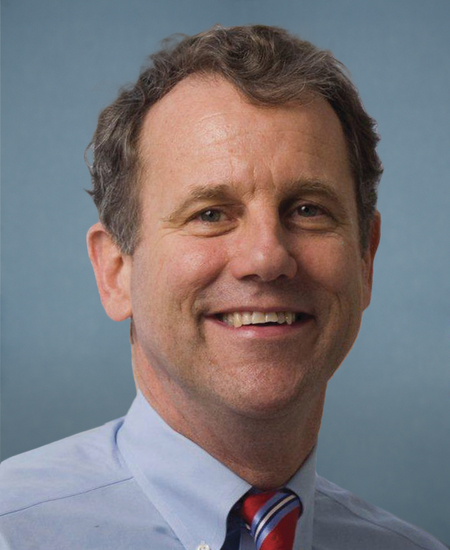
Sen. Sherrod Brown
Sponsored bills
Ulysses S. Grant Bicentennial Recognition Act This joint resolution authorizes the President to posthumously appoint Ulysses S. Grant to the grade of General of the Armies of the United States, effective on April 27, 2022.
Tyler Clementi Higher Education Anti-Harassment Act of 2021 This bill addresses harassment at institutions of higher education (IHEs). Specifically, the bill requires each IHE to include in its annual security report a statement of policy regarding harassment on the basis of a student's actual or perceived race, color, national origin, sex (including sexual orientation, gender identity, pregnancy, childbirth, a medical condition related to pregnancy or childbirth, and a sex stereotype), disability, or religion. In addition, the Department of Education may award grants to IHEs to initiate, expand, or improve programs to (1) prevent the harassment of students; (2) provide counseling or redress services to students who have been harassed or accused of subjecting other students to harassment; or (3) educate and train students, faculty, or staff to prevent harassment or address harassment if it occurs.
Radiation Exposure Compensation Act Amendments of 2021 This bill expands two programs that compensate individuals who were exposed to radiation during certain nuclear testing or uranium mining and subsequently developed medical conditions, including cancers. First, the bill expands and extends a program that compensates individuals who were exposed to radiation from atmospheric nuclear testing or other sources and subsequently developed specified cancers. Under current law, this program compensates individuals who were present in a designated geographic area during a period of nuclear testing and certain individuals employed in uranium mining. The bill expands the designated areas to include Colorado, Idaho, Montana, New Mexico, and Guam and additional areas in Arizona, Nevada, and Utah; makes more individuals who worked in uranium mining eligible for the program; increases the amount of compensation awarded to and provides medical benefits for eligible claimants; and extends for 19 years following the bill's enactment the fund that supports this program and the statute of limitations for filing claims (currently, the program terminates on July 10, 2022). Second, the bill makes certain individuals employed in uranium mines or mills eligible for a program that compensates workers, including Department of Energy employees and contractors, for illnesses caused by occupational exposure to radiation and hazardous substances during development and testing of the nation's nuclear weapons stockpile. The bill also establishes a grant program in the National Institute of Environmental Health Sciences for institutions of higher education to study the epidemiological impacts of uranium mining and milling among individuals without occupational exposure.
This resolution declares that Congress remains steadfast in its commitment to the people of Puerto Rico and the U.S. Virgin Islands to assist in restoring the islands to their full potential and that Congress will not abandon U.S. citizens living there or on the U.S. mainland in the aftermath of Hurricane Maria.
Financial Compensation for CFPB Whistleblowers Act This bill requires the Consumer Financial Protection Bureau to provide rewards to whistleblowers who report information relating to a violation of consumer financial law resulting in certain monetary sanctions exceeding $1 million. Specifically, the bureau must award compensation to whistleblowers for 10%-30% of the collected penalties. In cases where the bureau collects less than $1 million in penalties, the bureau must award any single whistleblower 10% of the amount collected or $50,000, whichever is greater. The bill also sets forth requirements regarding the legal representation of a whistleblower and provides for confidentiality regarding the whistleblower's identity.
Stock Buyback Accountability Act of 2021 This bill imposes a 2% excise tax on the value of any stock of certain publicly-traded domestic and foreign corporations repurchased (i.e., redeemed) by such corporations. The bill allows exemptions from the tax for repurchases that are part of a reorganization, for repurchased stock that is contributed to an employer-sponsored retirement plan or employee stock ownership plan, for repurchased stock whose value does not exceed $1 million, and for repurchases treated as dividends.
Pediatric Access to Critical Health Care Act This bill requires the Health Resources and Services Administration (HRSA) to award grants to children's hospitals and other providers that predominately treat individuals under 21 for improving pediatric health care infrastructure. In awarding the grants, HRSA must prioritize recipients that serve significant numbers of patients receiving medical assistance through Medicaid or the Children's Health Insurance Program or children from other underserved groups.
This resolution honors the life, legacy, and achievements of MacNolia Cox.
Do No Harm Act This bill prohibits the application of the Religious Freedom Restoration Act of 1993 (RFRA) to specified federal laws or the implementation of such laws. Currently, RFRA prohibits the government from substantially burdening a person's exercise of religion even if the burden results from a rule of general applicability, except in furtherance of a compelling governmental interest when using the least restrictive means. Under the bill, RFRA is inapplicable to laws or the implementation of laws that protect against discrimination or the promotion of equal opportunity (e.g., the Civil Rights Act of 1964); require employers to provide wages, other compensation, or benefits, including leave; protect collective activity in the workplace; protect against child labor, abuse, or exploitation; or provide for access to, information about, referrals for, provision of, or coverage for, any health care item or service. The bill prevents RFRA from being used to deny (1) goods or services the government has contracted, granted, or made an agreement to provide to a beneficiary of or participant in a program or activity funded by such government contract, grant, agreement, or other award; or (2) a person's full and equal enjoyment of a government-provided good, service, benefit, facility, privilege, advantage, or accommodation. In order for a person to assert a RFRA claim or defense in a judicial proceeding, the government must be a party to the proceeding.