

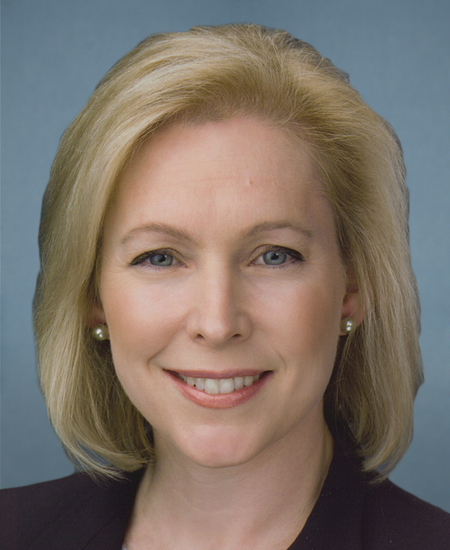
Photo of Kirsten E. Gillibrand
D United States Senate · New York

Sen. Kirsten E. Gillibrand

Compare
Total votes
1,054
all sessions
Attendance
100%
5 missed
Near the chamber average
With party
96%
of cast votes
Lower than 81% of chamber peers
Bipartisan score
2%
crosses aisle rarely
Higher than 79% of chamber peers
Sponsored
1,674
bills & resolutions
Higher than 79% of chamber peers
Committees
12
assignments
1,674 bills and resolutions

Sponsored bills

Total
1,674
Primary
223
Co-sponsor
1,451
This page
1,674
matching current filters
Co-sponsor S 1514
In committee · United States Senate · Co-sponsor
HELPER Act of 2023

Maddy summaryThe HELPER Act of 2023 creates a new FHA mortgage insurance program allowing eligible first responders and K-12 teachers to secure home loans with **no down payment**. It directly affects full-time law enforcement officers, firefighters, paramedics, EMTs, and public/private K-12 teachers who have worked in their roles for at least 4 of the past 5 years. Key provisions include requiring housing counseling, verifying employment status, and prohibiting monthly mortgage insurance premiums (replacing standard FHA requirements). The bill authorizes $660,000 for 2024 and $160,000 annually from 2025-2030 to fund this program, which expires after 5 years.

In committee Mar 12, 2024 1 co-sponsor
Co-sponsor S 1267
In committee · United States Senate · Co-sponsor
Fair Housing Improvement Act of 2023

Maddy summaryS.1267, the Fair Housing Improvement Act of 2023, expands federal housing anti-discrimination protections under the Fair Housing Act. It adds "source of income" (including housing vouchers, Social Security benefits, child support, and other lawful income), "veteran status," and "military status" as protected categories in housing. This directly affects renters and homebuyers using these income sources or who are veterans/military members, prohibiting landlords and housing providers from discriminating against them. The bill amends key sections of the Fair Housing Act to include these new categories and provides a 40-month transition period for agencies to adjust certifications.

In committee Mar 12, 2024 1 co-sponsor
Co-sponsor S 3883
In committee · United States Senate · Co-sponsor
Showing Up for Students Act

Maddy summaryThis bill provides $280 million in federal funding for the Office for Civil Rights (OCR) within the Department of Education for fiscal year 2024, with funds available through 2025. The OCR enforces civil rights laws in schools, investigating complaints related to discrimination based on race, gender, disability, or other protected characteristics. This funding directly supports the OCR's existing operations to address inequities in educational settings nationwide. It does not create new student programs or directly affect specific individuals, but rather strengthens the agency's capacity to handle civil rights cases in schools.

In committee Mar 6, 2024 1 co-sponsor
Primary S 3884
In committee · United States Senate · Lead sponsor
Providing Child Care for Police Officers Act of 2024

Maddy summaryThis bill creates a federal grant program to help states fund child care programs specifically for the children of police officers during their irregular work shifts. States compete for grants to support law enforcement agencies (with 20% of funds reserved for agencies employing fewer than 200 officers), covering costs like facility setup, provider training, and extended hours. Grantees must contribute matching funds (10-33% over three years) and follow state licensing standards. The program, authorized for $24 million annually through 2029, aims to address child care challenges tied to law enforcement work schedules.

In committee Mar 6, 2024 0 co-sponsors
Co-sponsor S 3842
In committee · United States Senate · Co-sponsor
Muhammad Ali Congressional Gold Medal Act

Maddy summaryThis bill authorizes Congress to award Muhammad Ali a Congressional Gold Medal in recognition of his lifetime achievements as a boxer, humanitarian, and civil rights advocate. The medal, designed by the Treasury Secretary, will be presented to Ali's wife, Lonnie Ali, following his death in 2016. Duplicate bronze medals may be sold to cover costs, with proceeds going to the U.S. Mint fund. The bill has no policy impact - it is purely commemorative, honoring Ali's contributions to sports, human rights, and Parkinson's disease advocacy.

In committee Feb 29, 2024 1 co-sponsor
Co-sponsor S 4
In committee · United States Senate · Co-sponsor
John R. Lewis Voting Rights Advancement Act of 2024

Maddy summaryThe John R. Lewis Voting Rights Advancement Act of 2024 updates the Voting Rights Act of 1965 to strengthen protections against voting discrimination. It clarifies how to prove vote dilution, denial, or abridgement claims and expands the types of voting changes requiring federal preclearance, including changes to election methods, boundaries, voter ID requirements, and polling locations. The bill requires states to provide public notice of voting changes at least 48 hours in advance and mandates transparency about demographic data related to polling places. This legislation directly affects states and political subdivisions with a history of voting rights violations, aiming to protect minority voters from discriminatory voting practices.

In committee Feb 29, 2024 1 co-sponsor
Primary S 3827
In committee · United States Senate · Lead sponsor
Strategic Plan for Aging Act

Maddy summaryS 3827, the Strategic Plan for Aging Act, requires states, tribes, and tribal organizations to develop coordinated 10-year plans ("Multisector Plans for Aging") to address aging needs. These plans must be created with input from older adults, caregivers, disability advocates, and community groups, and cover key areas like housing stability, healthcare access, social connection, and equity. The bill provides competitive grants (up to $500,000 per entity) to support the planning process, with at least 10 grants reserved for tribal entities. The plans must guide long-term policy and service coordination for older adults - especially those with disabilities, caregivers, and underserved groups - across health, housing, economic security, and disaster response.

In committee Feb 28, 2024 0 co-sponsors
Co-sponsor SRES 553
Passed · United States Senate · Co-sponsor
A resolution honoring the life of Jean A. Carnahan, former Senator for the State of Missouri.

Maddy summarySRES 553 is a ceremonial Senate resolution honoring Jean A. Carnahan, who served as Missouri’s first female U.S. Senator from 2001 to 2002 after her husband’s passing. The resolution expresses the Senate’s sorrow over her death, recognizes her service as First Lady of Missouri and U.S. Senator, and her advocacy for families and veterans. It directs the Senate Secretary to share the resolution with the House and Carnahan’s family, with no substantive policy changes or affected parties. This is a standard commemorative measure with no legislative impact.

Passed Feb 12, 2024 1 co-sponsor
Co-sponsor SRES 547
In committee · United States Senate · Co-sponsor
A resolution acknowledging the two-year anniversary of Russia's further invasion of Ukraine and expressing support for the people of Ukraine.

Maddy summarySRES 547 is a symbolic Senate resolution commemorating the two-year anniversary of Russia's full-scale invasion of Ukraine (launched February 24, 2022). It expresses U.S. support for Ukraine's territorial integrity and sovereignty, condemns Russian actions including war crimes (like the Bucha massacre), and reaffirms congressional backing for Ukraine's defense against aggression. The resolution has no binding effect or policy changes - it serves as a formal statement of solidarity with Ukraine, acknowledging the humanitarian crisis and international aid efforts. It was introduced by 31 Senators and does not alter laws, funding, or military commitments.

In committee Feb 8, 2024 1 co-sponsor
Co-sponsor S 3747
In committee · United States Senate · Co-sponsor
Removing Access Barriers to Running for Elected Office for People with Disabilities Act

Maddy summaryThis bill removes a barrier for people with disabilities seeking elected office by ensuring campaign work they perform doesn't affect their eligibility for federal or state benefits. Specifically, it requires that any campaign work done by a candidate with a disability - and any compensation received for that work - be disregarded when calculating benefits under programs like Social Security Disability Insurance (Title II) or Supplemental Security Income (Title XVI). This means individuals receiving disability benefits could run for office without risking loss of support due to campaign earnings. The law directly affects disabled candidates for federal, state, or local office who rely on these benefits.

In committee Feb 7, 2024 1 co-sponsor
Showing 721 to 730 of 1,674 bills
Previous 1 … 72 73 74 … 168 Next