

Maddy summaryThe Advancing Quantum Manufacturing Act of 2025 requires the Department of Energy and National Science Foundation to coordinate their quantum research through a dedicated liaison and cover a broad range of quantum technologies, including computing, sensing, and enabling tools like lasers and cryogenics. It directs the Commerce Department to establish a new Manufacturing USA institute focused on scaling up quantum manufacturing - providing end-to-end capabilities for design, fabrication, testing, and workforce development in quantum computing, sensing, and communication systems. The bill also mandates two studies: one by the National Academies to assess progress in the National Quantum Initiative Program, and another to identify collaboration barriers between research centers, industry, and academia. These provisions aim to accelerate domestic quantum technology production for national security and economic competitiveness.
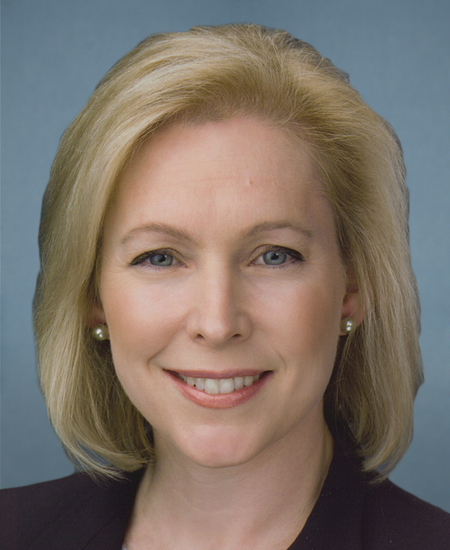
Sen. Kirsten E. Gillibrand
Sponsored bills
Maddy summaryThe Public Service Freedom to Negotiate Act of 2025 establishes federal minimum standards for collective bargaining rights for public employees and supervisory employees. The Federal Labor Relations Authority will determine if states' laws "substantially provide" these rights, and if not, the federal standards will apply to affected workers. The bill guarantees rights like forming labor organizations, negotiating wages and working conditions, and resolving disputes through mediation or arbitration, while prohibiting strikes that would disrupt emergency services. Existing collective bargaining agreements and units are protected from the bill's implementation.
Maddy summaryThis resolution (SRES 159) is a ceremonial Senate measure honoring the late Senator John Bennett Johnston, Jr. (1932-2024), who represented Louisiana in the U.S. Senate from 1972 to 1997. It commemorates his career, including his work on energy policy, flood control, and Louisiana conservation efforts, and requests the Senate adjourn in his memory while sending condolences to his family. As a non-binding resolution, it has no policy impact or direct effect on any individuals or laws.
Maddy summaryS 1275, the Impact Aid Infrastructure Partnership Act, provides federal funding to help schools on federal lands improve their aging facilities. It targets federally impacted local educational agencies (those serving schools on federal property like Indian reservations or military bases) that struggle with poor building conditions and limited local funding capacity. The bill authorizes $250 million annually for four years to fund competitive emergency repairs for schools with health/safety hazards and formula grants for agencies with limited bonding capacity. Local matching requirements vary based on financial capacity, with some agencies required to contribute 10-25% of project costs depending on their ability to pay.
Maddy summaryThe IDEA Full Funding Act (S 1277) mandates specific annual funding levels for the Individuals with Disabilities Education Act (IDEA) starting in fiscal year 2026. It sets fixed dollar amounts or percentage-based funding (ranging from 11.6% to 40% of a calculated base) for states providing special education services to children with disabilities aged 3-21. Funding becomes available on July 1 each year and remains accessible through September 30 of the following year, with amounts increasing annually through 2035. This directly affects all states receiving IDEA grants by guaranteeing minimum federal funding tied to the number of eligible students and national per-pupil spending averages.
Maddy summaryThe Driving Forward Act permanently exempts certain school bus drivers from needing to pass a pre-trip vehicle inspection test when obtaining a commercial driver's license (CDL). This directly affects school bus drivers in states that choose to participate in the exemption, as they will no longer need to complete this specific test. The bill also requires participating states to submit annual reports for six years after enactment, tracking how many drivers obtain CDLs under this exemption. The exemption extends a temporary rule previously published in the Federal Register (December 2, 2024), making it permanent without altering other CDL requirements.
Maddy summaryS 1289 authorizes the U.S. Mint to produce and sell commemorative $5 gold and $1 silver coins to mark the 25th anniversary of the September 11, 2001, terrorist attacks. The bill specifies coin specifications (e.g., 90% gold/silver content, design requirements including "Never Forget"), sets a one-year issuance window (January 1, 2027-2028), and requires surcharges of $35 per gold coin and $10 per silver coin. These surcharges will be paid directly to the National September 11 Memorial and Museum to support its operations and maintenance, with coins sold at a price covering face value, surcharge, and production costs. The legislation does not impose new regulations or affect public policy but focuses on commemoration and funding for the museum.
Maddy summaryThis bill would allow workers to deduct union dues directly from their taxable income (an "above-the-line" deduction) and restore deductions for other work-related expenses like uniforms or tools that were disallowed after 2017. It affects employees who pay union dues or incur job-specific costs, particularly those in unionized workplaces or professions requiring specialized equipment. The key mechanism creates a new deduction for union dues under existing tax code sections and revives the ability to itemize other work expenses, excluding them from the 2% floor on miscellaneous deductions. These changes would apply to tax returns filed for years beginning after December 31, 2024.
Maddy summaryThe Fair Day in Court for Kids Act of 2025 requires the government to provide free legal counsel at no cost to unaccompanied children in immigration court proceedings, starting as soon as possible after a notice to appear is issued. It mandates that children receive their complete immigration file within 7 days and have at least 10 days to review it before court proceedings continue, unless they waive this time. The bill also requires annual reports to Congress on the number of children represented, their nationalities and ages, and the effectiveness of legal representation programs.
Maddy summaryThis bill requires the Department of Housing and Urban Development (HUD) to develop guidelines for states and local governments to reform zoning laws that limit housing supply. The guidelines would recommend specific changes like eliminating parking minimums, allowing more housing types (such as duplexes and accessory units), and streamlining approval processes for new projects. It directly affects state and local governments, housing developers, and communities facing housing shortages - addressing a 3.85 million home shortfall cited in the bill. HUD must report to Congress on which states and localities adopt these reforms and their impact on building permits.