

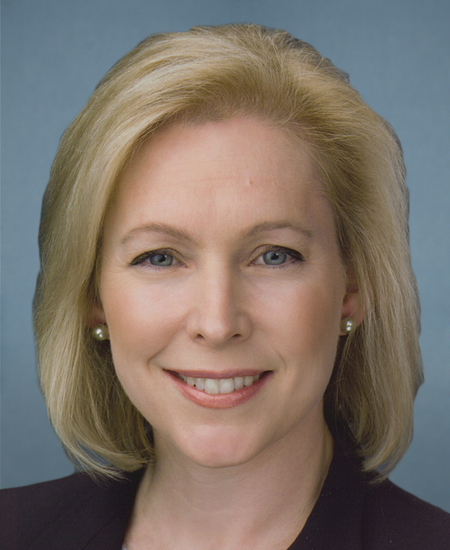
Photo of Kirsten E. Gillibrand
D United States Senate · New York

Sen. Kirsten E. Gillibrand

Compare
Total votes
1,044
all sessions
Attendance
100%
5 missed
Near the chamber average
With party
96%
of cast votes
Lower than 81% of chamber peers
Bipartisan score
2%
crosses aisle rarely
Higher than 79% of chamber peers
Sponsored
1,667
bills & resolutions
Higher than 79% of chamber peers
Committees
12
assignments
1,667 bills and resolutions

Sponsored bills

Total
1,667
Primary
222
Co-sponsor
1,445
This page
1,667
matching current filters
Primary SCONRES 25
Passed · United States Senate · Lead sponsor
A concurrent resolution recognizing the 15th anniversary of the January 8, 2011, Tucson, Arizona, shooting and honoring the survivors and victims, including former Congresswoman Gabby Giffords, a gun violence survivor and one of the most influential voices of courage in the United States in the fight to end gun violence.

Maddy summaryThis concurrent resolution (SCONRES 25) commemorates the 15th anniversary of the January 8, 2011, Tucson shooting that killed six people and injured 13, including former Congresswoman Gabby Giffords. It honors the victims (such as Judge John Roll, Gabriel Zimmerman, and 9-year-old Christina-Taylor Green), survivors like Giffords and Ron Barber (who later became a U.S. Representative), and the community's response. The resolution expresses support for survivors, recognizes Giffords’ advocacy against gun violence, and reaffirms commitment to respectful dialogue and opposing political violence. As a symbolic gesture, it does not enact new laws or policy changes.

Passed Feb 13, 2026 0 co-sponsors
Co-sponsor S 3869
In committee · United States Senate · Co-sponsor
Healthy Families Act

Maddy summaryThe Healthy Families Act would require most private employers and certain government entities to provide employees with earned paid sick time, allowing workers to take up to 56 hours per year for their own health needs, caring for family members, or addressing domestic violence, sexual assault, or stalking. Employees would earn 1 hour of paid sick time for every 30 hours worked, with the ability to use it for medical appointments, caring for family members with health needs, or seeking safety from violence. The bill prohibits employers from retaliating against workers who use this time and requires employers to post clear notices about the policy. It applies to most private employers, with specific provisions for government entities like the Library of Congress and Government Accountability Office.

In committee Feb 12, 2026 1 co-sponsor
Co-sponsor S 3892
In committee · United States Senate · Co-sponsor
Stop Price Gouging in Grocery Stores Act of 2026

Maddy summaryThis bill prohibits grocery stores from charging unreasonably high prices (defined as 120% or more of a product’s average price over the prior six months) unless they prove the increase stems from uncontrollable costs like supply chain issues. It bans using personal data - such as facial recognition or purchase history - to set different prices for individual shoppers and requires clear signage about facial recognition use at store entrances. Large grocery stores (over 10,000 sq ft) must replace electronic shelf labels with physical price tags. The Federal Trade Commission enforces these rules, allowing states and consumers to seek $3,000 per violation in court for price gouging or data misuse.

In committee Feb 12, 2026 1 co-sponsor
Primary S 3883
In committee · United States Senate · Lead sponsor
Language Access to Gun Violence Prevention Strategies Act of 2026

Maddy summaryThis bill requires the Department of Justice and Health and Human Services to translate key gun violence prevention materials - including extreme risk protection orders and safe storage guides - into priority languages (like Mandarin, Spanish, and others spoken by 3%+ of a population) for limited English proficiency (LEP) communities. It mandates that translated materials undergo review by community-based organizations serving those language groups before release. Grant applications for gun violence prevention programs must include targeted outreach plans for LEP populations, and federal agencies must develop public awareness campaigns in multiple languages. The law directly affects federal agencies, community organizations, and LEP populations seeking access to gun safety resources and prevention strategies.

In committee Feb 12, 2026 0 co-sponsors
Primary S 3882
In committee · United States Senate · Lead sponsor
Fair Legal Access Grants Act

Maddy summaryThis bill creates a federal grant program to provide legal resources for individuals seeking extreme risk protection orders (ERPOs), which temporarily remove firearms from people deemed a risk to themselves or others. It authorizes $50 million annually (2027-2031) for states, local governments, and tribes to fund legal counsel, multilingual resource centers, and training for legal and law enforcement staff on ERPO processes. The grants specifically aim to help "covered petitioners" (those eligible to request ERPOs) access representation and understand the legal process, including distinguishing ERPOs from domestic violence protection orders. The bill does not change ERPO standards or create new court jurisdiction but ensures petitioners have legal support.

In committee Feb 12, 2026 0 co-sponsors
Co-sponsor S 3855
In committee · United States Senate · Co-sponsor
United States-Israel Framework for Upgraded Technologies, Unified Research, and Enhanced Security (FUTURES) Act of 2026

Maddy summaryThe FUTURES Act (S 3855) establishes a formal U.S.-Israel Defense Technology Cooperation Initiative to accelerate joint development and integration of defense technologies. It directs the U.S. Secretary of Defense to identify Israeli-origin technologies for rapid adoption into American military systems, focusing on areas like counter-drone systems, missile defense, AI, cyber security, and directed energy. The bill authorizes $150 million annually (2027-2029) for this initiative, requiring regular reports to Congress on progress, technology transitions, and industry partnerships. This policy directly affects U.S. defense contractors, Israeli defense firms, and military acquisition programs by creating new pathways to incorporate Israeli innovations into U.S. systems.

In committee Feb 12, 2026 1 co-sponsor
Co-sponsor S 3861
In committee · United States Senate · Co-sponsor
Rural Innovation Stronger Economy (RISE) Reauthorization Act of 2026

Maddy summaryThis bill reauthorizes and expands the Rural Innovation Stronger Economy (RISE) grant program, providing $50 million annually from 2027 to 2031 to support economic development in rural communities. It specifically targets small rural areas, requiring that at least 10% of funds annually go to communities with fewer than 10,000 residents and encouraging broad representation across diverse rural community types. The bill removes previous references to "industry clusters" and instead focuses on grants supporting local economic activities, networks, and regional partnerships. It directly affects rural counties and towns seeking federal funding for projects like workforce training, infrastructure, and business development. The program aims to strengthen economic opportunities in underserved rural regions through targeted grant funding.

In committee Feb 12, 2026 1 co-sponsor
Co-sponsor S 3827
In committee · United States Senate · Co-sponsor
Financial Disclosure Modernization Act

Maddy summaryThis bill updates financial disclosure reporting thresholds for federal employees under Title 5, U.S. Code. It revises the dollar amounts requiring disclosure for certain financial interests (like dividends, rents, interest, and capital gains) by adding new higher-value brackets, ranging from $5 million to $1 billion. The bill also modifies asset value reporting categories, introducing new tiers from $50 million up to $1 billion. These changes apply to financial disclosure reports filed on or after the bill's enactment date. The bill directly affects federal employees required to submit financial disclosure reports under Chapter 131 of Title 5.

In committee Feb 11, 2026 1 co-sponsor
Co-sponsor S 3842
In committee · United States Senate · Co-sponsor
21st Century WIC Act of 2026

21st Century WIC Act of 2026 This bill permanently allows individuals to remotely certify their eligibility for, and receive benefits through, the Special Supplemental Nutrition Program for Women, Infants, and Children (WIC). Specifically, the bill requires that a state agency allow an individual seeking a WIC certification, recertification, or a nutritional risk evaluation to do so by phone or through video teleconference, in addition to the in-person option. A state agency has 90 days to collect data for a nutritional risk evaluation for a remotely certified individual. Further, a state agency may consider an applicant who meets the income eligibility standards to be temporarily eligible on an interim basis to participate in the program and may certify the individual for immediate participation without waiting for a nutritional risk evaluation. The bill also allows states to provide benefits on WIC electronic benefit transfer cards through mail or remote issuance instead of requiring participants to pick up or reload benefits in person at a WIC office. Further, the Department of Agriculture must report to Congress about the use of remote technologies and other digital tools in the WIC program. Currently, individuals are generally required to be physically present to certify their WIC eligibility and receive benefits, with exceptions. The Food and Nutrition Service has temporarily waived these requirements and allowed remote certification and benefits using authorities that were originally provided by laws that were enacted to address COVID-19.

In committee Feb 11, 2026 1 co-sponsor
Co-sponsor S 3833
In committee · United States Senate · Co-sponsor
LCBP Enhancements Act of 2026

Maddy summaryThis bill amends the Federal Water Pollution Control Act to establish a formal process for selecting and evaluating a fiscal agent managing the Patrick Leahy Lake Champlain Basin Program. It requires the Steering Committee and EPA Administrator to jointly select a qualified entity (e.g., nonprofit or commission) to handle program finances and administration, with assessments every five years to determine if a new agent is needed through competitive selection. The new fiscal agent must be headquartered in the Lake Champlain drainage basin, or in New York/Vermont if no local entity qualifies, ensuring local oversight. The bill also adds provisions allowing the Great Lakes Fishery Commission to collaborate on Lake Champlain fisheries work, including research and invasive species management.

In committee Feb 11, 2026 1 co-sponsor
Showing 211 to 220 of 1,667 bills
Previous 1 … 21 22 23 … 167 Next