

Veterinary Medicine Loan Repayment Program Enhancement Act This bill modifies the requirements for calculating taxable income to exclude from gross income payments under the federal veterinary medicine loan repayment program or any state loan repayment or forgiveness program that is intended to provide for increased access to veterinary services in such state.
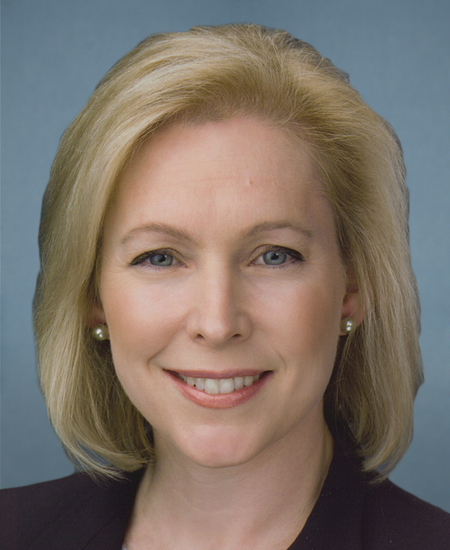
Sen. Kirsten E. Gillibrand
Sponsored bills
Historic Tax Credit Growth and Opportunity Act of 2021 This bill increases the rehabilitation tax credit and modifies certain requirements for the credit. The bill increases the rate of the credit to 30% for small projects (rehabilitation expenditures not exceeding $3.75 million) and caps the credit for such projects at $750,000 for all taxable years. The bill also expands the types of buildings eligible for rehabilitation by decreasing the rehabilitation threshold from 100% to 50% of project expenses. It also eliminates the basis adjustment requirement for the credit and modifies rules relating to the eligibility of tax-exempt use property for the credit.
Therapeutic Fraud Prevention Act of 20 21 This bill prohibits commercial conversion therapy, which is a practice or treatment designed to change a person's sexual orientation or gender identity or otherwise change behaviors, thoughts, or expressions related to gender or sexual attraction. This prohibition does not apply to treatment that assists an individual undergoing a gender transition or facilitates identity exploration and development.
Minor League Baseball Relief Act This bill establishes a program for the relief of certain minor league baseball clubs and independent professional baseball clubs that experienced large business losses. The bill provides funding for the Small Business Administration to make grants to such clubs that experienced decreases in gross revenue in 2020 of at least 75%, as measured against revenues in 2019 (or, if revenues were negatively affected by a natural disaster or weather disruption in 2019, by the average of revenues over the prior three-year period). The source of funding for the grants shall be funds appropriated under enacted COVID-19 relief legislation that have not been obligated and are no longer being used to carry out activities authorized under those laws. Grant amounts provided to any club may not exceed $10 million.
Championing Apprenticeships for New Careers and Employees in Technology Act or the CHANCE in TECH Act This bill requires the Department of Labor to enter into contracts with industry intermediaries to promote the development of and access to apprenticeships in the technology sector. The Department of Education (ED) may issue CHANCE in TECH Awards for 21st Century Schools to secondary schools or junior or community colleges that demonstrate high achievement in providing students necessary skills to compete in the 21st century workforce. In making an award, ED must consider the availability of science, technology, engineering, and mathematics (STEM), career and technical education, and computer technology courses at the schools.
Lead-Free Drinking Water for All Act of 2021 This bill reauthorizes through FY2031 and revises the Environmental Protection Agency's grant program for reducing lead in drinking water, including by establishing a deadline for grant recipients to fully replace lead service lines.
Break the Cycle of Violence Act This bill establishes federal grant programs and related entities to support violence intervention initiatives. Specifically, the bill directs the Department of Health and Human Services (HHS) to award grants for coordinated community violence intervention initiatives in communities disproportionately impacted by homicides and community violence. HHS must also establish several related entities, including an Office of Community Violence Intervention to administer programs and activities related to violence intervention; the Community Violence Intervention Advisory Committee to advise and assist the office and HHS; and the National Community Violence Response Center to provide training and technical assistance, coordinate research, and develop data collection policies. Additionally, the bill directs the Department of Labor to award grants for job training and workforce programs in communities disproportionately affected by gun violence to connect youth ages 16 to 24 to in-demand occupations.
Better Care Better Jobs Act This bill establishes programs and provides funds for state Medicaid programs to improve home- and community-based services (HCBS), such as home health care, personal care, case management, and rehabilitative services. Specifically, the bill provides funds for the Centers for Medicare & Medicaid Services to award planning grants, develop quality measures, and provide technical assistance to states regarding specified HCBS improvements, particularly with respect to access, utilization, and the associated workforce. The bill also increases the Federal Medical Assistance Percentage (i.e., federal matching rate) for HCBS in states that develop plans and meet specified benchmarks for improvements. The bill also makes permanent (1) the Money Follows the Person Rebalancing Demonstration Program (a grant program to help states increase the use of HCBS for long-term care and decrease the use of institutional care), and (2) certain provisions regarding Medicaid eligibility that protect against spousal impoverishment for recipients of HCBS.
Even Playing Field Act This bill addresses pay equity for amateur athletes and other personnel. It allows recognition, or continued recognition, of a national governing body of an amateur sports organization only if it provides equal investment, promotional support, working conditions (including staff support and facilities and equipment for training and competition), and wages and other compensation to all amateur athletes, without discrimination based on sex. National governing bodies must report periodically to Congress regarding pay equity. Each report shall include (1) the median compensation for amateur athletes, coaches, trainers, managers, administrators, and officials, disaggregated by race, gender, and employment category; and (2) the minimum and maximum compensation paid to such personnel, disaggregated by race, gender, and employment category.
Israel Relations Normalization Act of 2021 This bill requires the Department of State to take certain actions promoting the normalization of relations between Israel, Arab states, and other relevant countries and regions. Specifically, the State Department must develop a strategy on expanding and strengthening the Abraham Accords (the term used to refer collectively to agreements between Israel and the United Arab Emirates and between Israel and Bahrain marking the public normalization of relations between the two Arab countries and Israel). The strategy must include a description of how the U.S. government will encourage further normalization of relations with Israel. The State Department must report on the status of efforts to promote normalization of relations with Israel and other countries, including information on (1) laws that punish individuals for people-to-people relations with Israelis (i.e., anti-normalization laws), and (2) instances of the use of state-owned or state-operated media outlets to promote the prosecution of citizens or residents of Arab countries calling for peace with Israel.