Maddy summaryThis is a ceremonial Senate resolution (SRES 470) commemorating the death of former U.S. Senator Bob Dole of Kansas. It formally expresses the Senate's sorrow, requests the Secretary of the Senate transmit a copy to Dole's family, and directs the Senate to adjourn as a mark of respect. The resolution has no policy or legal effect - it solely serves as a symbolic tribute to Dole's public service career. It does not affect any individuals or enact new laws.
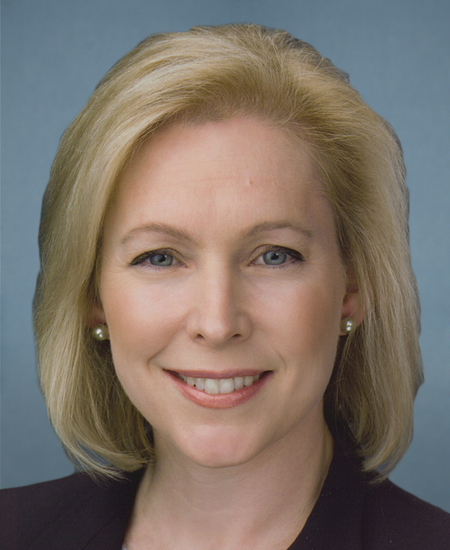
Sen. Kirsten E. Gillibrand
Sponsored bills
Masih Alinejad Harassment and Unlawful Targeting Act of 2021 or the Masih Alinejad HUNT Act of 2021 This bill imposes sanctions on foreign persons (i.e., individuals or entities) that are acting on behalf of Iran's government and involved in the harassment of certain individuals, such as human rights activists. The Department of State must periodically report to Congress the identities of foreign persons acting on behalf of Iran's government that are knowingly responsible for or complicit in the surveillance, harassment, imprisonment, or killing of citizens of Iran or the United States who seek to (1) expose corruption or illegal activity by Iranian government officials; (2) obtain, defend, or promote internationally recognized human rights; or (3) obtain, defend, or promote the rights and well-being of women, religious and ethnic minorities, and the LGBTQ community in Iran. The report must include foreign persons involved in such actions that occur inside or outside Iran. The President must impose property-blocking sanctions on persons identified in the report, as well as visa-blocking sanctions on the identified individuals. The Department of the Treasury must submit to Congress a report identifying any foreign financial institution that knowingly conducts a significant transaction with a person sanctioned under this bill. Treasury may prohibit the opening, or prohibit or impose strict conditions on the maintaining of a U.S. correspondent account or a payable-through account by such a financial institution.

Outdoors for All Act This bill directs the Department of the Interior to establish an outdoor recreation legacy partnership grant program under which Interior may award grants to states, certain political subdivisions of a state, special purpose districts, Indian tribes, or Alaska Native or Native Hawaiian communities or organizations. Funds must be used for projects to (1) acquire land and water for parks and other outdoor recreation purposes in qualifying areas, and (2) develop new or renovate existing outdoor recreation facilities that provide outdoor recreation opportunities to the public in qualifying areas. A qualifying area is an area that has a population of 30,000 or more in the most recent census, or that is administered by an Indian tribe or an Alaska Native or Native Hawaiian community organization. Interior shall give priority to projects that create or significantly enhance access to park and recreational opportunities in an urban neighborhood or community, engage and empower underserved communities and youth, provide opportunities for employment or job training for youth or underserved communities, establish or expand public-private partnerships, and take advantage of coordination among various levels of government.
Dairy Pricing Opportunity Act of 2021 This bill directs the Department of Agriculture (USDA) to hold national hearings to review Federal Milk Marketing Orders. (USDA uses these orders to establish a minimum price for various classes of milk.) The hearings must include the review of proposals from producers and the dairy industry on the price of Class I skim milk.
Protecting America's Meatpacking Workers Act of 2021 This bill addresses workplace conditions and safety with a particular focus on meat and poultry processing establishments and makes other changes to agricultural programs and activities. Generally, the bill provides funding through FY2027 for hiring additional Occupational Safety and Health Administration (OSHA) inspectors and related activities. It also restricts an employer's use of certain attendance policies under which a worker is assessed points for absences with progressive discipline imposed as points accumulate. Additionally, the bill expands protections for workers who exercise their rights under occupational safety and health laws and regulations. This includes specific protections and procedures for workers of meat and poultry processing establishments. The bill expands workplace safety and health requirements that apply to meat and poultry processing establishments, including by prohibiting waivers (subject to limited exceptions) related to line speeds and inspections. Additionally, OSHA must issue standards for these establishments that address, for example, ergonomic program management and preventing occupational exposure to COVID-19. OSHA must also (1) establish, within seven days, a process for establishments to report COVID-19 information; and (2) publish certain regulations regarding a workers' representative accompanying an OSHA inspector during inspections of an establishment. The bill provides funding through FY2031 for, and imposes additional conditions on recipients of, grants to improve meat and poultry processing facilities. Further, the bill increases funding for a program that supports regional and local food systems. It also requires country-of-origin labeling of beef, pork, and dairy products.
Protect America's Children from Toxic Pesticides Act This bill modifies provisions related to the registration, distribution, sale, and use of pesticides, including by cancelling the registration of organophosphates, neonicotinoids, and paraquat and by creating a process for interested individuals to submit a petition to designate an active ingredient or pesticide as a dangerous pesticide.
Food Donation Improvement Act of 2021 This bill expands liability protections for the donation of food and grocery products. Specifically, the bill expands the liability protections to include donations of an apparently fit grocery product or apparently wholesome food for which the recipient is charged a good Samaritan reduced price that is no greater than the cost of handling, administering, and distributing the food or product; or that is donated directly to a needy individual by a retail grocer, wholesaler, agricultural producer, restaurant, caterer, school food authority, or institution of higher education. The Department of Agriculture must issue regulations that clarify the quality and labeling standards that food products donated under the Bill Emerson Good Samaritan Food Donation Act must meet to be eligible for liability protection.
This bill redesignates the Geospatial Learning Center in the Next NGA West facility in St. Louis, Missouri, as the Senator Roy Blunt Geospatial Learning Center.
Transformation to Competitive Integrated Employment Act This bill addresses employment standards for people with disabilities. First, the Department of Labor must award grants to states and certain eligible entities to assist them in transforming their business and program models to support people with disabilities by providing competitive integrated employment, assisting them in finding and retaining work in such employment, providing them with integrated employment and integrated community participation and wraparound services, and ensuring that such services comply with federal regulations for individuals receiving home and community-based services. The bill also prohibits the issuance of new special certificates that allow payment of subminimum wages to people with disabilities and phases out existing certificates over a five-year period. Further, Labor's Office of Disability Employment must award grants for technical assistance and other strategic support to employers transitioning from special certificates to competitive integrated employment for people with disabilities. Labor must contract with a nonprofit entity to conduct an evaluation of the impact of these transitions.
Bolstering Infectious Outbreaks Preparedness Workforce Act of 2021 or the BIO Preparedness Workforce Act of 2021 This bill establishes a student loan repayment program for health care and related professionals who are engaged in either bio-preparedness and response activities or infectious disease care in underserved communities. For each year that a professional meets the work requirements of the program, the Health Resources and Services Administration may pay up to $50,000 of the professional's student loan principal and interest, up to a maximum amount of $150,000.