

This resolution remembers Her Majesty Queen Elizabeth II and her more than 70 years of service in support of the British people and the Commonwealth of Nations. The resolution also expresses gratitude to Queen Elizabeth II for her efforts to maintain strong bilateral relations between the United Kingdom and the United States. Finally, the resolution extends condolences to the family of Queen Elizabeth II, to the people of the United Kingdom of Great Britain and Northern Ireland, and to the peoples of the Commonwealth of Nations.
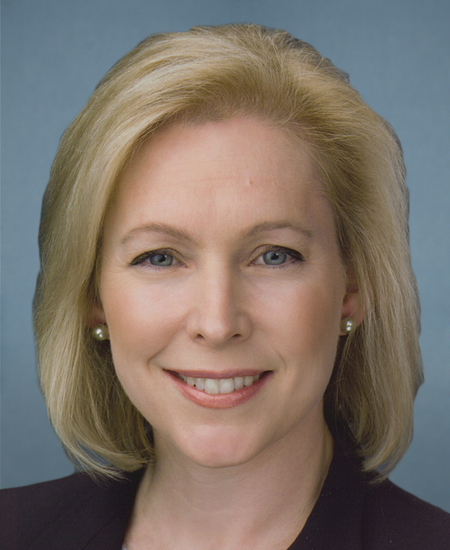
Sen. Kirsten E. Gillibrand
Sponsored bills
Nationwide Right To Unionize Act This bill provides authorization for labor agreements to require membership in a labor organization as a condition of employment regardless of state law (thus preempting state laws that prohibit such agreements).
Secure and Fair Enforcement Banking Act of 2021 or the SAFE Banking Act of 2021 This bill generally prohibits a federal banking regulator from penalizing a depository institution for providing banking services to a legitimate cannabis-related business. Prohibited penalties include terminating or limiting the deposit insurance or share insurance of a depository institution solely because the institution provides financial services to a legitimate cannabis-related business and prohibiting or otherwise discouraging a depository institution from offering financial services to such a business. Additionally, proceeds from a transaction involving activities of a legitimate cannabis-related business are not considered proceeds from unlawful activity. Proceeds from unlawful activity are subject to anti-money laundering laws. Furthermore, a depository institution is not, under federal law, liable or subject to asset forfeiture for providing a loan or other financial services to a legitimate cannabis-related business. The bill also provides that a federal banking agency may not request or order a depository institution to terminate a customer account unless (1) the agency has a valid reason for doing so, and (2) that reason is not based solely on reputation risk. Valid reasons for terminating an account include threats to national security and involvement in terrorist financing, including state sponsorship of terrorism.
This resolution expresses that the Senate has heard the announcement of the death of the Honorable Jacqueline R. Walorski, Congresswoman for the Second Congressional District of Indiana. The resolution also honors Representative Walorski for her service to Indiana and the United States. The resolution expresses that when the Senate adjourns today, it stands adjourned as a further mark of respect to the memory of Representative Walorski.
National Flood Insurance Program Reauthorization and Reform Act of 2021 This bill generally revises the National Flood Insurance Program (NFIP) and reauthorizes the program through FY2026. The bill addresses NFIP coverage, cost, and availability, including by generally prohibiting the Federal Emergency Management Agency (FEMA) from raising certain premiums, surcharges, and fees more than 9% a year for five years; revising flood insurance coverage limits; establishing a means-tested program to provide financial assistance to low income households through policy discounts; and revising standards and certification requirements for flood insurance rate maps. The bill also revises administrative provisions of the NFIP, including by allowing for the continuous operation of the NFIP during a lapse in appropriations, and prohibiting the Department of the Treasury from charging FEMA interest for NFIP debt for five years. The bill sets forth requirements for Write Your Own companies related to reimbursements, agent commissions, and penalties for underpayment of claims. (A Write Your Own company writes and services federal standard flood insurance policies in its own name.) The bill establishes state or tribal government revolving funds for flood mitigation activities and also provides for loans, grants, and other incentives regarding mitigation.
Livable Communities Act of 2021 This bill creates the Office of Sustainable Communities in the Department of Housing and Urban Development (HUD) to coordinate the provision of long-term affordable housing, transportation, and environmental projects and to administer grant programs established in the bill. The bill creates the Comprehensive Planning Grant Program and the Community Challenge Grant Program to be administered by the office. Grants under the Comprehensive Planning Grant Program must be used for specified activities related to the coordination, development, or updating of a comprehensive regional plan across jurisdictions and agencies. Grants offered under the Community Challenge Grant Program must be used to promote integrated planning and investments across policy and governmental jurisdictions and to implement projects identified in a regional plan. The bill also creates a program that requires HUD to provide loans and loan guarantees to projects that meet specified criteria. Eligible projects must be part of a community-wide development plan, promote sustainable development, and ensure that housing units associated with the project are affordable and initially occupied by lower-income renters or homeowners.
Reproductive Health Care Accessibility Act This bill establishes various grants and related programs that address sexual and reproductive health care for individuals with disabilities. Specifically, the Health Resources and Services Administration must support training for health care providers who offer sexual and reproductive health care to individuals with disabilities, and educating individuals with disabilities about sexual and reproductive health care. The Administration for Community Living must establish a national center to provide recommendations, technical assistance, and other resources related to the provision of sexual and reproductive health care for individuals with disabilities. The bill also authorizes support for medical schools, nursing schools, and other educational institutions that offer obstetrics and gynecology training programs to expand the number of individuals with disabilities entering the reproductive health care workforce. Additionally, the Department of Health and Human Services must study the effectiveness and other aspects of reproductive health care services and programs for individuals with disabilities.
Maddy summaryThis bill would add wigs to Medicare's list of covered durable medical equipment by amending the Social Security Act to include "cranial prostheses" (such as wigs) under coverage. It directly affects Medicare beneficiaries requiring wigs for medical reasons, such as hair loss due to cancer treatment, who currently lack this coverage. The key provision requires a dermatologist, oncologist, or physician to provide written certification of medical necessity as part of rehabilitative treatment. This change would allow Medicare to cover wigs under the same framework as other durable medical equipment like walkers or wheelchairs.
Preventing a Patronage System Act of 2022 or the PPSA Act of 2022 This bill prohibits executive agency positions in the competitive service from being placed in the excepted service, unless such positions are placed in Schedules A through E as in effect on September 30, 2020. The bill also prohibits positions in the excepted service from being placed in any schedule other than the aforementioned schedules. On October 21, 2020, former President Donald Trump issued an executive order titled Creating Schedule F in the Excepted Service . The order placed executive agency positions that are of a confidential, policy-determining, policy-making, or policy-advocating character, and that are not normally subject to change as a result of a presidential transition, under a new schedule in the excepted service (Schedule F) instead of the competitive service. The order also required any such positions in the excepted service to be reclassified to Schedule F. The order was revoked by President Joe Biden on January 22, 2021.
Let Doctors Provide Reproductive Health Care Act This bill sets out protections for and establishes programs to support health care providers (and those who assist such providers) who offer reproductive health care services that are lawful in the state where the services are provided. Reproductive health care services refer to abortion services; contraceptive services; in vitro fertilization; or other reproductive care, education, and counseling that is provided (1) at a health care site or via telehealth, and (2) in a medically accurate manner. The bill prohibits individuals, entities, and states from preventing, restricting, or otherwise interfering with the provision of lawful reproductive health care services by health care providers. The Department of Justice, individuals, or providers may bring a lawsuit to enforce this bill, and states are not immune from suits for violations. Furthermore, states may not use federal funds to pursue legal cases or similar proceedings (e.g., adverse licensing proceedings) against health care providers, individuals, or entities that offer or assist with lawful reproductive health care services. Additionally, medical malpractice insurers may not deny coverage to or sue a health care provider because the provider offers or assists with lawful reproductive health care services. The bill also funds grants to assist health care providers who offer or refer for abortion services and face legal issues relating to their provision of reproductive health care services with legal matters and improving security.