

Maddy summaryThe NSF AI Education Act of 2024 creates federal scholarship programs for undergraduate and graduate students studying artificial intelligence (AI) at U.S. colleges and universities. The bill establishes specific scholarship tracks for AI and agriculture, AI and education, and AI and advanced manufacturing, with priority given to students at rural-serving institutions, Tribal Colleges, and historically underserved communities. It also creates Centers of AI Excellence at community colleges and vocational schools, funds AI resources for schools, and requires the development of guidance for AI use in K-12 classrooms. The legislation aims to expand access to AI education across diverse educational settings and support workforce development in AI-related fields.
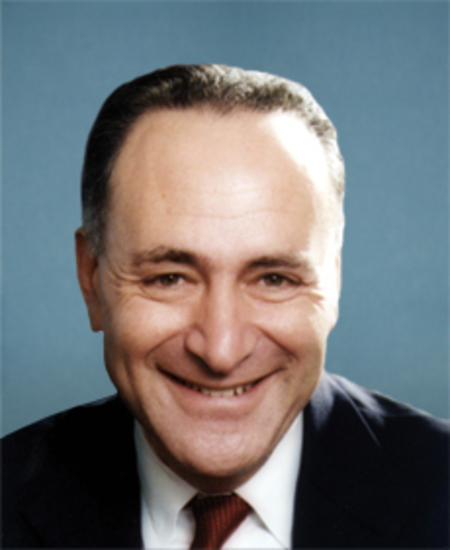
Sen. Charles E. Schumer
Sponsored bills
Maddy summarySRES 783 is a procedural resolution to correct a typographical error in the title of an amendment to S. 2073. It fixes the official Senate record so the amendment title correctly states "An Act to protect the safety and privacy of children on the internet" instead of the previous incorrect wording. This resolution affects only the Senate's official documents related to S. 2073 and has no impact on the underlying legislation or any individuals. It does not change the content or purpose of S. 2073 itself. The correction is purely administrative, ensuring the title matches the bill's actual intent.
Maddy summaryThis bill (S 4870) requires five federal financial regulators - the Federal Reserve, FDIC, OCC, NCUA, and CFPB - to submit a detailed report to Congress within 90 days of enactment. The report must analyze how AI is used in regulated financial institutions, current AI governance standards, potential regulatory gaps, inter-agency coordination issues, and the agencies' future AI plans and resource needs. It focuses on identifying knowledge gaps and resource requirements for overseeing AI in finance, not on creating new regulations. The bill aims to inform Congress about the regulatory landscape surrounding AI in banking and consumer financial services.
Maddy summaryS 3696, the DEFIANCE Act of 2024, creates a federal civil remedy for individuals harmed by non-consensual disclosure of intimate images or digital forgeries. It directly affects people whose authentic intimate images are shared without consent or who are subjected to AI-generated "deepfake" images that appear real. Key provisions allow victims to sue for $150,000 in liquidated damages, privacy protections (like pseudonyms), and injunctions against disclosure, with a 10-year statute of limitations. The law supplements existing state laws but does not override them, focusing solely on civil remedies for these specific harms.
Maddy summaryThis bill reauthorizes the Patrick Leahy Lake Champlain Basin Program Foundation to protect and restore Lake Champlain and its watershed, which includes parts of New York and Vermont (and potentially Quebec). It establishes a Steering Committee with representatives from New York, Vermont, and Quebec to develop and implement a comprehensive plan for pollution prevention, ecosystem restoration, and climate change response. The bill authorizes $45 million annually from 2025-2034 to fund the Foundation's work, which will support projects to improve water quality, restore habitats, and address climate impacts in the Lake Champlain Basin. The Foundation will coordinate with federal, state, and local partners to carry out the plan, which must include public input and be reviewed every 5 years.
Maddy summarySRES 765 is a Senate resolution honoring the late Senator James M. Inhofe of Oklahoma following his death on July 9, 2024. The resolution commemorates his 28-year Senate service (1994-2023) and 52 years in public office, highlighting his work on defense policy, aviation legislation, infrastructure projects, and support for military bases in Oklahoma. This procedural resolution expresses the Senate's condolences and formally recognizes his legacy, rather than enacting any policy changes.
Maddy summaryThis bill authorizes Congress to award a single Congressional Gold Medal to Jens Stoltenberg, former Secretary General of NATO, recognizing his leadership during his nine-year tenure. It directs the Treasury to strike the medal and allows for the sale of bronze duplicates to cover costs. The medal honors Stoltenberg's role in strengthening NATO's defense spending, enlargement, and unity - particularly during Russia's invasion of Ukraine - though the bill itself creates no new policy or obligations. The award is purely ceremonial and affects only Stoltenberg as the recipient.
Maddy summaryThis bill corrects funding and eligibility rules for the World Trade Center Health Program, directly affecting 9/11 responders and survivors seeking medical care. It allows licensed mental health providers (not just physicians) to certify mental health conditions for program eligibility, requiring the program administrator to define these provider categories within 180 days. The bill also clarifies that deceased individuals should not be counted in enrollment statistics for funding calculations and adds $2.97 billion in funding for fiscal year 2024, with adjusted annual funding formulas extending through 2090. These changes aim to streamline access to care and stabilize long-term program financing for affected individuals.
Maddy summaryThis bill (S 4554) is a non-binding resolution expressing Congress's "sense" that protections for abortion access should be supported after the *Dobbs* decision and that *Roe v. Wade* protections should be restored. It does not create new laws or change existing policies; it is solely a statement of congressional opinion. The resolution directly affects no individuals or entities, as it lacks legal force. Key provisions (Section 2) state Congress supports post-*Dobbs* reproductive health care access and aims to restore *Roe*-era protections, but these are declarative statements only.
Maddy summaryThis Senate resolution (SRES 744) expresses the Senate's support for designating June 28, 2024, as "Stonewall Day" to commemorate the 1969 Stonewall Uprising, a pivotal moment in LGBTQIA+ rights history. It recognizes the significance of the uprising in advancing LGBTQIA+ equality and supports the opening of the Stonewall National Monument Visitor Center on that date. The resolution does not create new laws or affect specific individuals; it is a symbolic gesture acknowledging historical events and encouraging public recognition of the LGBTQIA+ civil rights movement.