

Green Spaces, Green Vehicles Act of 2021 This bill directs the Department of Energy (DOE), the Forest Service, and the National Park Service (NPS) to collaborate on a Green Spaces, Green Vehicles Initiative to facilitate the installation and use of zero-emissions vehicle infrastructure, including on land that is not National Forest System land or NPS land. The agencies shall facilitate such installation and use, including by acquiring zero-emissions vehicles for the fleets of the Forest Service and the NPS. For purposes of determining whether the acquisition of alternative fueled vehicles is practical for the fleet of the Forest Service or the NPS, DOE shall take into account the availability on National Forest System land or NPS land, as applicable, of zero-emissions vehicle infrastructure.
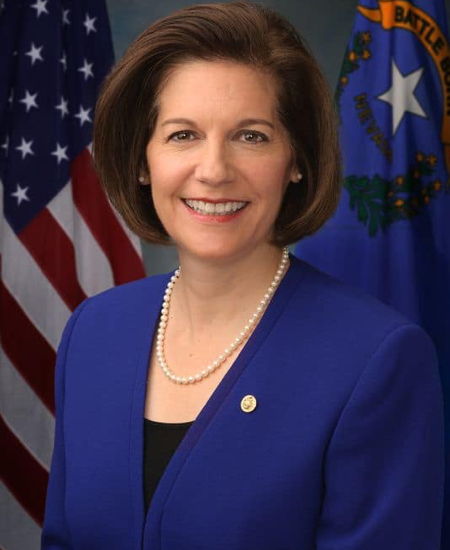
Sen. Catherine Cortez Masto
Sponsored bills
This bill requires the Department of Transportation and the Department of Energy to jointly establish a working group to make recommendations on the development, adoption, and integration of certain electric vehicles into U.S. transportation and energy systems. In addition, the working group must develop, electronically publish, and update a resource guide that provides information about electric vehicles and their charging infrastructure.
Improving Health Insurance Affordability Act of 2021 This bill expands the eligibility of taxpayers for the refundable tax credit for coverage under a qualified health plan and increases cost-sharing subsidies under the Patient Protection and Affordable Care Act.
Unemployment Insurance Technology Modernization Act of 2021 This bill requires the Department of Labor to study and report on the technology needs of federal and state unemployment compensation programs. Based on this study, Labor must develop, operate, and maintain a modular set of technology capabilities to modernize the delivery of unemployment compensation. Before the deployment of the technology capabilities to all states, Labor must select at least four states to participate in a pilot program to test the technology capabilities and demonstrate that they meet requirements. The bill establishes accessibility requirements for filing online unemployment compensation claims. In addition, it prohibits the technology capabilities from relying solely on a high-risk automated decision system to (1) deny a claim for unemployment compensation, (2) reduce the amount of unemployment compensation for which a claimant is eligible, or (3) deny a claimant's right to appeal an unemployment compensation decision.
Clean School Bus Act of 2021 This bill directs the Department of Energy (DOE) to establish the Clean School Bus Grant Program in the Office of Energy Efficiency and Renewable Energy. Under the program, DOE must award grants for the replacement of existing diesel school buses with electric buses.
This bill permits the use of tax-exempt facility bonds to fund zero-emission vehicle infrastructure. The bill defines zero emissions vehicles as any light- or heavy-duty vehicles that conform to the regulatory zero-emission vehicles standard or vehicles that produce zero exhaust emissions of any criteria pollutant or greenhouse gas under the Clean Air Act.
Forced Arbitration Injustice Repeal Act This bill prohibits a predispute arbitration agreement from being valid or enforceable if it requires arbitration of an employment, consumer, antitrust, or civil rights dispute.
Stop Tip-overs of Unstable, Risky Dressers on Youth Act or the STURDY Act This bill requires the Consumer Product Safety Commission to revise the safety standards for freestanding clothing storage units such as dressers, bureaus, or chests of drawers. Such standards must include specified testing related to tip overs and new warning requirements for all such products entering the U.S. market.
Safe Step Act This bill requires a group health plan to establish an exception to medication step-therapy protocol in specified cases. A medication step-therapy protocol establishes a specific sequence in which prescription drugs are covered by a group health plan or a health insurance issuer. A request for such an exception to the protocol must be granted if (1) an otherwise required treatment has been ineffective, (2) such treatment is expected to be ineffective and delaying effective treatment would lead to irreversible consequences, (3) such treatment will cause or is likely to cause an adverse reaction to the individual, (4) such treatment is expected to prevent the individual from performing daily activities or occupational responsibilities, (5) the individual is stable based on the prescription drugs already selected, or (6) there are other circumstances as determined by the Employee Benefits Security Administration. The bill requires a group health plan to implement and make readily available a clear process for an individual to request an exception to the protocol, including required information and criteria for granting an exception. The bill further specifies timelines under which plans must respond to such requests.
Coronavirus Medicaid Response Act This bill increases the Medicaid federal matching rate, also known as the Federal Medical Assistance Percentage (FMAP), for states and U.S. territories that experience economic downturns (i.e., high unemployment) beginning on or after January 1, 2020, in accordance with specified requirements and limitations. The bill's increase is in addition to previously enacted FMAP increases relating to COVID-19 (i.e., coronavirus disease 2019) but may not result in an FMAP greater than 95%.