

Toxic Exposure Training Act of 2021 This bill requires the Department of Veterans Affairs (VA) to provide training to its health care and benefits personnel regarding veterans who have been exposed to toxic substances. The VA must provide its health care personnel with education and training to identify, treat, and assess the impact of illnesses related to exposure to toxic substances. Such training must address how to ask for additional information from veterans regarding exposure to different toxicants. Additionally, the VA must establish an annual training program for claims processors who review claims for disability benefits related to service-connected disabilities based on exposure to toxic substances.
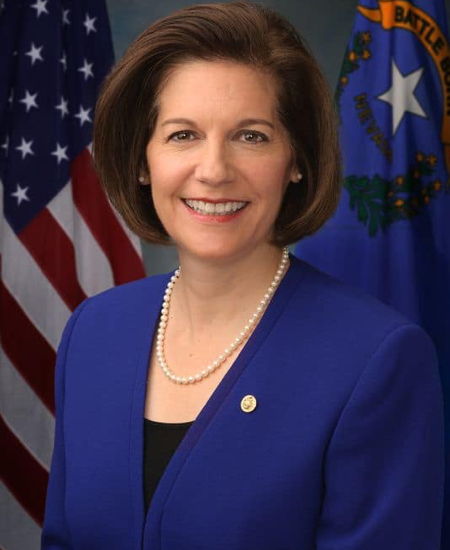
Sen. Catherine Cortez Masto
Sponsored bills
Extending Tribal Broadband Priority Act of 2021 This bill requires the Federal Communications Commission (FCC) to, within 30 days, establish a new tribal priority window for the 2.5 gigahertz band, through which tribes in rural areas may apply for unassigned spectrum. The new window is subject to the same terms and conditions as the tribal priority window that was adopted by the FCC on July 10, 2019, and that closed on September 2, 2020.
Fairness for Rape Kit Backlog Survivors Act of 2021 This bill requires state victim compensation programs, as a condition of receiving certain grants, to waive deadlines to file for compensation in cases where a victim failed to meet the deadline due to delays in testing biological material collected as evidence related to a sexual offense.
American Infrastructure Bonds Act of 2021 This bill allows the issuer of an American infrastructure bond a tax credit for 28% of the interest payable under such bond.
Public Buildings Renewal Act of 2021 This bill allows tax-exempt financing of certain government-owned buildings by expanding the definition of exempt facility bond to include bonds used for qualified government buildings. A qualified government building is a government-owned building or facility that consists of one or more of the following an elementary or secondary school; a facility of a state college or university used for educational purposes; a public library; a court; a hospital or health care facility; a laboratory or research facility used by a governmental unit; a public safety facility; or an office for government employees. The bill excludes buildings or facilities that include specified recreational equipment or are used for the primary purpose of providing retail food and beverage services, recreation, or entertainment. The bill establishes (1) a $5 billion limit on the amount of tax-exempt financing which may be provided for government buildings, and (2) procedures for allocating and applying for the financing. The bill exempts the bonds for government buildings from the volume cap on private activity bonds.
Lymphedema Treatment Act This bill provides for Medicare coverage of lymphedema compression treatment items. Specifically, the bill provides for coverage of (1) standard and custom fitted gradient compression garments that are prescribed by a physician or other specified health care professional to treat lymphedema, and (2) other devices determined to be effective in the prevention or treatment of lymphedema.
Federal Reserve Racial and Economic Equity Act This bill requires the Federal Reserve Board to carry out its duties in a manner that supports the elimination of racial and ethnic disparities in employment, income, wealth, and access to affordable credit. The board must report on disparities in labor force trends as well as on plans and activities of the board to minimize and eliminate these disparities.
Social Security Fairness Act This bill repeals provisions that reduce Social Security benefits for individuals who receive other benefits, such as a pension from a state or local government. The bill eliminates the government pension offset , which in various instances reduces Social Security survivors' benefits for spouses, widows, and widowers who also receive government pensions of their own. The bill also eliminates the windfall elimination provision , which in some instances reduces Social Security benefits for individuals who also receive a pension or disability benefit from an employer that did not withhold Social Security taxes. These changes are effective for benefits payable after December 2021.
Child Care for Working Families Act This bill provides funds and otherwise revises certain child care and early learning programs for low- to moderate-income families. Specifically, the bill provides funds for the Child Care and Development Block Grant program and reestablishes it as a child care and development assistance program. The bill also allocates program funds for states to provide services and supports to infants, toddlers, and children with disabilities. Further, the bill revises the program to require each state to create a tiered and transparent system for measuring the quality of child care providers, which must include evidence-based standards and payment rates that are based on a certain cost estimation model; ensure that copayments are based on a sliding scale and that no family receiving assistance pays more than 7% of its household income on child care; and use quality child care amounts for certain activities, such as increasing the supply of child care providers. The bill also provides funds and establishes grants for states to create preschool programs for low- to moderate-income children between the ages of three and five years. The Department of Health and Human Services (HHS) must make grants to Head Start agencies to provide children with access to full-school-year and full-school-day services, provide access to additional service hours for migrant and seasonal agencies, or enhance the quality of existing services. Finally, the bill requires, and provides funds for, HHS to assist Head Start agencies with ensuring their teachers and staff are paid a living wage.
Clean Energy for America Act This bill provides tax incentives for investment in clean electricity, clean transportation, clean fuel production, energy efficiency, and sets forth workforce development requirements for the energy sector. The bill also terminates certain fossil fuel provisions and requires contractors on federal energy projects to ensure that not less than 15% of total labor hours be performed by qualified apprentices.