

Accelerating Kids' Access to Care Act This bill requires state Medicaid programs to establish a process through which qualifying out-of-state providers may enroll as participating providers without undergoing additional screening requirements. Among other things, a qualifying provider must (1) serve minors, or adults whose condition began as a minor; and (2) have previously been screened for Medicare participation or for participation in the Medicaid program of the state in which the provider is located.
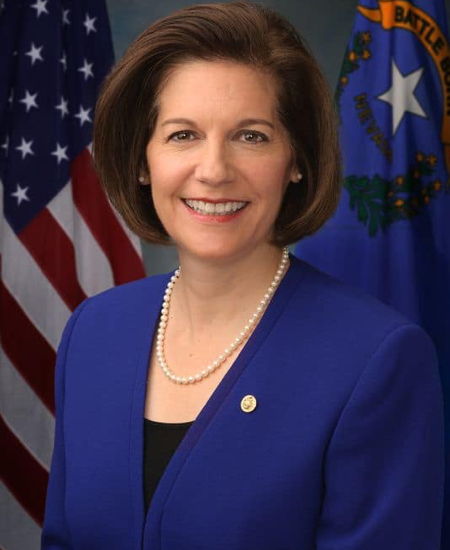
Sen. Catherine Cortez Masto
Sponsored bills
Voters' Access to Water Act This bill prohibits states from restricting the donation of food or nonalcoholic beverages to individuals who are outside of the entrance of a polling place for a federal election if such items are distributed without regard to electoral participation or political preference. However, states may prohibit individuals who are distributing these items from engaging in political or electioneering activity.
This resolution condemns the acts of gun violence that led to the tragic loss of eight lives in Georgia on March 16, 2021.
Transportation Resources to Add Vital Economic Longevity Act or the TRAVEL Act This bill makes various changes to programs of the Department of Transportation (DOT) to facilitate travel and tourism. The changes include increasing the federal share up to 100% for highway projects that result in significant local or economic growth, including increased travel and tourism; requiring that transportation plans address strategies to enhance travel and tourism; and establishing an office within DOT to coordinate and implement activities to enhance travel and tourism. In addition, DOT must consider the extent to which a project contributes to economic competitiveness, including increased travel and tourism, when selecting projects for the National Infrastructure Investment program. DOT must also establish a program to fund planning activities and projects to improve and facilitate long-haul travel (trips of at least 50 miles from the point of origin to the point of destination) on the national transportation network. Additionally, the bill expands eligibility for other transportation-related grants and programs to include projects related to travel and tourism. In particular, it makes such projects eligible for (1) the Nationally Significant Highway and Freight Projects program, (2) the Surface Transportation Block Grant, (3) the Congestion Mitigation and Air Quality Improvement Program, and (4) the Consolidated Rail Infrastructure and Safety Improvements Program. The bill also sets out economic vitality as a separate goal of the Federal-Aid Highway Program. (Currently, the goal of economic vitality is linked specifically to freight movement.)
Military Justice Improvement and Increasing Prevention Act of 2021 This bill modifies the process and policy related to the disposition of charges and convening of courts-martial for certain sexual assault cases and other specified offenses under the Uniform Code of Military Justice (UCMJ). Among other elements, the bill provides that the determinations on the preferral, disposition, and referral of charges for specified offenses under the UCMJ must be made by a commissioned officer of the Armed Forces who is designated as a court-martial convening authority (in grade O-6 or higher) and who is available for detail as trial counsel, has significant trial experience, and is outside the chain of command of the member subject to the charges.
Supporting and Empowering the Nation to Improve Outcomes that Reaffirm Careers, Activities, and Recreation for the Elderly Act or the SENIOR CARE Act This bill expands eligibility for the Medicaid Ticket to Work Program to include individuals who are 65 years of age or older. (Under the current program, states may establish a Medicaid buy-in option for working individuals with disabilities whose income exceeds the customary limits and who are between the ages of 16 and 64.)
Military Hunger Prevention Act This bill requires the Department of Defense (DOD) to pay a basic needs allowance to certain low-income members of the Armed Forces. Specifically, those eligible for the basic needs allowance are members who (1) have completed initial entry training, (2) have a gross household income that did not exceed an amount equal to 130% of the federal poverty guidelines of the Department of Health and Human Services (HHS), and (3) do not elect to decline the allowance. In situations where a household contains two or more eligible members, the bill specifies that only one allowance may be paid per year to one member they jointly elect. The amount of the allowance must be the aggregate amount equal to 130% of the HHS federal poverty guidelines minus the gross household income of the covered member during the preceding year divided by 12. The Defense Finance and Accounting Service (DFAS) of DOD must notify, in writing, individuals determined to be eligible for the allowance. The notice must include information regarding financial management and assistance programs administered by DOD for which the individuals are also eligible. Individuals who seek to receive the allowance must submit specified information to DFAS.
USTR Inspector General Act of 2021 This bill requires the President to appoint an Inspector General of the Office of the U.S. Trade Representative (USTR). Among other responsibilities, the Inspector General shall (1) conduct and supervise audits and investigations relating to the programs and operations of the USTR, (2) recommend policies for preventing and detecting fraud and abuse in those programs, and (3) provide a means for keeping the USTR and Congress informed about problems and deficiencies in those programs and operations.
Technology Standards Task Force Act of 2021 This bill directs the Office of Science and Technology Policy to establish a task force on setting emerging technology standards, to be known as the Emerging Technology Standards-Setting Task Force. The task force shall develop a long-term strategic plan for the United States to lead emerging technology standards-setting processes.
Coronavirus Housing Counseling Improvement Act This bill authorizes additional housing counseling services provided through the Neighborhood Reinvestment Corporation. Funding priority is given to counseling organizations that target low-income and minority homeowners, renters, individuals experiencing homelessness, and individuals at risk of homelessness.