America's Red Rock Wilderness Act This bill designates specified lands in the following areas of Utah as components of the National Wilderness Preservation System: (1) Great Basin, (2) Grand Staircase-Escalante, (3) Moab-La Sal Canyons, (4) Henry Mountains, (5) Glen Canyon, (6) San Juan-Anasazi, (7) Canyonlands Basin, (8) San Rafael Swell, and (9) Book Cliffs and Uinta Basin. The bill sets forth administrative requirements for (1) the exchange of state-owned lands within such areas, (2) federal reservation of water rights, (3) measurement of setbacks for roads with adjacent wilderness, (4) authorized livestock grazing, and (5) withdrawal of such lands from disposition under certain public land laws.
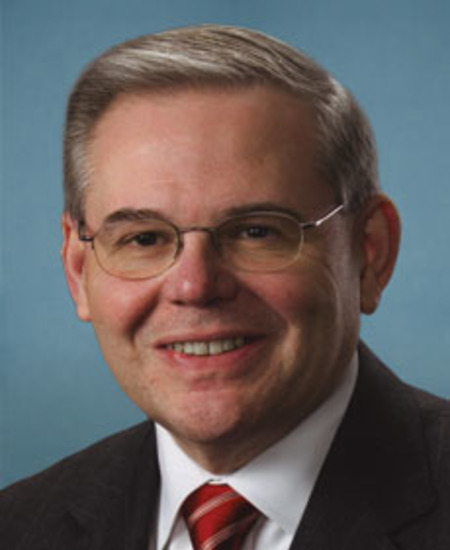
Sen. Robert Menendez
Sponsored bills
Voters' Access to Water Act This bill prohibits states from restricting the donation of food or nonalcoholic beverages to individuals who are outside of the entrance of a polling place for a federal election if such items are distributed without regard to electoral participation or political preference. However, states may prohibit individuals who are distributing these items from engaging in political or electioneering activity.
Strategic Competition Act of 2021 This bill addresses various foreign relations issues, with a focus on China. Among other things, the bill requires the U.S. Agency for Global Media to take certain actions to support independent journalism and combat censorship in countries where the Chinese Communist Party or other entities are promoting disinformation; requires the Department of State to establish programs to engage partner countries on issues such as regulatory harmonization and technology partnerships; prohibits any individual who has served as Secretary of State or Deputy Secretary of State from representing a foreign government entity before the executive branch; requires the State Department to develop and implement a plan for increasing the U.S. presence in the Indo-Pacific region; authorizes various foreign military financing and diplomatic activities in Southeast Asia and the Indo-Pacific region; prioritizes the transfer of excess defense articles to Taiwan, Thailand, Indonesia, Vietnam, and Malaysia; prohibits a country from receiving certain U.S. assistance if that country hosts a Chinese military installation within its territory, with some exceptions; authorizes the U.S. representative to the Inter-American Development Bank to vote for an increase in the bank's capital stock; requires strategies to engage with other countries on issues such as managing relations with China; authorizes military training assistance activities in Latin America and the Caribbean; establishes an interagency working group to counter Chinese cyber aggression in Africa; authorizes activities to promote democracy in Hong Kong; and imposes sanctions on foreign individuals and entities responsible for certain abuses (e.g., forced labor and coercive abortions) in China's Xinjiang region.
This resolution condemns the acts of gun violence that led to the tragic loss of eight lives in Georgia on March 16, 2021.
Military Justice Improvement and Increasing Prevention Act of 2021 This bill modifies the process and policy related to the disposition of charges and convening of courts-martial for certain sexual assault cases and other specified offenses under the Uniform Code of Military Justice (UCMJ). Among other elements, the bill provides that the determinations on the preferral, disposition, and referral of charges for specified offenses under the UCMJ must be made by a commissioned officer of the Armed Forces who is designated as a court-martial convening authority (in grade O-6 or higher) and who is available for detail as trial counsel, has significant trial experience, and is outside the chain of command of the member subject to the charges.
Safeguarding Human Rights in Arms Exports Act of 2021 or the SAFEGUARD Act of 2021 This bill establishes specified measures to prevent the sale, export, or transfer of defense articles or defense services to foreign countries for use in violation of international humanitarian law or internationally recognized human rights. These measures include (1) prohibiting arms sales to countries committing genocide or war crimes, (2) requiring a consideration of human rights practices and democratization in any foreign country to which an arms sale is contemplated, and (3) providing for congressional oversight of arms exports to foreign countries wherein certain human rights violations have occurred.
Military Hunger Prevention Act This bill requires the Department of Defense (DOD) to pay a basic needs allowance to certain low-income members of the Armed Forces. Specifically, those eligible for the basic needs allowance are members who (1) have completed initial entry training, (2) have a gross household income that did not exceed an amount equal to 130% of the federal poverty guidelines of the Department of Health and Human Services (HHS), and (3) do not elect to decline the allowance. In situations where a household contains two or more eligible members, the bill specifies that only one allowance may be paid per year to one member they jointly elect. The amount of the allowance must be the aggregate amount equal to 130% of the HHS federal poverty guidelines minus the gross household income of the covered member during the preceding year divided by 12. The Defense Finance and Accounting Service (DFAS) of DOD must notify, in writing, individuals determined to be eligible for the allowance. The notice must include information regarding financial management and assistance programs administered by DOD for which the individuals are also eligible. Individuals who seek to receive the allowance must submit specified information to DFAS.
USTR Inspector General Act of 2021 This bill requires the President to appoint an Inspector General of the Office of the U.S. Trade Representative (USTR). Among other responsibilities, the Inspector General shall (1) conduct and supervise audits and investigations relating to the programs and operations of the USTR, (2) recommend policies for preventing and detecting fraud and abuse in those programs, and (3) provide a means for keeping the USTR and Congress informed about problems and deficiencies in those programs and operations.
Accessible Voting Act of 2021 This bill addresses voting accessibility for individuals with disabilities and older individuals. First, the bill establishes the Office of Accessibility within the Election Assistance Commission (EAC). The office must serve as the advocate on behalf of voters with access needs, ensure state and local election officials are maintaining voting systems that meet Department of Justice accessibility standards, and make payments to states to implement the accessibility requirements outlined by the bill. In addition, the office must establish and operate a National Resource Center on Accessible Voting to provide state and local election officials, poll workers, and volunteers with the information and technical assistance needed to provide accessible voting. The office must also work with state and local election officials to collect data and administer a public national voter accessibility website. The bill requires each state to (1) ensure election websites are accessible and meet specified requirements, (2) designate a single office to provide information on federal elections to individuals with disabilities and older individuals, (3) notify the public of changes to voting practices, (4) expand access to absentee registration procedures and no-excuse mail-in absentee voting in federal elections, and (5) ensure all polling places and voter drop boxes are accessible. The EAC must coordinate with specified agencies to make grants to eligible entities to study, test, and develop accessible voting options. The bill also permanently reauthorizes and expands a Department of Health and Human Services grant program for increasing accessibility to polling places.

Marijuana Data Collection Act This bill requires the Department of Health and Human Services, in coordination with the Department of Justice, the Department of Labor, and relevant state agencies, to enter into an arrangement with the National Academy of Sciences in order to study the effects of marijuana legalization in states for medicinal or non-medicinal use.