This resolution reaffirms the goals of World Refugee Day and the commitment of the United States to promote the safety and well-being of refugees.
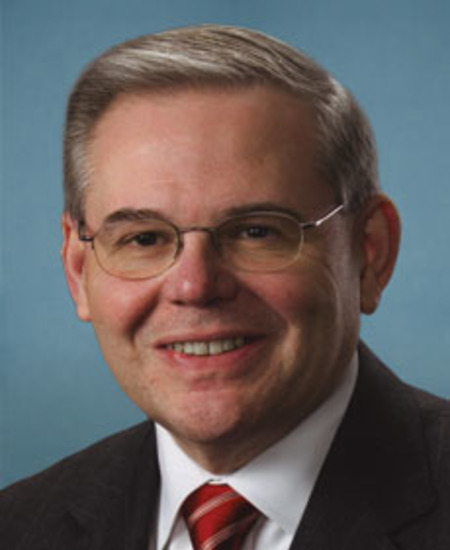
Sen. Robert Menendez
Sponsored bills
Puppies Assisting Wounded Servicemembers Act of 2021 or the PAWS Act of 2021 This bill requires the Department of Veterans Affairs (VA) to implement a grant program for the purpose of pairing service dogs with eligible veterans. Organizations that receive grants shall provide veterinary health insurance coverage, hardware, and travel expenses for each service dog and veteran participating in the program. Eligible veterans are those who (1) are enrolled in the VA health care system, (2) have been evaluated and treated for post-traumatic stress disorder (PTSD) but remain diagnosed with PTSD, (3) may benefit from a service dog, and (4) agree to successfully complete training provided by an eligible organization. Veterans are required to see a VA health care provider at least once every 180 days to determine whether the veteran continues to benefit from a service dog. Eligible organizations are nonprofit organizations that are accredited by a widely recognized accreditation organization, meet publicly available standards set forth by the Association of Service Dog Providers for Military Veterans, have expertise in the needs of veterans with PTSD, agree to cover all costs in excess of the grant amount to guarantee the benefits of the program, agree to reaccept or replace a service dog provided to a veteran, and submit an application to the VA. Any improvement in PTSD symptoms as a result of the provision of a service dog shall not affect the veteran's eligibility for any other VA benefits. The Government Accountability Office must report on the grant program.
Superfund Polluter Pays Restoration Act of 2021 This bill (1) reinstates the Hazardous Substance Superfund financing rate beginning 60 days after enactment of this bill; (2) increases such rate from 9.7 cents to 17.2 cents per barrel of crude oil (adjusted for inflation after 2021); (3) reinstates and increases the rates of tax on taxable chemicals (adjusted for inflation after 2021); and (4) modifies the definition of crude oil to include any bitumen or bituminous mixture, any oil derived from such mixture (including oil derived from tar sands), and any oil derived form kerogen-bearing sources (including oil derived from oil shale). The bill amends the Comprehensive Environmental Response, Compensation, and Liability Act of 1980 to allow the use of the Superfund for environmental remediation without further appropriation.
Lori Jackson-Nicolette Elias Domestic Violence Survivor Protection Act This bill makes changes to the federal statutory framework that prohibits the shipment, transport, receipt, or possession of firearms or ammunition by an individual who is subject to a qualifying domestic violence court order. Under current law, a qualifying domestic violence court order must meet certain requirements, including to (1) be issued after a hearing of which the individual had notice and an opportunity to participate; and (2) restrain the individual from harassing, stalking, or threatening an intimate partner (i.e., a current or former spouse, a co-parent of a child, or a current or former cohabitant) or the child of an intimate partner. This bill expands the scope of qualifying domestic violence court orders to include an order that is issued after an ex parte hearing (i.e., a hearing with only one party present); restrains the individual from harassing, stalking, or threatening a dating partner or former dating partner; or restrains the individual from intimidating a witness. Current law also prohibits an individual who is convicted of a misdemeanor crime of domestic violence from shipping, transporting, receiving, or possessing firearms or ammunition. These restrictions generally only apply to spouses, co-parents, and cohabitants, and to offenses that involve physical force or deadly weapons. This bill expands the scope of these restrictions to include dating partners and offenses that involve stalking. Finally, the bill authorizes grants for state, local, and tribal governments to remove firearms and take other steps after a domestic violence court order is issued.
Fire Fighters and EMS Employer-Employee Cooperation Act This bill requires the Federal Labor Relations Authority to determine whether a state substantially provides fire and emergency medical services (EMS) personnel the right to form and join a labor organization; recognition by fire and EMS employers of the employees' labor organization, agreement to bargain with the organization, and reduction of any agreements to writing in a contract or memorandum of understanding; the right to bargain over hours, wages, and terms and conditions of employment; and arbitration or other mechanisms to resolve an impasse in collective bargaining negotiations. The bill makes the authority responsible for (1) determining the appropriateness of units for labor representation; (2) supervising elections; (3) conducting hearings and resolving complaints of unfair labor practices; and (4) protecting the right of employees to form, join, or assist any labor organization, or to refrain from doing so. An employer, fire and EMS personnel, or labor organization may not engage in a lockout, sickout, work slowdown, strike, or any other organized job action that will measurably disrupt the delivery of emergency services and is designed to compel an employer, fire and EMS personnel, or labor organization to agree to the terms of a proposed contract.
Washington, D.C. Admission Act This bill provides for admission into the United States of the state of Washington, Douglass Commonwealth, composed of most of the territory of the District of Columbia. The commonwealth shall be admitted to the Union on an equal footing with the other states. The Mayor of the District of Columbia shall issue a proclamation for the first elections to Congress of two Senators and one Representative of the commonwealth. The bill applies current District laws to the commonwealth and continues pending judicial proceedings. The commonwealth (1) shall consist of all District territory, with specified exclusions for federal buildings and monuments, including the principal federal monuments, the White House, the Capitol Building, the U.S. Supreme Court Building, and the federal executive, legislative, and judicial office buildings located adjacent to the Mall and the Capitol Building; and (2) may not impose taxes on federal property except as Congress permits. District territory excluded from the commonwealth shall be known as the Capital and shall be the seat of the federal government. The bill maintains the federal government's authority over military lands and specified other property. The bill provides for expedited consideration of a joint resolution repealing the Twenty-third Amendment to the Constitution, which provides for the appointment of electors of the President and Vice President. The bill continues certain federal authorities and responsibilities, including regarding employee benefits, agencies, courts, and college tuition assistance, until the commonwealth certifies that it is prepared to take over the authorities and responsibilities. The bill establishes the Statehood Transition Commission to advise the President, Congress, and District and commonwealth leaders on the transition.

National Flood Insurance Program Consultant Accountability Act of 2021 This bill allows the Federal Emergency Management Agency (FEMA) to terminate certain contracts under the National Flood Insurance Program on the basis of detrimental conduct to the program by a covered entity (an attorney, law firm, consultant, or third-party company that provides certain services under the contract). Specifically, on such basis, FEMA may terminate a contract between a covered entity and a Write Your Own company (a property and casualty company that writes and services federal standard flood insurance policies in its own name). FEMA shall establish a process for a covered entity to appeal such a termination. Neither FEMA nor a Write Your Own company is required to make an early-termination payout to a covered entity with respect to a contract terminated under the bill.
Clean Energy for America Act This bill provides for tax incentives for investments in clean electricity, clean transportation, energy efficiency, and the termination of certain provisions relating to oil, gas, and other fossil fuels. Among other provisions, the bill allows new tax credits for investment in clean energy facilities and for the production of electricity from clean energy and clean fuel; allows a new tax credit for expenditures for clean energy property used in connection with a principal residence; allows a new tax credit for sustainable aviation fuel; allows an alternative motor vehicle tax credit for fuel cell motor vehicles, electric vehicles, and for refueling property; allows a tax credit for the production of electricity from clean hydrogen; extends for one year the second generation biofuel producer tax credit and the tax credit for alternative fuels; modifies existing tax credits for energy efficient residential buildings, energy efficient home improvement expenditures, geothermal heat pumps, and the tax deduction for energy efficient commercial buildings; terminates certain provisions relating to oil, gas, and other fossil fuels; requires that at least 15% of the total workforce labor hours be performed by qualified apprentices; requires that projects receiving federal assistance comply with federal prevailing wage requirements; and allows the issuance of tax-exempt private activity bonds for qualified carbon dioxide capture facilities.
This joint resolution proposes an amendment to the U.S. Constitution that prohibits slavery and involuntary servitude as a criminal punishment.
Global Labor Support Act of 2021 This bill addresses U.S. foreign policy concerning labor rights, including in Bangladesh. Specifically, the bill authorizes visa- and asset-blocking sanctions on foreign persons responsible for gross violations of the human rights of workers. The bill also replaces the position of Special Representative for International Labor Affairs at the Department of State with the position of Ambassador-at-Large for Global Labor Rights. The ambassador must lead U.S. diplomatic engagement on labor issues. Additionally, the State Department, the U.S. Agency for International Development (USAID), and the Department of Labor must carry out activities to protect and promote labor rights worldwide; the bill establishes a fund in the Department of the Treasury for those activities. Additionally, USAID must extend through FY2028 its Global Labor Program, which supports worker organizations in addressing labor issues in their countries. The bill also requires reporting on labor issues. The State Department must annually report on the status of internationally recognized labor rights in certain countries, including any country receiving U.S. foreign assistance. If a report indicates that a country has poor performance on labor issues, Labor must deploy personnel to the U.S. mission in that country to lead interagency coordination of the labor portfolio. The Government Accountability Office must also assess U.S. government efforts concerning labor rights globally. Furthermore, the bill sets out requirements concerning labor rights in Bangladesh, such as directing the President to work with the government of Bangladesh on updating its commitments to labor rights and worker safety.