Maddy summarySRES 593 is a Senate resolution honoring former U.S. Senator Kaneaster Hodges, Jr. of Arkansas, who served from 1977 to 1978. The resolution expresses the Senate’s "profound sorrow" at his death and directs the Secretary of the Senate to transmit an enrolled copy to his family. It also calls for the Senate to adjourn as a mark of respect. This is a ceremonial resolution with no policy provisions or direct impact on legislation or constituents.
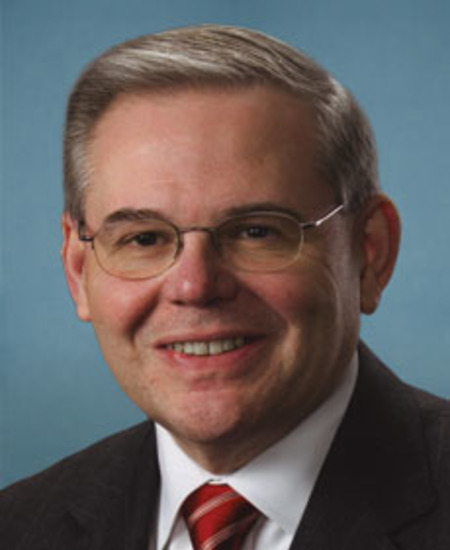
Sen. Robert Menendez
Sponsored bills
This resolution recognizes that Black women are experiencing high, disproportionate rates of maternal mortality and morbidity in the United States and that Black Maternal Health Week is an opportunity to deepen the national conversation about Black maternal health.
Supporting Athletes, Families and Educators to Protect the Lives of Athletic Youth Act or the SAFE PLAY Act This bill directs several agencies to undertake specified activities and expand surveillance related to cardiac conditions, concussions, and heat-related illnesses among young athletes. The bill also establishes requirements for schools with respect to concussions and excessive heat. Specifically, the Centers for Disease Control and Prevention (CDC) must (1) develop information for schools, childcare centers, and others on high-risk cardiac conditions in children, adolescents, and young adults; and (2) incorporate questions about cardiac conditions in an existing school-based health survey. In addition, the CDC must develop guidelines for emergency action plans for youth athletics programs, and the Food and Drug Administration may issue guidelines related to youth consumption of energy drinks. The Department of Health and Human Services (HHS) must award matching grants to local educational agencies for automated external defibrillator and cardiopulmonary resuscitation trainings. The Department of Education, in consultation with HHS and the National Oceanic and Atmospheric Administration, must develop public education materials focused on the health risks of exposure to extreme heat and humidity, and public schools must develop action plans for athletic activities during periods of excessive heat or humidity. The bill establishes minimum requirements for elementary and secondary schools related to concussions, including but not limited to (1) implementing a standard plan for concussion safety and management, and (2) ensuring students returning to academics after a concussion receive certain services and supports.
Hispanic Educational Resources and Empowerment Act of 2022 This bill directs the Department of Education to (1) award grants to Hispanic-serving institutions of higher education (IHEs) to improve and expand innovative collaboration agreements between local educational agencies and IHEs to better serve Hispanic and Latino students, (2) provide technical assistance to such IHEs, and (3) contract with a third party to conduct an independent evaluation of grant activities. Such grants must be used for specific activities, such as improving school-based and institutional practices to prepare students for postsecondary education and addressing nonacademic needs of students that are barriers to college enrollment.
Rural Hospital Support Act This bill modifies and extends certain payment adjustments for rural hospitals under Medicare's inpatient prospective payment system. Specifically, the bill indexes payment adjustments for sole community hospitals and Medicare-dependent hospitals to FY2016 operating costs, if it results in higher payments for such hospitals. The bill also makes payment adjustments for Medicare-dependent hospitals and low-volume hospitals permanent (the adjustments currently expire at the end of FY2022).
Ethiopia Peace and Stabilization Act of 2022 This bill addresses U.S. efforts to support a peaceful, democratic Ethiopia and bring an end to the country's civil conflict. The President may provide support for efforts (1) by the African Union or other credible entities to bring about a peaceful resolution to the conflict across Ethiopia; (2) to engage in peace building, mediation, and community reconciliation; and (3) to pursue accountability for war crimes and crimes against humanity in Ethiopia. The Department of State must develop and implement strategies to support democracy, rule of law, and human rights in Ethiopia. The State Department must also ensure the implementation of a strategy, to be developed by the U.S. Agency for International Development, to support conflict mitigation and management, reconciliation, and trauma healing for Ethiopians affected by the conflict. The President must impose property- and visa-blocking sanctions on foreign individuals and entities that have engaged in certain actions related to the conflict in Ethiopia, such as taking significant actions to undermine efforts to end the conflict or deriving significant benefit from efforts to impede the transition to democracy. The bill also (1) prohibits the U.S. International Development Finance Corporation from providing support for economic development projects in Ethiopia, (2) suspends any U.S. security assistance to the government of Ethiopia, and (3) requires U.S. representatives at international financial institutions to oppose any loan or extension of assistance to the governments of Ethiopia and Eritrea. These restrictions shall continue until there is a resolution of the civil conflict.

Educators Expense Deduction Modernization Act of 2022 This bill increases the tax deduction for the expenses of eligible educators from $250 to $1,000, An eligible educator is, with respect to any taxable year, an individual who is a kindergarten through grade 12 teacher, instructor, counselor, principal, or aide in a school for at least 900 hours during a school year.
Accountability for Cryptocurrency in El Salvador Act or ACES Act This bill requires the Department of State to devise and implement a plan to mitigate any potential risk to the U.S. financial system posed by the adoption of a cryptocurrency as legal tender in El Salvador and any other country that uses the U.S. dollar as legal tender. The State Department must report to Congress on this plan and on various issues relating to El Salvador's adoption of Bitcoin as legal tender.
United States-Ecuador Partnership Act of 2022 This bill requires and authorizes actions to strengthen the U.S.-Ecuador relationship. The President may transfer two excess Coast Guard vessels to Ecuador if there is sufficient capacity to maintain the vessels. The Department of State must develop and implement a strategy to strengthen commercial and economic ties between the United States and Ecuador, including by (1) promoting cooperation and information sharing to increase trade and investment opportunities, and (2) supporting efforts by Ecuador's government to promote a more open and competitive business environment. The State Department must also develop and implement a strategy to increase the capacity of Ecuador's justice system and law enforcement to combat crime, corruption, and the harmful influence of malign foreign and domestic actors. The U.S. Agency for International Development (USAID) must develop and implement a strategy to support inclusive economic development across Ecuador's national territory, including by facilitating increased access to financing and investment for small- and medium-sized businesses. USAID must also, by working through appropriate nonprofit organizations, develop and implement programs to provide training and technical assistance to strengthen the National Assembly of Ecuador. USAID must also develop and implement programs to improve ecosystem conservation and enhance the effective stewardship of Ecuador's natural resources. The State Department and USAID must periodically report to Congress on the implementation of these strategies and programs.
This resolution recognizes the accomplishments and example of Cesar Estrada Chavez. The resolution also encourages the people of the United States to commemorate his legacy and to always remember his rallying cry, "Si, se puede!" (which means "Yes, we can!").