

Maddy summaryThis bill reauthorizes funding for the National Firefighter Cancer Registry, which tracks cancer cases among firefighters. It increases annual funding from $2.5 million (2018-2022) to $5.5 million for fiscal years 2024-2028. The registry remains voluntary, collecting data on firefighters diagnosed with cancer to better understand occupational risks. This funding ensures the program continues operating to gather and analyze cancer incidence data. The direct effect is on the registry program itself, enabling ongoing data collection for firefighter health research.
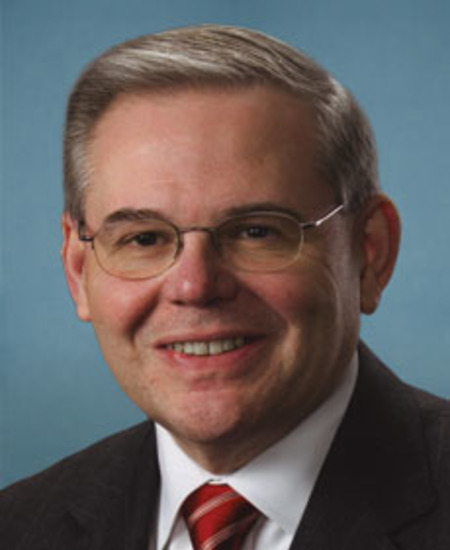
Sen. Robert Menendez
Sponsored bills
Maddy summarySRES 263 is a symbolic Senate resolution commemorating June 19, 2023, as "Juneteenth National Independence Day" to recognize June 19, 1865 - the date Union troops announced the end of slavery in Texas. It honors the historical significance of this date, when news of emancipation reached enslaved people in the Southwestern U.S. after the Civil War. The resolution does not create new laws or policies but formally acknowledges this observance as part of U.S. history and heritage, supporting nationwide recognition of the event. It affects all Americans by affirming a shared historical moment in the nation's journey toward freedom.
Maddy summarySRES 259 is a symbolic Senate resolution (not a bill) recognizing the significance of U.S.-India relations. It reaffirms the partnership rooted in shared strategic interests, trade (with $191 billion in 2022 bilateral trade), defense collaboration, educational exchanges (including 82,000 Indian student visas in 2022), and technological cooperation like the iCET initiative. The resolution does not create new laws or obligations but formally expresses support for deepening ties across economic, defense, and people-to-people channels. It was introduced by Senators Menendez, Warner, and Cornyn on June 21, 2023, and referred to the Foreign Relations Committee.
Maddy summaryThis bill allows the Federal Communications Commission (FCC) to directly pursue legal action to recover unpaid fines for violations of telemarketing rules (Section 227 of the Communications Act) if the Attorney General does not act within 120 days. It directly affects telemarketers and companies that violate restrictions on automated calls or unsolicited communications. The key change requires the FCC to take over enforcement for unpaid fines over $25 million after the 120-day window, covering costs and expenses of the litigation. This streamlines the process for recovering large penalties without waiting for the Justice Department to initiate lawsuits.
Maddy summaryThis bill (S 2082) amends existing U.S. law to clarify legal pathways for victims of terrorism to seek compensation from foreign states. It updates references in federal statutes (28 U.S.C. § 1605B and 18 U.S.C. § 2331) to explicitly include entities organized under U.S. law when defining "national of the United States" for terrorism lawsuits. The changes ensure victims can pursue claims under Section 2333 against foreign states that sponsor terrorism, while also clarifying how judgments against such states can be executed. These technical amendments apply to all pending or future cases filed after the bill's enactment, directly affecting terrorism victims seeking legal recourse in U.S. courts.
Maddy summaryThe Equality Act (S 5) amends federal civil rights laws to explicitly prohibit discrimination based on sexual orientation and gender identity in public accommodations, employment, housing, credit, and jury service. It expands existing protections under the Civil Rights Act of 1964 by clarifying that discrimination based on sexual orientation or gender identity constitutes sex discrimination, as established by the Supreme Court's Bostock decision. The bill directly affects businesses, employers, housing providers, financial institutions, and government services that receive federal funding, requiring them to provide equal access and treatment regardless of sexual orientation or gender identity. It includes specific provisions addressing discrimination in foster care and adoption, where LGBTQ individuals often face barriers, and clarifies definitions of terms like "gender identity" and "sexual orientation" for consistent application. The law creates a uniform national standard for nondiscrimination where many states lack such protections, aiming to eliminate barriers to full participation in society for LGBTQ individuals.
Maddy summaryThis bill adds multi-cancer early detection screening tests to Medicare Part B coverage, directly affecting Medicare beneficiaries. It creates a new coverage category for FDA-approved blood tests (like those analyzing cell-free DNA) that screen for multiple cancer types simultaneously, as defined in the bill. Medicare would cover these tests once every 12 months, and the bill clarifies that this change does not impact existing coverage for standard cancer screenings like mammograms or colonoscopies. The policy change ensures beneficiaries can access these new screening options without unnecessary delays after FDA approval.
Maddy summaryThis Senate resolution (SRES 258) reaffirms the U.S. commitment to supporting refugees and displaced persons globally and domestically. It urges the administration to meet robust refugee admissions goals (noting only 31,797 arrived in the U.S. by May 2023, far below the 125,000 target), uphold asylum protections under the Refugee Act of 1980, and strengthen partnerships with the UNHCR. The resolution specifically calls for increased U.S. leadership in humanitarian aid, addressing root causes of displacement, and ensuring refugees have access to education and livelihoods. It directly affects refugees seeking resettlement in the U.S. and global host countries bearing the burden of displacement crises.
Maddy summaryS 2061 establishes a federal task force to address the theft of catalytic converters and other high-value auto parts containing precious metals. The 11-member task force, including DOJ, transportation officials, and state/local law enforcement representatives, will assess current laws and recommend prevention strategies to deter theft and trafficking. It must submit an initial report within 90 days and final recommendations within 18 months to Congress, the Attorney General, and state attorneys general. This directly affects law enforcement agencies and vehicle owners facing rising theft risks.
Maddy summaryThe Freedom to Travel for Health Care Act of 2023 prohibits states from restricting or penalizing individuals for traveling to another state to access legal reproductive health care, including abortion services. It also bans discrimination against those who assist with such travel or provide the care, and overrides conflicting state laws that interfere with these rights. The bill allows individuals, healthcare providers, and the federal government to sue to enforce these protections in court, with remedies including injunctions and attorney fees. It directly affects patients seeking care across state lines, healthcare providers, and organizations facilitating such travel.