

Banning Operations and Leases with the Illegitimate Venezuelan Authoritarian Regime Act or the BOLIVAR Act This bill temporarily prohibits an executive agency from entering into a contract for the procurement of goods or services with any person that it determines, with the concurrence of the Department of State, knowingly engages in significant business operations with the Maduro regime in Venezuela. The bill lists exceptions, including where vital to U.S. national security or as necessary for purposes of providing humanitarian assistance, disaster relief and other urgent lifesaving measures, or to carry out noncombatant evacuations. The prohibition shall not apply to contracts that support U.S. government activities in Venezuela or to contracts with international organizations. The State Department may waive the requirements of this bill upon determining that to do so is in the national interest.
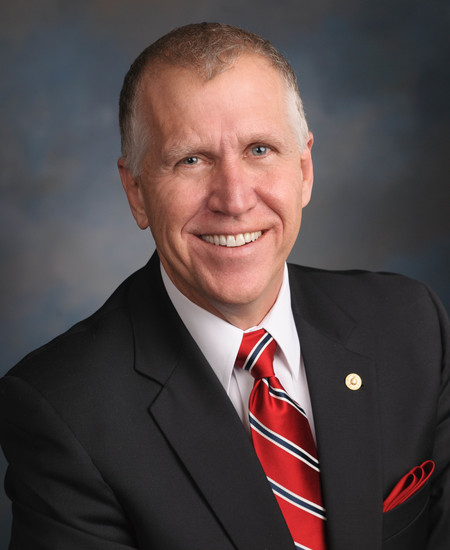
Sen. Thom Tillis
Sponsored bills
Protecting Firefighters from Adverse Substances Act or the PFAS Act This act requires the Department of Homeland Security (DHS) to develop guidance for firefighters and other emergency response personnel on training, education programs, and best practices to protect them from exposure to perfluoroalkyl and polyfluoroalkyl substances, commonly referred to as PFASs, from firefighting foam and to prevent the release of PFASs into the environment. These substances are man-made and may have adverse human health effects. A variety of products contain the compounds, such as nonstick cookware or weatherproof clothing. DHS shall make available a curriculum designed to reduce and eliminate exposure to PFAS from firefighting foam and personal protective equipment (PPE); prevent the release of PFAS from firefighting foam into the environment; and educate firefighters and other emergency response personnel on foams and non-foam alternatives, PPE, and other firefighting tools and equipment that do not contain PFAS. The U.S. Fire Administration shall make recommendations to DHS as to the content of the curriculum. DHS must create an online public repository on tools and best practices to reduce, limit, and prevent the release of and exposure to PFASs.
Financial Regulators Transparency Act of 2022 This bill makes certain disclosure and ethics requirements applicable to the Federal Reserve banks and financial regulators. For example, the bill makes Federal Reserve banks subject to Freedom of Information Act requests and makes financial regulators subject to congressional ethics inquiries.
Safeguarding American Innovation Act This bill addresses the security of federally funded research and development grants and export-controlled goods, technologies, or sensitive information. The bill establishes in the Office of Management and Budget a Federal Research Security Council to develop federally funded research and development grant making policy and management guidance to protect the national and economic security interests of the United States. Each executive agency on the council shall be responsible for assessing federal research security risks posed by persons participating in federally funded research and development. The bill prohibits any individual from knowingly (1) preparing or submitting a federal grant application that fails to disclose the receipt of any outside compensation, including foreign compensation, by the individual; or (2) forging, counterfeiting, or otherwise falsifying a document to obtain a federal grant. An alien shall be inadmissible to the United States if a consulate or the Department of Justice knows the alien seeks to enter the United States to acquire export-controlled goods, technologies, or sensitive information if the Department of State has determined that such acquisition would be contrary to U.S. national security (including economic security). The bill revises provisions relating to the disclosure of foreign gifts.
Retirement Savings for Americans Act of 2022 This bill provides retirement savings accounts to eligible workers without employer-sponsored retirement plans. Participants' contributions are matched (up to certain thresholds) by the government through a federal income tax credit.
Continuity for Operators with Necessary Training Required for ATC Contract Towers Act of 2021 or the CONTRACT Act of 2021 This bill exempts certain air traffic controllers from a required reduction in their retirement annuity payment on account of earnings from certain work performed while entitled to such annuity. Under current law, retired Federal Aviation Administration air traffic controllers receive an annuity payment during the period between the mandatory retirement age of 56 and the Social Security minimum age of 62. Such annuity payment is required to be reduced by a certain percentage of any excess earnings during this period. The bill exempts from such reduction in annuity payments an air traffic controller who participates in the Air Traffic Control Contract Program (a public-private partnership for air traffic control services) following mandatory retirement.
This joint resolution nullifies a Department of Education rule published on July 6, 2022, concerning final priorities, requirements, definitions, and selection criteria for the Charter Schools Program.
Pharmacy Benefit Manager Transparency Act of 2022 This bill generally prohibits pharmacy benefit managers (PBMs) from engaging in certain practices when managing the prescription drug benefits under a health insurance plan, including charging the plan a different amount than the PBM reimburses the pharmacy. The bill also prohibits PBMs from arbitrarily, unfairly, or deceptively (1) clawing back reimbursement payments, or (2) increasing fees or lowering reimbursements to pharmacies to offset changes to federally funded health plans. PBMs are not subject to these prohibitions if they (1) pass along 100% of any price concession or discount to the health plan, and (2) disclose specified costs, prices, reimbursements, fees, markups, discounts, and aggregate payments received with respect to their PBM services. Further, PBMs must report annually to the Federal Trade Commission (FTC) certain information about payments received from health plans and fees charged to pharmacies. The FTC and state attorneys general are authorized to enforce the provisions of the bill.
Mandatory Materiality Requirement Act of 2022 This bill limits additional disclosure requirements applicable to issuers of securities. Specifically, the Securities and Exchange Commission may only require an additional disclosure if the commission determines that there is a substantial likelihood that a reasonable investor of the issuer would consider the information important with respect to an investment decision.
Quantum Computing Cybersecurity Preparedness Act This bill addresses the migration of executive agencies information technology systems to post-quantum cryptography. Post-quantum cryptography is encryption strong enough to resist attacks from quantum computers developed in the future. Not later than one year after the National Institutes of Standards and Technology has issued post-quantum cryptography standards, the Office of Management and Budget (OMB) shall begin to prioritize the migration of agency information technology systems to post-quantum cryptography. Not later than one year after the date of the enactment of this bill, the OMB shall submit to Congress a report on a strategy to address the risk posed by the vulnerabilities of agency information technology systems to the potential capability of a quantum computer; the funding necessary to secure such information technology systems from the threat posed by adversarial access to quantum computers; and a description of federal coordination efforts to develop standards for post-quantum cryptography, including any federal Information Processing Standards.